
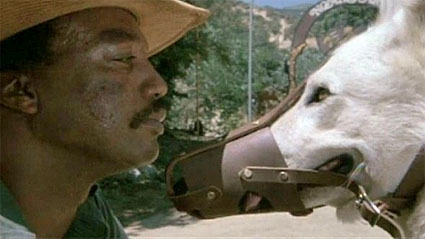
 Two Sam Fuller films this week for Midnight Screenings, one from the very beginning of his career and one from the mature, weary Fuller nearing his end.
You just want to feel bad for White Dog. No film should be subject to the dogged (excuse the pun) beating Samuel Fuller’s 1982 social expose was, especially coming hot on the heels of the studio absolutely decimating Fuller’s seminal 1980 war picture The Big Red One. Even a worthless production shouldn’t have to wait over a quarter-century to receive any meaningful public exposure after failed preview screenings. No film, I say, should bear this sort of weight. But especially not White Dog, one of the greatest films to even glance at racism head-on. After the film was shunned from theatrical distribution in 1982 and Sam Fuller grew disinterested in making American film productions ever again, its eventual release by Criterion 25 years late is no great consolation prize. Continue reading
 Two Sam Fuller films this week for Midnight Screenings, one from the very beginning of his career and one from the mature, weary Fuller nearing his end.
 Nicholas Ray is not generally considered a canonical director; he’s a deep cuts guy, but he holds a pride of place among the faithful. His films are so unapologetic in their demonic distortion that they seem to decompose the very girders of cinema itself. The films themselves become dangerous. But Ray deserves all the status in the world, for his films were more sincere than arguably any other directors working at the time, or ever. Ray’s films lived with a pure mantra, and arguably the purest mantra of all great directors: cinema should, at its best, be a totally sensory experience, an experiential pang of emotion where story, theme, and character are transmuted into direct experience.
  After Pat Garrett and Billy the Kid, Sam Peckinpah would move away from the 1800s, although that doesn’t mean he left the Western behind. Bring Me the Head of Alfredo Garcia is without a doubt a Western; it is as cracked and craggy as any of Peckinpah’s prior films, and its thematic content is almost identical, although it takes place in the 1970s. This is fitting, and perhaps the only way Peckinpah could have progressed as a director. His prior two Westerns saw the end of the era, with Peckinpah tackling the transition from the individualist, outlaw lifestyle to a more socially sanctioned form of violence bred by corrupt and violent men being buttoned up on the outside without actually curbing their violent tendencies on the inside. The Wild Bunch and Pat Garrett and Billy the Kid were about the end of the West, but also about its continuity, its persistence in the modern era. The deserts and the ten-gallon hats had been replaced with institutions and machinery, with the industrial revolution and government. But the raspy habit of men fighting the only way they’d been taught how, and the curdled fact that these men were being destroyed by these ways, remained.
  It is easy to view Pat Garrett and Billy the Kid, Sam Peckinpah’s first Western post-The Wild Bunch, and examine it as a follow-up to that seminally shrieking exercise in wolf-like nihilism. It would be easy to do so, and probably correct, but also incomplete. Pat Garrett, which follows ex-outlaw turned lawman Pat Garrett (James Coburn) as he vengefully hunts down his ex-partner Billy the Kid (Kris Kristofferson), bears an outline that is almost identical to The Wild Bunch. In both films, an ex-outsider who becomes a man of respectable society is strangled by his dogmatic commitment to hiding the memories of his lawless days by killing the last reminder he has of those days. In both films, the violence of wild society gives way to the violence of so-called “civilized” society, and in both cases, the social outlaws must die so that the corporate, conglomerate violence of civil people can live.
  This week’s pair of Midnight Screenings will return us to the far-flung past of 2006 and 2007, a more innocent time in film history …
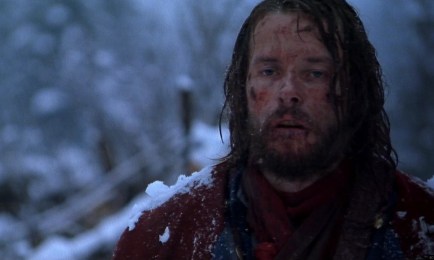 1999 was a year of new beginnings for a great many directors of the cinema, filmmakers who used their 1999 offerings to launch their careers to greater artistic, as well as commercial, heights. Although we often forget, it was also the year of Antonia Bird’s Ravenous, a film that ought to have launched her to new heights but somehow left her scrambling for an audience. In a year of openly defiant, exploratory films from many talented artists, Ravenous remains one of the most defiant and exploratory. Yet it never found an audience for itself or its director, likely because its defiance, experimentation, and exploration are all hidden. Even more-so, they are secret, and the film goes to great lengths to pretend it is nothing more than an everyday comedy-horror exploitation-film of the distinctly late ’90s post-Scream variety. It is a film where the experimentation is wholly submersed into subfuscous genre mechanics, a great devious trick of a film, and I can think of no more perfect nature for such a deliciously sinister exercise in cutthroat filmmaking.
  It is said that the best horror films traffic in the slithering, slimy replacement of the mundane by the uncanny. True, to some extent, but the best of the best posit something more. Take 1974’s The Texas Chainsaw Massacre by Tobe Hooper, a work that posits the mundane as the uncanny, locating a world where the mundane regions of American society were the most uncanny. A world where mundane and innocent society never really existed except in the romantic dreams of the American imagination. A world where everyday life is actually an uncanny abyss of demonic activity just waiting to swallow goodness and human life up whole.
 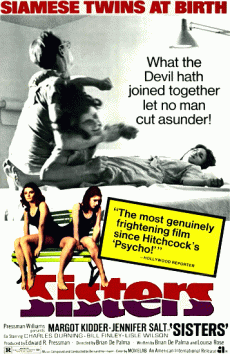 A Brian De Palma double-feature this week on Midnight Screenings.
