
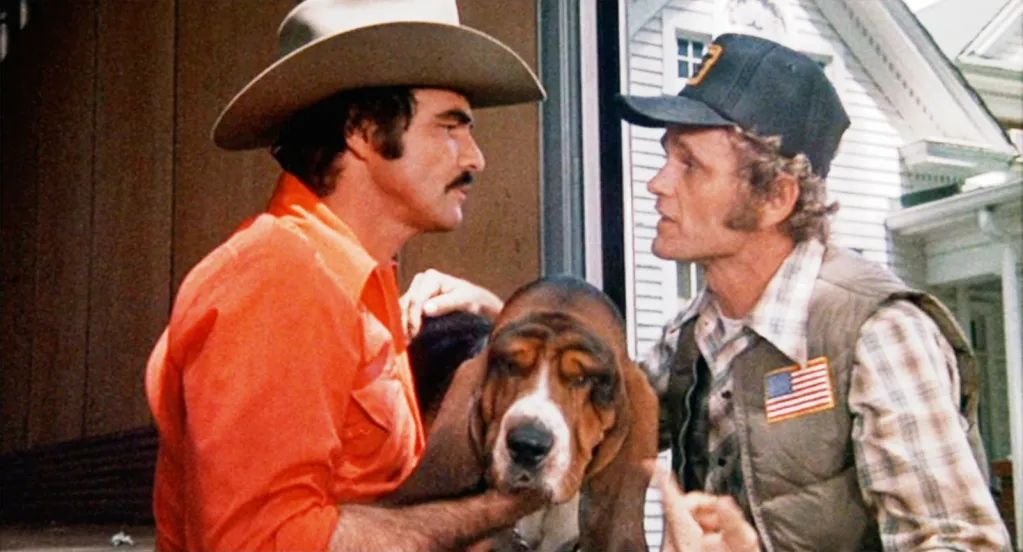
It’s odd to feel like it needs to be said for a film that was, at its time of release, one of the five highest money earners (unadjusted for inflation) in US Box Office history, but Smokey and the Bandit really is one of the key texts of 1970s American cinema. Released in 1977, this is a film aware of, and blissfully ignorant about, the world it has entered into. Offering an innocently insubordinate but not very challenging vision of anti-authoritarian freedom and a celebration of mere personal charisma as a form of authentic rebellion, it is a text that is hopelessly inadequate to solve the problems of its environment. Beset on all sides by the neoliberal desecration of working-class solidarity, the desacralization of a particular American idiom of collective life rooted in an abiding belief in a contract between the public and its government, Smokey and the Bandit has little to offer to save the nation other than an irascibly impish vision of redemptive speed. It salvages hope via a zealous romance of energetic freedom, a libertarian insistence that the state only obstructs, and that its institutions are de facto illegitimate when they aren’t abusive. This is no image of leftist salvation. It isn’t a sustainable image of resistance. It isn’t what America needed, then or now. And yet…
Bandit is sticky. It gets all over you like, as the film says, maple syrup. Something about its empty evanescence makes it linger. Thematically, it’s basically a rewrite of It Happened One Night, another tonic for tough times about a perpetually smirking asshole of a protagonist and a runaway bride as a fellow traveler, a comedy not of remarriage – separation and reunion restored with a difference – but of survival, of getting by through pure guile. Co-writers James Lee Barrett, Charles Shyer, and Alan Mandel and director Hal Needham offer a vision not unlike Robert Riskin and Frank Capra’s: mostly without overt critique, but not without clear perspective. Six years before this film, Two Lane Black Top framed the highway as a void of existential emptiness, while, two years before that, Easy Rider metaphorized the finale of the 1960s as an apocalyptic cataclysm. Six years after this film, Paris, Texas would figure it as a dissociative fugue state, the rumination of a lost drifter unable to find a new future or to return to a stable past. Comparatively, Smokey and the Bandit revs up a path not forward or backward but outward through pure immanence. It kicks up so much dust that the timeline it is supposed to be looking for gets lost in the fray. The opening glimpses of the truck are less symbols of America than invitations to appreciate motion, the poesis of movement and minutiae for their own sake.
All in all, the film occupies a peculiar register of the American mind, a strangely aloof and blissful perpetual present-tense, a cotton-candy Americana of the eyes and the stomach. This is, of course, an image of the cinematic dream factory – as star Burt Reynolds says at one point, “It’s not a convoy, it’s a dream,” mechanical collectivity fused into human myth – but the film quietly celebrates the various everyday people who have to work this desperate situation in this wayward country to produce the dream-machinery of Hollywood Americana. It isn’t going to save us, the film seems to know, but there is something decidedly worthwhile about its vision of a nation of nomads and itinerants, a convoy country that tucks you into a rocking chair safer than a “womb,” a fantasy that this is, after all, the birth, or potential rebirth, of a nation.
Directed by Hal Needham with obvious affection for the humans in it and the easy but effortful work they perform, Bandit imagines a post-racial utopia of truckers, drifters, and auto aficionados, a gearhead nation united in a love for the mercurial mixture of energy, ingenuity, and mechanism. The only explicit racist is the antagonist sheriff Buford T. Justice (Jackie Gleason), who chases our protagonist across the country and who is horrified at the thought that African American police officers exist, and could, in the film’s view, be just as incompetent (is this democracy?). In contrast, there’s a casual inter-racialism among the truckers throughout, a social fabric of mutuality. An African American man named “grave robber” leading a funeral procession of Black auto aficionados serendipitously calls our protagonist when he passes by, promising to help him by blocking the sheriff for several minutes. A Japanese truck driver inexplicably shows up to waylay the police and shout “banzai,” a bizarre recycling of wartime caricature that retains its rejection of American authority but here serves the American proletariat. This isn’t exactly enlightened, but it’s a grappling with collectivity that is unexpected in a film that worships at the altar of its apparent hero, Bo “The Bandit” Darville (Burt Reynolds).
And why are these disparate scions of the American working class willingly conscripting themselves into Bo’s renegade army? Presumably for the same strange reason that the second highest grossing film of the year would be the story of two men delivering beer from Texas to Atlanta. Second, of course, to Star Wars, which isn’t any more fantastical than this film, or any less infatuated with the human labor of living in, and upkeeping, a “used universe.” The people in this film rally around Bandit’s effort, much as the people who watched it celebrated it in the theaters. And he appreciates the help, for he, in his own way, is helping. The actual beer is transported by Cledus “Snowman” Snow, an easy-going trucker, while our protagonist Bo drives nearby in a Pontiac Trans Am, running “interference” by generally making a nuisance of himself, distracting the police from the speeding truck. The actual trip to Texas is uneventful, but the return is derailed almost instantly when Bandit picks up a runaway bride Carrie (Sally Field), who he self-amusedly names “Frog,” fresh off of abandoning Junior Justice (Mike Henry), son of Gleason’s small-town sheriff, who in turn pursues Bandit well outside his jurisdiction.
Make no mistake: Bandit’s Trans Am is certainly the showpiece object, and Burt Reynolds’s horribly affixing grin is magnetically enervating. After a particularly impressive feat, he looks at the camera and smiles before continuing on to the next scene. The mischievous smirk signals that he is, ultimately, a human Bugs Bunny in a world of Elmer Fudds, and the screen warps around him. But his is a generous charisma that cedes ground to others. Smokey is also an unusually collective vision of a nation of renegades and fugitives. A contemporary studio film in the 21st century would flatten these figures into symbols of American diversity. Smokey, for the most part, lets them in, allows them to show off their stuff, and helps them ride away into the sunset.
It is, of course, fundamentally escapist. Consider the opening credits. There’s none of the factory machinery stop-starting in hesitant motion that begins Paul Schrader’s Blue Collar, from the following year, where the opening signals that the characters, working-class factory workers, are already imprisoned within an unforgiving but cruelly banal structure of power. These images stop to lock the characters into the fallout of the mid-century vision of social democracy. Dark intimations like these linger only faintly in Bandit’s universe, which begins with romantic images of mechanical icons of modern America that slow only, like Bandit himself, to let us know that the film knows that we are transfixed. Otherwise, they cannot be stopped. This film has little interest in long-term transformations in society. Its vision of freedom is a fleeting mood generated through acceleration, camaraderie, and disrespect toward authority. There’s no real threat here. Bandit only comes close to being caught when he’s too busy enjoying himself. This is not the wolf’s vision of the world but the peacock’s.
It isn’t a vision that can last forever. If Bandit is Bugs Bunny and the sheriff Elmer Fudd, they are also Wile E. Coyote and Roadrunner, one a Melvillian monomaniac, and the other an anarchic velocity. If the film continued, they would repeat the chase forever. There isn’t a path out of this America, so the film offers only a smirk along the way. That means that Blue Collar is inextricably the better film, and it is the one we need, a film that understands that the structures of exploitation cannot simply be outrun. It reckons with the creation of the apocalypse that we live in today. Smokey and the Bandit, comparatively, is a film with no structural impediments that can’t be given the runaround, a fantasy of the hereafter that also promises (hopes?) that there have been moments, or figments of moments, where that hereafter was a now. It invests in a fable of American togetherness that, in its cartoonish zeal, is both fallacious and meaningful. Bandit attempts not to conquer but to outpace oppression with pure mood and friendship. Its rebellion is tonal, not revolutionary. It may just understand that its resistance is necessary but not sufficient to the world it inhabits.
That’s despairing stuff if you think about it, but Bandit doesn’t dwell on it. There’s plenty dangerous in Reynolds’ charisma. In its catalytic zeal, in the ease with which he turns the world on him, his dastardly charisma can easily turn dictatorial. He effortlessly wields metal and speed, a seductive Whitmanesque shaman of the people promising vitality through sheer force of personality. He supervises the screen as much as he inhabits it. But the film clearly prefers Bandit’s rebellious entropy, which, even though it exercises its own playful dominion over the world, also creates a form of democracy that does really cede ground to others. The others in the film don’t seem to bow before him but, rather, to grant a passing moment to help Bandit on the daily path of their lives.
This film is all guile and gumption, and it may be aware of the potential and limitation of this sort of resistance. Bandit’s ironic vigor encroaches on the knowing chilliness that would deflate the self-isolating masculinity of Chevy Chase or Bill Murray in the 1980s. But while those ‘80s totems of renegade Reaganesque individualism extend no gratitude or grace to others – they know that the world has no better options for them and that all they can do is cynically stay one step ahead of others – only Bandit seems to really birth a collective, to ask us to maintain faith in the world, to act as a spiritual guardian rather than a demanding demagogue arbitrating screen space. He believes in the prospect that people can become companions over shared momentum and mutual amusement. The ones who cannot are the cops. They have no real sympathy, even for one another. Buford’s jurisdiction expands beyond his stated local boundaries, but the film uses this to recognize that authority is absurd. The police engage in internecine warfare signaling insecure men extending their wounded egos outward through facades of control. If this is an image of power simply functioning, an image of fragile force, perhaps it is the case that only Bandit is necessary to tilt it off its axis. It seems somewhat ready to collapse on its own. The film’s definition of heroism is the collision point of collective improvisation and institutional fragility. If it mistakes velocity for democracy, it certainly feels like it could cure all ailments.
Score: 8/10

