
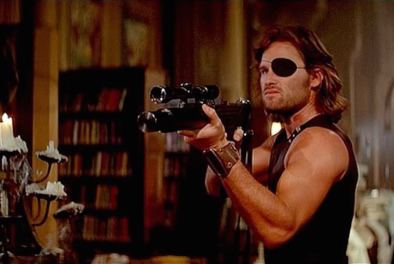
 Update June 2019: After a rewatch, I’m struck by how much Escape from New York’s essentially anti-authoritarian stance also feels like a quintessentially early ’80s response to the failures of the liberal project of the ’60s and the New Hollywood project of radicalizing cinematic form in the ’70s. Carpenter’s film undeniably paints a picture of the powers that be as deluded autocrats and maniacal functionaries, but its post-hippie validation of anarchy defines itself individually and skeptically rather than communally and with a utopian accent. On balance, I don’t know how I feel about this any more than I do Carpenter’s deliberately fearful Assault on Precinct 13, where a black cop and an old-school white criminal learn to get along only while under siege from an interracial army of cinematographically-zombified gang members putting aside their racial differences to assault the status quo. That said, while Assault merely updates and urbanizes Western conventions, Escape ironizes its, offering up cinema’s greatest ode to and takedown of the John Wayne archetype, one who refuses to coopt societally-accepted norms of the “good” (even if it means doing “bad”). Plus, it’s pretty great filmmaking nearly forty years later, a phenomenal exploration of Carpenter’s singularly elastic ability to massage visual absence into a vision of apocalypse, be it at the level of the individual (Halloween, faceless evil), the local (The Thing, evil in our own image), or the world, as in this film.
Original Review:
Scruffy and stubborn as a mule, Escape from New York is probably a failure for director John Carpenter, but it is a treat for anyone else all the same. Carpenter has been vocal about his genre-DJ dreams of hopscotching from horror to action to Westerns to fulfill his inner-desires of throwing pebbles toward all outsider genres under the sun. More pragmatically, he sought new genres to avoid type-casting as a master of horror. Trouble is that Carpenter’s soul, despite his brain telling him otherwise, was a horror director, and his eye followed his soul. Even Carpenter’s best action material – 1986’s Big Trouble in Little China for one – doesn’t work so much as an action movie; it’s more a deconstruction of American action movie tropes that tickles the rib with how foolish American action movies could be. Whether or not that was Carpenter’s intent, the arguably accidental success of Big Trouble reveals a director who didn’t have much of an eye for conventional action directing, for his action directing was too sluggish and stilted to function as a serious work of the form.
Continue reading
 So, “comedy sequels” right?
 With the culmination of the month-long Worst or “Worst” feature on some of the alleged worst films ever made, what a better way to return to the weekly Midnight Screening series than a great film about the guy who made some of the alleged worst movies ever made…
 To recap: the Universal Horror individual monster franchises varied wildly and inconstantly, and often in directions and to magnitudes any sane person would never imagine. Sometimes, however, Universal Horror just created something that can not compare to anything on this earth, in their canon or otherwise. Sometimes they made Murders in the Rue Morgue, just about the perfect encapsulation of messy early sound cinema trying to cope with the increased narrative bent of sound and having no idea what to do with narrative at all. The end result is Universal Horror at their most indebted to quilt-work, patching together the expressionist dread and crawling, impulsive weirdness of silent cinema – itself having very little to do with narrative or realism – and trying desperately to mold all of this prismatic and arcane visual strangeness into something that can approximate “narrative”. It fails as a narrative proper, but what hypnotic failure it is.
  Rene Clair didn’t have it easy. Soundly trounced by the French New Wave and never really forgiven in the public consciousness, Clair was a hot button go-to guy in the early days of sound cinema, a born-and-bred scientist with tools in sound and space who saw cinema – like all the great early masters – as an expressive, flexible plaything more than a get-the-job-done tool. Play he did, although his somewhat overly-formed style admittedly hit a limit when it traded in the dangerous waters of experimentation for something a touch more gentle and composed. Clair enjoyed a good composition as much as the next director, but there was his compositions always ran the risk of boxing him in to a settled path, rather than letting him loose to ravenously tear down the walls and traverse new, unsettled regions of cinema. He had his limits, in other words, but the 2010s hardly even acknowledge him. Clair was a class act, and whatever his American films did to keep him away from true adventure and challenge, he never gave a film less than his full attention. The no man’s land that is his reputation today seldom takes into account his very real, if somewhat overly-rigid, talents as a filmmaker.
  When Ana Lily Amirpour recently released her lushly sensualist horror film A Girl Walks Home Alone at Night, her cinematic passion was matched in its cathartic potency only by its free-wheeling desire to devour all influences. Obviously, Jim Jarmusch was the cipher through which her film’s identity was largely cracked, but in her sun-deprived cinematic wasteland, another female filmmaker was a key stepping stone: Kathryn Bigelow, a women who has since made a pit-stop in can’t-be-this-good action cinema before taking a well-deserved break to produce two of the finest naturalist war thrillers ever made. She went on to make more composed films, in other words, and probably better ones too, but her underdog outlaw passion in the world of film never burned as brightly as it did in her first big break: the 1987 film Near Dark, nothing less than a full-on vampire-western-romance-horror (a mouthful, but it should sound familiar to fans of Amirpour’s debut). It takes a lot for a film to invent a genre. That it comes within an inch of perfecting it on its first try is not only testament to Bigelow’s fully-formed craft, but of her restless, travelling spirit.
  Anyone familiar with Jacques Tourneur doesn’t need to read a review for evidence to the claim that Out of the Past is one of the best film noirs ever made. But that doesn’t mean establishing and specifying what is so undeniably great about it isn’t a worthwhile pleasure all the same. Cutting his teeth on Val Lewton’s near poverty-row horror unit for RKO, a team that single-handedly saved American horror in the 1940s by injecting a dose of the European, and a team which counted Tourneur as its most valuable member, Tourneur is one of the unheralded masters of the medium of cinema and one of the most poetic genre directors ever to grace the silver screen. Pairing him to noir like a fine wine to a slab of deliberately indelicate beef is too obvious to be a stroke of genius, but the results are no less marvelous for the “why didn’t they think of this earlier” nature of the film.
 That Universal Soldier: Day of Reckoning exists indicates something is wrong with the world. That it is, against its better judgment, a near masterpiece, at least in terms of filmmaking principles and matching those principles to its narrative concerns, implies something is far worse with the world than anyone could have imagined. But yes, the fourth or eighth or ninety-sixth film in the bro-fest science fiction routine slaughterhouse that is the Universal Soldier series, tangled up in its Roland Emmerich-directed roots and choking on them for decades now, is good. In fact, in its own way, it’s fairly great. And how shocking that this way approximates ’70s art-house horror/crime/thriller/ sci-fi that only passingly gestures toward any idea of “action” and even then does wonders to detach “action” from anything resembling Roland Emmerich. What a strange, strange film. Plus, if it means anything to you, it is probably, by several orders of magnitude, superior to anything Dolph Lundgren or Jean-Claude Van Damme have starred in (although the post-structuralist JCVD, a sly little nightstalker of a film, comes pretty close for the latter star). Pleasures abound in this weird, weird world of ours, folks.
  Because I reviewed Shaun of the Dead and The World’s End and couldn’t stand the gap in the middle…
 Simon Pegg, Nick Frost, and Edgar Wright simply “get” genre comedy. They may be the only ones to really nail it since Sam Raimi, and for the same reason. What Raimi understood is that making a comedy out of a noted “serious” genre was about more than making fun of it. It was about teasing out the fundamental intersections between emotions and exploring how filmmaking – that is the literal process of shot to shot structuring of a film – could divulge different and seemingly contradictory emotions simultaneously. His preferred contradiction, of course, was between lingering dread and gut-busting Warner Bros comic anarchy. His masterpiece Evil Dead II was not simply about scaring us and then making us laugh, but about dissecting the language of film to explore the intersection of technique and emotion in prismatic, multitudinous ways. Put simply, it was about exploring the way that something, be it a shot or a performance tick or a line or the film itself, could be both funny and scary, rather than, say, take a funny scene and follow it with a scary one.
