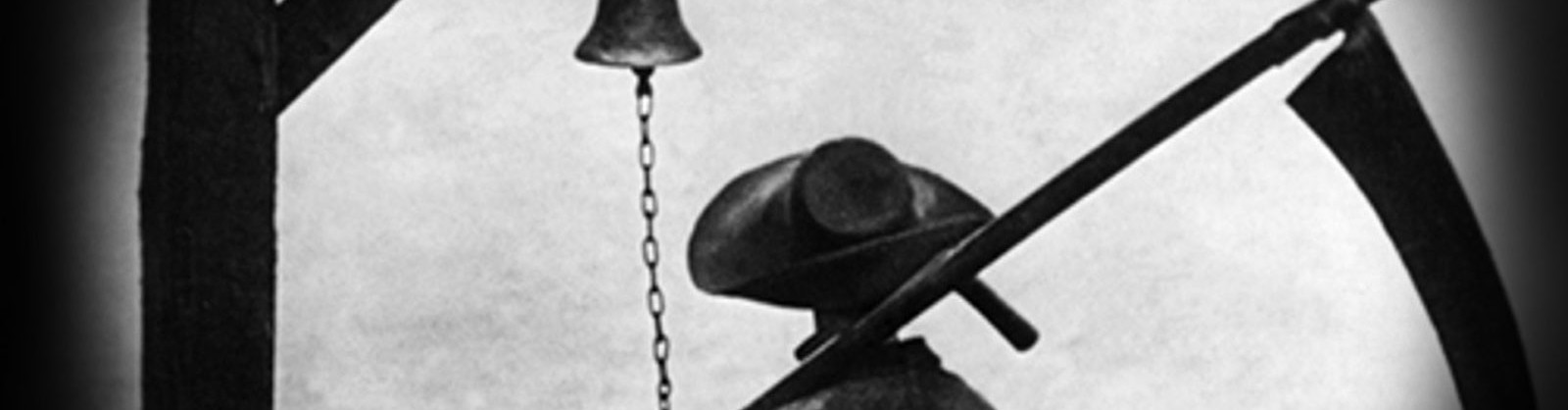
The Mask begins with a quintessential maneuver of the mid-century, an opening address from a man in a suit whose minor-key smirk and mix of self-importance and ease puts him somewhere between expert and huckster. The film conjures a phalanx of mid-century signifiers. A simulacrum of William Castle introduces us to the film’s world, laundering exploitation through the language of psychoanalysis and unsettling that very modern science by exposing its occult pre-history. He speaks of, and the film moves in, the primitivist and modernist language of masks as a metaphor for the subcutaneous, explosive violence and metabolic intuition lingering beneath the even temper of modern science. Is this man a scientist, practical man of affairs, a trickster, or a channeler of something more demonic? What, the film ponders, separates any of these from the others?
Masks abound in the film to which they bequeath a title, suffusing us in the intellectual miasma of mid-century thought. While the speaker professionalizes the film, The Mask poeticizes his language almost immediately with a cut to a woman’s screaming visage, then to a violent man’s assaulting face, two very different sorts of masks, expressive images exposing two consciousnesses locked in impossible conflict. What masks do they wear, and are they doomed to repeat themselves in an eternal cycle of fear and desire? The Mask offers another sonic bridge to a telephone, tethering the irrational to the technological, and suddenly we’re away from primitive ritual and into a sterile modernity already beginning to decay. Within a few shots, the film has already blurred science and mysticism and then linked swamp and skyscraper, plunging into the masks that modernity wears and then exposing the difficulty of defining a true face.
The quickness of the images, and the mischievousness of the opening announcement, inform us that the film is best approached not as a rigorous and analytical inquiry into the nature of these entanglements but, like many great horror films, as a dive into the psychic slurry of a mid-century culture exploring the liminality of conceptions of truth, the confusion of a period trying to reconcile itself to its own internal tensions. This was an era trying to reconstruct a fallen modernism but that hadn’t quite figured out how to reconfigure itself into something new. In that environment, The Mask is mostly in it to screw with us, but that doesn’t mean the terrifying obsession of Doctor Allan Barnes (Paul Stevens), newly infatuated with a cursed tribal mask, and his partner Pam Albright’s (Claudette Nevins) increasingly desperate attempt to save him, can’t breach below the surface of our soul. The good doctor’s search for “places that man has never reached before” is embodied in the film’s own quest to drag William Castle’s playfully mercurial charlatan back to its mystical roots, to submerge itself, and us, into a psychological abyss.
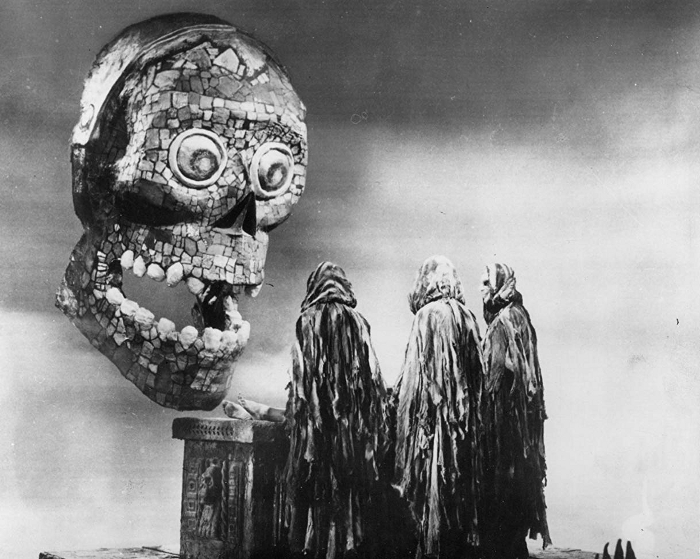
As anyone who has seen it can attest, Serbian-born montagist and avant-garde artist Slavko Vorkapich’s interstitial dreams are the raison d’être for the film. The three implosive scenes are its heaviest weapons in what amounts to an act of psychological warfare, a vertiginous descent into an associative playground of the mind. In the first scene, eyeballs rush forward, a zombified congregation feels their way toward the screen, out into the dark of the audience, or into a cave of subconscious past. In the second scene, we fall through cosmic space, the mask coming from the sun. Its hand presses on the screen, reaching out toward communion with a cinematic past of playful mysticism, a phantasmagoria of monstrosities and forbidden desires, a communion of science and superstition, a revelation of truth that is also a fearful regression into a primordial cosmic communion. It reminds us that the same milieu, the same art form, that birthed Persona’s screen-ravaging opening in 1966 could create something as deliriously vulgar as The Mask five years beforehand with many of the same techniques.
The film’s writer Herb Alpert (not that one) had a brother who was deeply involved in Cold War social science, and this connection hangs over the film’s fixations. “Not sure I understand all the elements myself,” our protagonist says, and that is very much the point. He becomes the mulch of rationalism, the grist it crushes but cannot name. He is a phantasm wandering through a fog of half-truths and dream-visions that he can explore but not explain or understand. This is pure “cinema of attractions,” suggesting equal parts pre-psychedelic pageantry (looking forward to the later 1960s) and a forbidding séance for a cinema long past, an era where the art form was more interested in devouring reality than depicting it. What we have here is a watery descent into a cinematic canvas of confusion, into a River Styx, a cinematic death wish, what Gorky called a “land of shadows,” a fugue state between revelation and obliteration.
These are the showpiece moments – they shape the film architectonically – but it’s the respites that I often found most compelling. In between Barnes and Albright, even in moments of apparent sedation, tensions between ways of being brew. In even the most apparently straightforward scenes, the camera backs out and dives in, recoiling and returning to the fray. In one scene where Pam confronts him, Allan is viewed in profile, cut off at the chest in the frame, while Pam pushes inward to wrest control from his myopia. When he sits up, he is in the foreground, staring at the camera, now asserting control, receding into himself, irradiated by a halo of demonic revelation. In the next shot, they’re in profile, now mutually vulnerable, the camera inching into their world, insisting on a truer space of mutuality briefly open to them. Yet he remains more lit, her in relative darkness, unable to breach him with the mysteries of her ambivalence, her humanity, complicating his commitment to “truth” beyond reason. In the next shot, he is in the foreground again, but now slightly out of focus, pushing too close to something the film can’t fully name.
When he finally answers the call of the mask’s, asking her to do likewise, the film captures her in profile, tilting sideways to view it, a profile not of indecision and entrapment but frustrated connection. This is a rich interpersonal instability, not unlike Bergman’s Persona in how her face has morphed into a confused and abstract portrait of curiosity and uncertainty, a genuine desire to connect not with the hypostasized Truth that Barnes seeks, but to understand why he seeks it, and what to do about it. The titular mask, the film suggests, might just make manifest the dark and tormented vestiges of the mind that were already latent within us. It lays bare our abiding capacity to destroy everything we know about one another in our desire to search for a transcendent reality beneath our undulating and all-too mundane surfaces. For a man heroically confronting – conquering – the inexplicable with Ahab-like intensity, the film reminds us that the inner ocean’s realities are as brackish and murky as the collective unconscious of a wounded modernity. But the greatest mystery of all, and the most worthwhile, might be something other than the lone individual or the abstract total: the inordinately complex difficulties, the terrifying and revealing masks, of engaging one another.
Score: 8.5/10

