
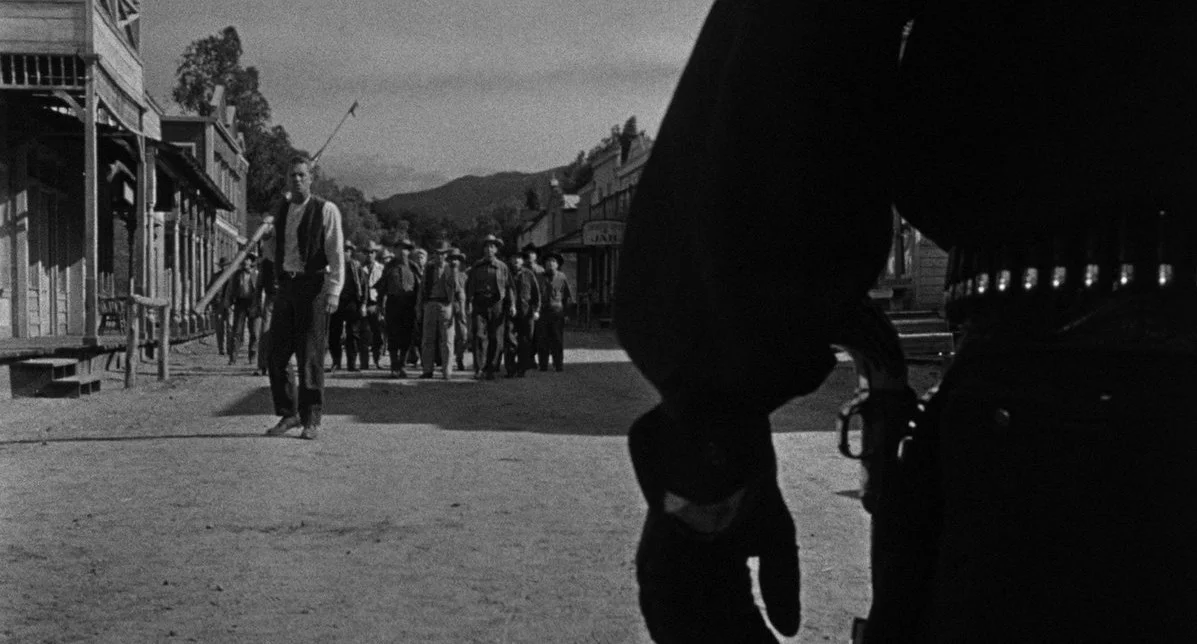
The protagonist of Terror in a Texas Town is a sturdy, all-American sailor with a gigantic harpoon. He’s a worthwhile man, but the film’s soul is the film’s antagonist. We meet him as he sees himself: as a dark shadow passing over the screen, “death walking around in the shape of a man.” This is a torturous and dislocated film in which everyone is at odd angles to everyone else, a film that is fascinated with how people occupy space. But Johnny Crale (Nedrick Young), a self-hating mercenary whose body is almost always in side profile, alone seems to recognize how he presents himself to the world. When he speaks to others, he looks behind them or above them, never at them. He suggests a hesitance to meet the world directly, like he’s afraid of his own outline and can’t even acknowledge where he stands, how he might look in the mirror. His imagination is cynically circumscribed by capitalism: “As long as there are men like you,” he tells a rapacious robber baron, “there will always be work for men like me.” The film doesn’t insist on any of this. It exhibits such casual mastery, such economy of form. He begins the film passing in the foreground, facing away, moving from left to right as he passes over the camera, and over the film frame. This is the black hat of the traditional Western no longer as a mere villain or an antagonist to be felled or bemoaned but a moving abyss in which the film finds itself.
Crale is a fascinating figure here, a self-hating antagonist who, after shooting a man dead, shoots his corpse five more times, angry at the body for not accepting the status quo and for activating his capacity to be complicit in its perpetuation. His violence reads as displaced impotence. He is a victim of a dehumanizing system incentivized to abstract responsibility and to turn his frustration onto others, to kill for people in power so that he does not have to reckon with the possibility that the system might be otherwise. When confronted with the death of his father, our quasi-protagonist George Hansen (Sterling Hayden) asks what kind of a country can condone a man dying and not asking any questions. Crale cynically remarks that, in this country, you can be sure he’ll get a pageant in lieu of an interrogation. The dead will be honored in America, but the causes of their death will never be seriously reckoned with.
Young was a shaping voice in the film’s creation, not only playing the all too aware heavy but working on the script with Dalton Trumbo, both of whom were literally or figuratively blacklisted. In bitter, eloquent lines like his claim about his lady friend – “I keep her occupied 24 hours a day,” to which the only response to the woman is “make sure he pays you overtime” – capitalism controls belonging, which is replaced by a self-hating kind of coercion. They both know better, the screenplay suggests, but they cannot summon the will to act otherwise.
Sterling Hayden, who does play the technical protagonist of this film, had, in real life, been coaxed into naming names under HUAC before trying to spend his career atoning for that action through recommitment to leftist cinema. But he is less of a person here, more a force. A sailor cast adrift in the dusty waves of the frontier, he feels like a man out of place, a proletarian coworker of a collective vessel fugitively tossed overboard into the Wild West, the America’s canvas of individualistic capitalism. I couldn’t help think of what the Martinican Marxist CLR James writes about Herman Melville, in whom he saw an aspirational vision of collective emancipation not in Melville’s monomaniacal Ahab or the acquiescent Ishmael but in the sailors themselves, in their capacity for mutual relation with the world. Right at the mid-century moment when the Melvillian Ahab was being framed by most American intellectuals as a reflection of totalitarian control, Terror defends one of the sailors as a bearer of life, a figure who, through a kind of dogged charisma, a dimmed but not diminished recalcitrance to the forces of business, galvanizes the town into action. He’s not really a man but a vibration in the ether, a wave unsettling things to render them anew.
That Hayden’s character is mostly evacuated of personality is not a failure of individualism but a kind of emancipation of selfhood, a giving-up of his subject status to become one with the collective around him. He does not have to think to act rightly, the film suggests. He simply does. Crale, conversely, is like a grotesque perversion of Ishmael, a hopeless sidekick who thinks hard and often about something going awry all around him but who cannot remove himself from the powers that launder his position in society. This is the villain not as a controlling zealot but an ironic calculator who has seen too much and gambled that no better world is available, that he would rather slide into the role presented to him than risk achieving what Christopher Lasch would call the “true and only heaven.”
James found American failure not only in its capacity for populist fascism but in the timid foreknowledge of its bourgeois class, a phalanx of compromised men and women who knew better, who cynically refused the call of a human togetherness. This is a film about our capacity to be in relation with one another, to realize how we are intercepted and redirected by forces well beyond us, and to appreciate that the only way to resist is to work with those inscribed in us as we mutually shape the shifting contours of our humanity. The first collective in the film arrives right after that opening void I began the review with: an amazing early scene where the town debates what to do. The camera summons a collective village voice, circling, listening. Crale summons his violence at one point by shooting out the fire on each of six candles. But here, the camera suggests that the fire is dimly burning. The visuals, the camera moving between person without cutting, connecting them while granting them their individuality, enacts unity in difference, and difference in unity, each person accentuating themselves because of their position within the space, rather than against it.
The camera is Joseph Lewis’s, a decade on from his seminal Gun Grazy and now on the other side of an anti-communist witch hunt. Lewis, frustrated with Hollywood himself, went out on a limb to collaborate with his fellow leftist artists. His camera seems chastened by doubt but armored in its frustration with the status quo, offering not Gun Crazy’s cruel vision of outsiders cutting a path apart but, rather, a collective coming together to reshape the center. What would it mean for the characters to stabilize themselves in the frame, to work with the world of the camera, to shape their space anew, to make the camera more democratic by demanding more space, together, in it? Terror in a Texas Town becomes a film about the contingency of our chances, the wildness of our engagement with one another. It evokes the fragile necessity of our capacity to find the potential within us to habituate ourselves to the fruits of our collective relationship with the space that we inhabit, and that inhabits us.
While the film does conclude with a wild west standoff, it subtly reshapes its implications, framing it not as an expansion of action but a narrowing of vision. Hayden’s Hansen does confront Crale, but it isn’t Hansen who destroys Crale’s consciousness. It’s another man, a farmer who refuses to bend over, who accepts that his self-worth is worth more than what Crale can do to his body. His refusal rocks Crale to the core, sending him into a robotic spiral that offers him a path out, a map back to his humanity that he ultimately refuses. Near the end of the film, a mirror in the room can’t reflect him straightaway. He recognizes who he is, but, like a vampire, cannot see himself. His refusal of connection finally causes a collapse. He no longer fights against his worst impulses but gives in to his own death drive. By the time he confronts Hansen, he’s already dead.
So, the filmmakers hope, might be the vision of America he stands for. When Hansen confronts him, he isn’t really saving the say. The film is an inverse High Noon: this is not a solitary hero but a collective vision of mutual humanity standing fast against the robotic enforcer. The wave behind Hansen is rushing toward Crale, the people, the proletariat, ready for battle. The high noon showdown of one against one is exposed not as a heroic conquest and achievement but a linear vision, a thinning of imagination winnowing the complexity of engagement. The film still relishes the heroism, a recognition of the need to stand up and fight, but it offers less a heroic reclamation of selfhood than a quiet vision of camaraderie. It has focused and clarified things, but only to open them back up to a potential sea-change. It has already given us so many compositions of three figures, often one in between two others, so many icons of a body caught between worlds, an image of America adrift between refusal and relation. The film’s conclusion is nothing less than the flood, an oncoming energy that, in destroying the archetypal soul of America in the cowboy hero, hopes to grant us the capacity to save ourselves from the myths that bind us to our own death.
Score: 10/10

