
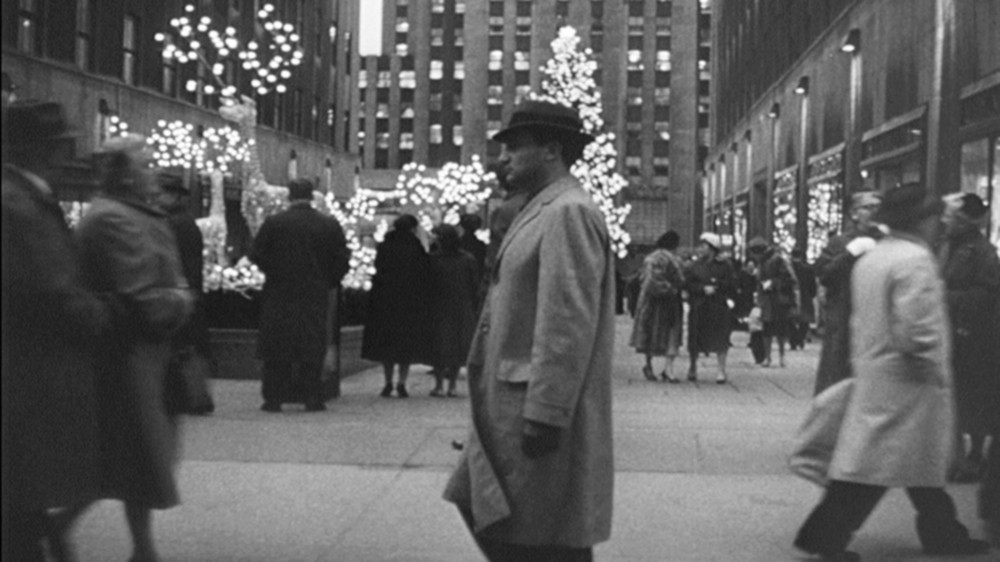
The title doesn’t suffer any fools. This is a howl of cinematic nothingness, a pitilessly impotent roar. It’s a post-noir stripped to the wiry skeleton: no shadows, an open-air prison that hides things in plain sight. Allen Baron is the shaggiest of auteurs, a ramshackle one-man band who directs and writes a doom and then casts himself to wear it. He fashions himself as an icon figure of mid-century social disintegration that is nonetheless entirely integrated into himself, a man who is entirely cohesive, basically complete in himself, and yet essentially a void. He is a performer who is both a presence and an absence, a blank face that registers as an abyss moving through a land without shadows.
Contrast this with Orson Welles’ magisterial The Trial from the same year, the greatest Kafka adaptation in all of cinema. Welles may have been the surest hand and most preternatural eye ever to weaponize a movie camera, and his 1962 film is one of the great cinematic acts of abandonment, a brutal displacement of space-time in which reality folds in on itself as the modernist dream of productive experimentation and creative curiosity eat themselves alive. An amazing film, no doubt, one that formally turns the 20th century’s Promethean vision of progressive order into its own death spasm. Baron’s much less famous film is, in some sense, more frightening, a hell that masquerades not as the good – with its pretensions of order and stability – but the neutral. Blast of Silence is a film for what Daniel Bell called “the end of ideology”: visions of a better world – visions of the world – have been discharged, and the characters are all just tenants moving from store to store in the remnants of a world that functions but does nothing more.
There’s nothing grand about Blast of Silence. It promises no withdrawal in the form of utopia, and it promises no exodus in the form of an apocalypse. There’s only a now, a flatline. This is not Welles’s modernist promise interred in its own abstract Kafkaesque geometry – an architecturalization of Charles Foster Kane’s own morbid ego and elephantine charisma – but an essentially banal world. No one in Blast has any plans, least of all those in power. There are no totalitarian overseers enforcing and justifying a state vision. This is a city that needs no excuse to murder. It arrives like a train, “right on schedule.” Murder is a “business.” And Blast of Silence is business-like in its severe austerity, a corrosive and unsettling meditation on modern alienation and spiritual ennui that hits like a bullet. No one here is an ideologue. They’re professionals. That is an ideology, of course, but they don’t need to know that, and they don’t need someone to hide it from them. It feels like the open-casket funeral for the traditional film noir, deflating its romantic fatalism and sinister glamour and exposing an apathetic world, a planar space. There’s nothing in the dark.
At the beginning of a decade rife with contradiction, Blast of Silence is a kind of social necropsy, a corpse as curdled as anything found in an independent film movement of the moment. It’s vicious stuff, an unreconstructed sort of emptiness that peers as far over the edge into the abyss as any urban labyrinth had by that point. There’s no sentimentality here, just a looping severity that offers little release, imprisoning Baron’s Franky Bono in determined cycle. He’s the icon figure of a portrait of urban desolation as cold and and stringent as it is intimate, a horrid crystallization of the type populating what David Riesman called America’s “other-directed” “lonely crowd.” Franky Bono is a shark, a calculated projection of “self” directed only toward fulfilling the next job. He’s a frail condensation of a national thaw.
Baron’s dialogue, delivered out of his mouth like gravel breaking the gears of a wood-chipper, is as omnipresent as it is fatalistic. Every line could be an epitaph. “Remembering out of the black silence, you were born in pain” is an iron verdict. “They all hate the gun they hire. When people look at you, baby boy Franky Bono, they see death. Death across the counter” is a bracingly self-aware shard of post-WWII wisdom, an anti-existential image of penitential submission to the status quo. “You’re alone. But you don’t mind that. You’re a loner. That’s the way it should be” turns a status into an acceptance into an ontology into a feat of human nature. His counterpoint – “You’re alone now. All alone. The scream is dead. There’s no pain. You’re home again, back in the cold, black silence” – forecloses his fear of death with annihilating serenity. Narration is almost always a cinematic crutch; Blast of Silence turns it back on itself, like switchblade at its own neck, into a structural principle. The voice isn’t an inner monologue but God’s judgement of a society that has turned us all into professionals of one kind or another, our lives summarized in Baron’s impersonal mantra: “a killer who doesn’t kill gets killed.” He’s okay though. He’s made it into the “upper 5 percent income bracket” in a shell game of 24-hour street-lamps, circling around Manhattan like a ghost with an iron-clad schedule, passing a wild swastika of children, an anatomized flaneur who passes the time with window shopping at its loneliest, one more piece of storefront upholstery who mistakenly got up and walked around for a life. The demented image of an upside-down panda bear toy held by someone who might kill him is a vicious double for our boy himself: a weapon that is also a product that is also a throwaway.
Blast of Silence is a nasty piece of work, an effigy for a society that teaches its subject to revere accumulation, Allen Ginsberg’s “mammon,” a country that turns people into the not so cheerful robots of C. Wright Mills’s “sociological imagination” who lack even a capacity despise their condition. There’s no rebellion, no existential freedom found in contrapuntal acts of alienation, no transcendence found in staring into the confusion of what amounts to a hopelessly transactional existence. This is not Bressonian emptiness, despite both Baron and Bresson evacuating affect from their performers. While Bresson’s characters live a kind of embodied transcendence, a form of spiritual resistance at odds with the material world around them, Baron’s operator is nothing more than a cog in a preordained narrative machinery. This is the terminal logic of an ossified society that is thoroughly un-redemptive, a vision of existence in which all society wants us to be is the right tool for the job.
Score: 9/10

