Monthly Archives: April 2026

Fragile Frontiers: Terror in a Texas Town

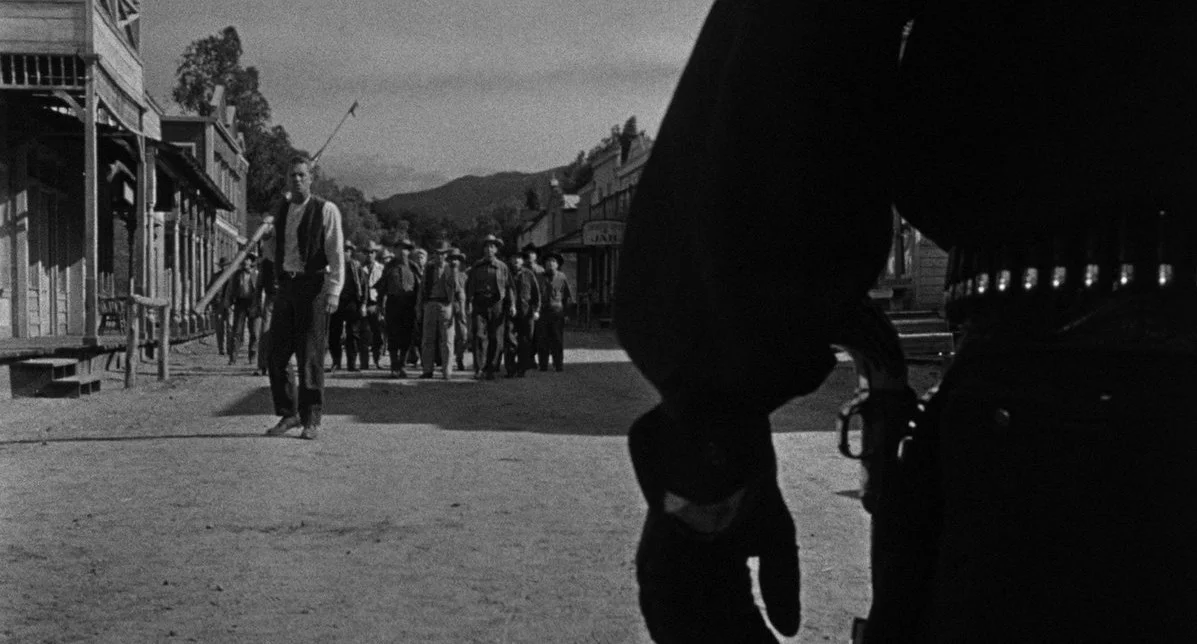
The protagonist of Terror in a Texas Town is a sturdy, all-American sailor with a gigantic harpoon. He’s a worthwhile man, but the film’s soul is the film’s antagonist. We meet him as he sees himself: as a dark shadow passing over the screen, “death walking around in the shape of a man.” This is a torturous and dislocated film in which everyone is at odd angles to everyone else, a film that is fascinated with how people occupy space. But Johnny Crale (Nedrick Young), a self-hating mercenary  whose body is almost always in side profile, alone seems to recognize how he presents himself to the world.  When he speaks to others, he looks behind them or above them, never at them. He suggests a hesitance to meet the world directly, like he’s afraid of his own outline and can’t even acknowledge where he stands, how he might look in the mirror. His imagination is cynically circumscribed by capitalism: “As long as there are men like you,” he tells a rapacious robber baron, “there will always be work for men like me.” The film doesn’t insist on any of this. It exhibits such casual mastery, such economy of form. He begins the film passing in the foreground, facing away, moving from left to right as he passes over the camera, and over the film frame. This is the black hat of the traditional Western no longer as a mere villain or an antagonist to be felled or bemoaned but a moving abyss in which the film finds itself.

Crale is a fascinating figure here, a self-hating antagonist who, after shooting a man dead, shoots his corpse five more times, angry at the body for not accepting the status quo and for activating his capacity to be complicit in its perpetuation.  His violence reads as displaced impotence. He is a victim of a dehumanizing system incentivized to abstract responsibility and to turn his frustration onto others, to kill for people in power so that he does not have to reckon with the possibility that the system might be otherwise. When confronted with the death of his father, our quasi-protagonist George Hansen (Sterling Hayden) asks what kind of a country can condone a man dying and not asking any questions. Crale cynically remarks that, in this country, you can be sure he’ll get a pageant in lieu of an interrogation. The dead will be honored in America, but the causes of their death will never be seriously reckoned with.

Continue reading
Midnight Screenings: Bone

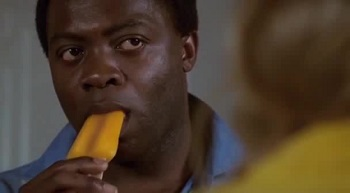
Larry Cohen is one of the great cinematic provocateurs, but Bone is one of his few films worthy of being considered genuinely troubling. Cohen’s films are intrepidly amusing and almost always mischievous with their grasp of truth, but Bone, his debut, tilts normality in a subtler, and ultimately, more forceful manner. In the image of married couple Bill (Andrew Duggan) and Bernadette (Joyce Van Patten) lounging outside by their pool, Bone frames a horridly bland image of bourgeois suburban domesticity. In the image of Yaphet Kotto (Bone) appearing out of nowhere, dressed like an escaped criminal and ready to move to a decidedly more banal prison. Lasciviously grabbing a rat out of the pool, he impishly winks  “you wanna touch it.” The sexual joke is funny, but Kotto’s wryly menacing eyes and shit-eating grin makes it truly uncomfortable in a way that, say, The Stuff simply isn’t, even when the characters are exploding into morasses of liquid sludge. Cohen’s screenplay is working at a higher level than The Stuff because it goes lower, right into modernity’s cloaca.

“Is there anything I can do for you all?,” Bone asks with playful gruesomeness that exposes him as a hilarious perversion of the “magical Negro” stereotype, the black man as cosmic force who intrudes on the normal order of things in order to reveal the middlebrow monotonies and manicured calculations of their bourgeois lives. Rather than salvation, though, the titular Bone offers destruction. He comes not to absolve them of their existence, but to corrode the strictures of their being, to filter their sanity through a prism of psychological erosion. He’s the existential specter they need, a cinematic wraith who emerges, as if out of the liminal undulations of a cinema of the id, the infested impurity of their pool itself, to clarify their fears and catalyze their anxieties. When Bill walks through the city on a mission from Bone, he passes a sign that says “new adult theatre open.” You said it, buddy.

Continue reading

Midnight Screamings: Burn, Witch, Burn

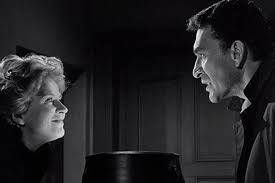
Burn, Witch, Burn, directed by Sidney Hayers and based loosely on Fritz Leiber’s novel Conjure Wife, follows Norman Taylor, a newly appointed psychology professor at a quaint British school whose professional identity rests entirely on self-confidently deconstructing irrational beliefs. An arbiter of post-enlightenment skepticism, he, and his subject position, necessitates that superstition be seen as a relic of primitive, pagan thinking. Taylor’s position reflects a characteristically mid-20th-century confidence in scientific rationalism, a worldview the film subtly interrogates as it evokes the early 1960s – a moment poised between postwar solidity and the creeping resurgence of countercultural forces. To those invested in the sanctified stability of mainstream forms, these new energies seemed to rekindle an occult past that had been only apparently foreclosed by the hegemony of rationalism.

In this film, however, these energies were only superficially dormant, less absent than silently constitutive of the very reason that Taylor grounds his identity in. An identity the film finally destabilizes, disfiguring Taylor’s self-enclosure by slowly exposing the protective influence of his wife Tansy. Her charms, written off by Taylor as trivial superstitions, ultimately prove entirely essential for maintaining the subterranean order beneath the internecine rivalries and bristling anxieties of the modern academic world, which claims that it thrives on order but can clearly not sustain itself without tensions and complexities it must superficially disavow.

When Taylor discovers these threats – in the form of his wife’s protective superstitious charms hidden throughout the house – he destroys them. His sense of self depends on this destruction, but this very act begins to scrap away the veneer of rational stability that had granted this practical man of mid-century academic affairs, and the social structures he represents, legitimacy. These seemingly irrational currents which he must deny are ultimately exposed as the hidden backbone of the system that must excise them to the margins in order to preserve its identity, revealing a science that is more vulnerable, and ultimately more fragmented, than it is willing to admit.

Continue reading