
 Spike Lee’s crowd-funded erotic vampire blaxploitation film remake (and how glad am I to be able to type those words) is a sanguine, sultry, swaggering, sensuous smorgasbord of film history, chilled-over-icy Euro cinema cool, and simmering, low-key empathy. It is also slightly confused, off-handedly comic, and unusually bizarre in the mode of mid-’90s Spike Lee. For his part, Lee has always been a confused director, a director whose aspirations have almost always exceeded his grasp, and his ode to African American cinema is no different.
But Da Sweet Blood of Jesus (a name almost as wonderful to type as the film’s genre) is the right kind of mess, a kind of filmmaking in free fall. It’s like a Spike Lee joint right after a bar-room brawl, and that’s a ticket anyone should want in on. It opens on a recollection of the seminal opening to Do the Right Thing, where Rosie Perez flailed with fire and lust over the confrontational, brimstone-flinging “Fight the Power” by Public Enemy and Lee’s chalked-up street pop-art. In Da Sweet Blood, however, the tone and tempo are the polar opposite of Do the Right Thing. Charles “Lil Buck” Riley dances, surely, but he doesn’t flagellate. He shimmers and quavers. He pursues dance as interpretive surrealism, marking the film as something less pop-art sermon and more art-house eulogy. Continue reading
 Love & Mercy is very likely the best possible version of its screenplay. Written by Michael Alan Lerner (adapting from his novel Heroes and Villains) and Oren Moverman, this exploration of Brian Wilson’s mental trauma is distributed across two time periods: the ’60s, when he was something of the ringleader of pop-smith group The Beach Boys, and the ’80s, when he was an ailing, anxious shut-in under the domineering control of a doctor whose interest in Wilson becomes more sinister and dogmatic with each minute. The screenplay is not inadequate per-se, and strengths abound. It wisely avoids a narrative-of-progress tone, for instance, and it explores two specific moments in Wilson’s life rather than shuffling the actors through time and Wilson’s best-known moments. In retaining a specificity of focus, it allows the film to be about who Brian Wilson is rather than what he does, and that sort of experiential, lived-in character study is thrillingly antithetical to the spirit of most biopics.
  Bluntly, Inside Out is not a good film because it explores the inner regions of a child’s mind, nor is this a particularly novel concept. The girders of the screenplay strip parts from many films that rest on the subject of literalizing human emotion.. Winnie the Pooh, in all its facets, including the seminal duo of feature films by Pixar’s parent company, Disney, is implicitly about childhood emotions let loose in the forest of the mind. Eeyore is melancholy, Tigger is a deranged enthusiast and childhood id, Pooh is the curiosity balancing them all on a pin head. The Hundred Acre Wood is Christopher Robin’s free-floating mental space, scratchily drawn with free-floating ambition and tapered-off regions where the harsh scrawl fades into watercolor lightness to symbolize Robin’s emotions eventually trailing off into the great unknown limbo of pure empty whiteness.
  I am told there is a Scream TV show out now. What better opportunity to review a film I pointedly and adamantly do not like, and also to finally fill the weirdly pesky “review a film from 1996” gap in my blog that has somehow tempted me longer than any other single year.
  After Pat Garrett and Billy the Kid, Sam Peckinpah would move away from the 1800s, although that doesn’t mean he left the Western behind. Bring Me the Head of Alfredo Garcia is without a doubt a Western; it is as cracked and craggy as any of Peckinpah’s prior films, and its thematic content is almost identical, although it takes place in the 1970s. This is fitting, and perhaps the only way Peckinpah could have progressed as a director. His prior two Westerns saw the end of the era, with Peckinpah tackling the transition from the individualist, outlaw lifestyle to a more socially sanctioned form of violence bred by corrupt and violent men being buttoned up on the outside without actually curbing their violent tendencies on the inside. The Wild Bunch and Pat Garrett and Billy the Kid were about the end of the West, but also about its continuity, its persistence in the modern era. The deserts and the ten-gallon hats had been replaced with institutions and machinery, with the industrial revolution and government. But the raspy habit of men fighting the only way they’d been taught how, and the curdled fact that these men were being destroyed by these ways, remained.
  It is easy to view Pat Garrett and Billy the Kid, Sam Peckinpah’s first Western post-The Wild Bunch, and examine it as a follow-up to that seminally shrieking exercise in wolf-like nihilism. It would be easy to do so, and probably correct, but also incomplete. Pat Garrett, which follows ex-outlaw turned lawman Pat Garrett (James Coburn) as he vengefully hunts down his ex-partner Billy the Kid (Kris Kristofferson), bears an outline that is almost identical to The Wild Bunch. In both films, an ex-outsider who becomes a man of respectable society is strangled by his dogmatic commitment to hiding the memories of his lawless days by killing the last reminder he has of those days. In both films, the violence of wild society gives way to the violence of so-called “civilized” society, and in both cases, the social outlaws must die so that the corporate, conglomerate violence of civil people can live.
  If you are a cinephile, it is a fair guess that you have seen your share of war-time romances, one of the stodgiest of all film sub-genres. But that does not mean you have a Soviet war-time romance, nor have you seen a Mikhail Kalatozov war-time romance. Kalatozov is one of the masters of world cinema (his later Yo Soy Cuba is both a passionate ode to a lifestyle and a perplexing, dumbfoundingly beautiful exercise in pushing the heights of camerawork to impossible achievements). He is not nearly as well known today as he ought to be (but the same can be said of all post-Eisenstein Soviet cinema, excepting Tarkovsky), largely because political lines in the sand were well entrenched by the time Cranes was made. He was bound to the lingering death of existing in a world with more interest in denouncing art than expressing it. At least Cannes got it right, putting political qualms aside and awarding The Cranes are Flying the Palme d’Or for its luminous artistic achievement, transcendent performances and craft, and its stunning ode to love and loss in a world that no longer knew the meaning of the former term.
  Federico Fellini, the grand master of Italian cinema, began his life behind a camera as a young lad among the neo-realists, a protege of sorts to De Sica and Rossellini and their own habits of redefining cinema forever. Fellini, like those masters of the form, sought to reject Hollywood convention and lay down a thick layer of everyday humanity with non-actors and grungier camera techniques less galvanized in Hollywood glamour and melodrama. This shift itself was a towering upheaval to the cinematic tradition, a tangible stimulant to directors everywhere to shake the foundations of film land and brace for impact.
 It is hard to imagine a better version of Jacques Cousteau’s The Silent World, and that is a troubling fact. Lit with a fluorescent technicolor expressiveness, this non-narrative documentary of undersea images is like a peek through the looking glass of another world, exactly the magical, alien world of whimsy and majesty that Cousteau dedicated his life to and dared to see in his dreams. With the soon-to-be seminal Louis Malle (who would direct through the French New Wave and then hop on over to Hollywood) by his side, The Silent World is a visuals-first extravaganza of lush, hysterical colors and evocative silences. All these years later, it is also, perhaps unintentionally, a showpiece for the arrogance of mankind, and the terror of humanity at its egotistical worst.
 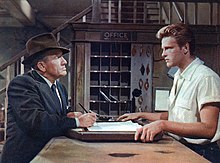 John Sturges, mostly famous for his two later rugged process-driven films, The Great Escape and The Magnificent Seven, drew out a mostly forgotten niche of manly not-quite-action films. They weren’t really violent, but they had the soul of action entertainment in their braggadocio and mechanics-first brand of raspy storytelling. His two most famous films are given at least the repute of minor-classics, but he is not particularly associated with them. He was a man who worked with groups of talented actors, and they often dwarfed him in the final analysis, not because he was appreciably under-skilled, but because he always subsumed his skill to the mechanics of the narrative, and we as a society tend to focus on actors and narrative at the expense of directors. He didn’t have a truly unique style, so to speak, but he was an ultra-competent director, and arguably the ultra-competent director. And his competence never tipped over into out-right genius quite like it did in Bad Day at Black Rock.
