
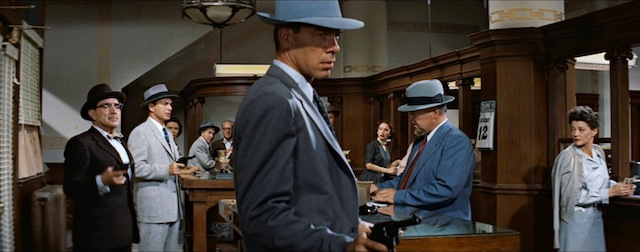
Richard Fleischer is usually seen as a journeyman director of “tentpole” films, texts designed to hold up the dream cloth over the Hollywood machine, to keep the cinematic mechanism, and us, in partial darkness. He would become a staple of the machine for the muscular but oneiric 20,000 Leagues Under the Sea, the phantasmagorical Fantastic Voyage, and the lurid, empathetic, and subtly radical Mandingo. Even his less eager-to-please films fit within the archetypes of their time-period, like thecruel, discomfiting The Boston Strangler echoing the rise of the New Hollywood and the terse Narrow Margin pushing low-budget noir to new heights of uncomfortably cramped enclosure.
Given his work as a stylist more than a formalist – his textured embroidery of screenplays rather than his perspectival exploration of them through his craft – it’s easy to forget him. Still, it wouldn’t be lying to say that the only film Fleischer made that really feels like it went out of its way to disfigure its own generic and stylistic convictions, rather than expand them (as in most of his films) or submerge them into an abyss (as in Boston Strangler), is 1955’s Violent Saturday. While Margin was a nasty, disfiguring geometry and Boston Strangler a dark, cloacal summoning of inner murder, Violent Saturday is eye-opening ecology turned into unforgiving velocity.It depicts a termite colony of a town, and this is a termetic work, in Manny Farber’s sense: exploring, infesting, rummaging in America’s forgotten corners. It moves sideways from person to person, but somehow forward as pure motion and kinesis through that continual waylaying. Its narrative rhythms manage to be associative but also inexorable, as though crawling toward a necessary, tragic, final logic that unites everyone here and breaks them apart, visualizing a nation that enacts many forms of violence, often minor and infrastructural, and that believes that a bigger, more visible, more insisting violence is the only thing that can shift a paradigm. This is a film that moves exhaustingly and fundamentally toward an ultimate showdown, yet it figures this not as a comeuppance or a consummation but a consolation for a country that hasn’t really figured out what it means to exist as humans together.
Violent Saturday suggests violence’s connective thread most explicitly in the final image, where executive Shelley Martin (Victor Mature) seems, through his impromptu heroism against several bank robbers, to overcome his son’s frustration at his not having been called to romantic duty in WWII. In its final moment, Violent Saturday exposes the nation’s psychic obsession with masculine valor and renewal through violence, implying that the nation needed the crime at the center of the film even as it must condemn the men who enact it. Violence here is fatalistically preordained. Someone has to commit violence at home for this man to have his day in the sun. The narrative machinery of the nation demands it, and the country will find an event to fulfill its needs somewhere.
But has the country learned anything, or is this mid-century violence coming home just the chickens coming home to roost? Martin is not the protagonist. Indeed, the film quietly undercuts his moment by presenting it as one among three equal revelations. Shelley saves the day and is, perhaps, a town hero, just as another man reveals to a nurse that he has spied on her undressing, and just as another man quietly breaks down over the death of his wife, speaking to the same nurse, who loves him. Maybe he actually loves her too. This feels like three variations – “romance, comedy, tragedy” in order – but the tone is subtly deflationary and decidedly stone-faced. These three extensions of the final confrontation in the film are presented without comment, given equal narrative weight in a film that is quietly tabulating results it cannot fully understand, treating them matter-of-factly as essentially the same, as three tremors of nuclear fallout in a Southwestern town just realizing a bomb has been blowing up, around the world, for decades and maybe only just hit them. How, the film asks in the act of not choosing, would we weigh these three results, these three epilogues, and can this nation weigh them honestly? Which is the “right” conclusion in a film with so many characters, so many tones?
This is a film that is deeply interested in both systems of relation and systems of stasis that lower the human to a mere force, an instrumental actor in a wider world in which we are all agents and all often, albeit incompletely, pre-determined. At one point, two men discuss a women dancing with a man. “She moves like a Swiss watch,” one man says, to which another man responds “watch it son, go easy or you’ll get train sick.” These two people have been rendered machinery, and she a landscape. The two men watching are winding the scene up to work for their amusement, but they are also stilled as mere observers of a moving display. Who is in motion, and who is still? Who is preparing the path for future events, and who is enacting them?
The apparent instigators of the titular violence – two of whom are the watchers in this scene – are Harper (Stephen McNally) who arrives in town posing as a salesman, Dill (Lee Marvin), who is nursing an addiction, and Chapman (J. Carroll Nash), who seems genuinely pleased to give some candy to a child despite his capacity for violence. The men arrive one by one, on time, all in a day’s work. None of them are especially excitable, or very passionate. They are professionals, formed forces exerting just enough energy to alter the state of the world around them. Machines in a clockwork, they work to get the job done.
But is that all they are? A wildly, unexpectedly intimate scene of Marvin and McNally discussing past romantic connections for a significant length of time leads to them witnessing Bank Manager Harry Reeves (Tommy Noonan) “casing the building.” Actually, he’s just innocently walking his dog. But, actually, he’s moving along to watch the aforementioned nurse Linda Sherman (Virginia Leith) undress in her window. Then he’s watching Elsie Braden (Sylvia Sidney), a librarian, drop a purse into a trashcan. Understanding that this indicates her disposing evidence, he and her come to a mutual decision to hold these crimes against one another if either tells. They all observe each other, only for the film to observe all this as simply more minutiae of the day. Here, the two criminals aren’t just cogs in a preordained mechanism, but fulcrums in a fluid artistic (and sociological) organism endlessly growing and adapting to its interests.
They watch, and he watches, and she watches him. The criminals, earlier, had watched Boyd Fairchild (Richard Egan) dancing with the nurse Linda Sherman (Virginia Leith), who loves him dearly (they’re the two dancing), only to demur because he (Boyd) genuinely loves his wife (Margaret Hayes), despite her own infidelity. He was “all-American negotiator at Princeton,” he says, but he seems unable to negotiate a story that he only knows a small portion of. That anyone here only knows a small portion of. Even though the two watchers will kill Boyd’s wife, he is unaware of them, and he will be even more unmoored when the death offers neither Linda nor Boyd the escape path they cannot find, any kind of way to unwind this tightly bound but slowly fragmenting tapestry that does not realize it is also a powder keg waiting to explode and that it is a marginal, mundane existence that will not really explode even when it seems to. Death will affect them all, but the town must continue on.
All of this is to say: we are watching a plan that works like clockwork, but it collapses like clockwork as well. The robbers’ is a machine-like glimpse onto a mechanical nation, but within it, we are constantly reminded, messy and slovenly human lives nonetheless tick, connecting in unexpected ways, engaging the complexity of determinism, chance, and agency with perhaps little conscious recognition that they are doing so. Tiny particles of emotion precipitate around a crime conducted like so much everyday business in the community. Like a Douglas Sirk forcefield tangled into a Robert Altman ribbon, in turn laminated by Samuel Fuller into a cold, distant atom, the film is a vision of the nation: deeply receptive to one another and yet disgracefully distant from anyone, piston-like yet adrift, still beginning but completely finished.
Review: 10/10

