
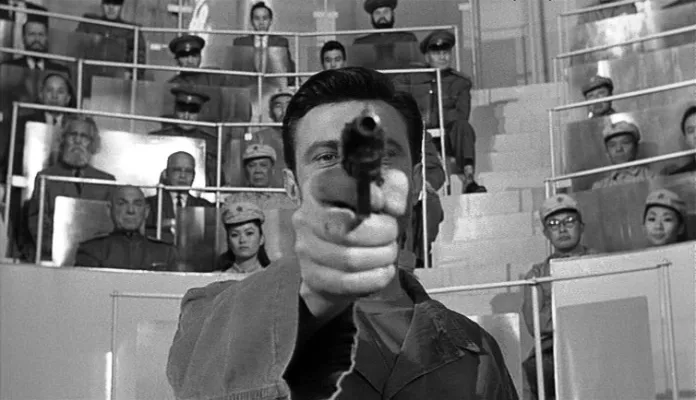
The Manchurian Candidate oozes conspiratorial energy, and it is palpably, productively uncertain about where to channel its energies, or how to even begin to place a target. Despite the film’s various attempts to direct what historian Richard Hofstadter called “the paranoid style” of American politics toward a particular culprit, The Manchurian Candidate is a deeply destabilized picture, one in which every urge to name a cause for America’s existential uncertainty overflows with remainders and excesses. The film’s search for an enemy promises a prime meridian for the instabilities of the modern world, but, in the end, the political demon infecting America in The Manchurian Candidate is both everything and nothing.
Not that the film doesn’t play into the hand of mid-century “vital center” politics. In typical mid-century fashion, communism and fervent anti-communism are ideologically equated – both are seen as controlling, anti-democratic, close-minded threats to a fundamentally open and available nation – but the real beauty of the film, with its wired connections and haywire narrative flow, its difficulty connecting its own logic and building its argument, is to lay bare how the mechanisms of social consensus, even beyond any particular ideology, work to enforce the given and narrate the kinds of control we are primed to notice and critique. We’re so busy looking for a culprit, a chimerical cabal harnessing the irrepressible energies of modern confusion, that we can’t see how the idea of such an enemy – the notion that blame can be corralled and named so easily – is itself a sleight of hand.
Who precisely is moving the cards though, and who is really being moved? In the characteristically torqued fashion of director John Frankenheimer, characters collide before they seem to have made sense of why they are here. Janet Leigh’s Eugenie Rose Cheyney is certainly the most obvious example in the screenplay, and her sudden infatuation with Frank Sinatra’s nominal protagonist Major Bennett Marco is rather, we might say, conspicuously underdeveloped. Her love nominally positioned as a natural, domesticated counterpoint to the romance of the doomed Raymond Shaw (Laurence Harvey), her willingness to support Marco, to play housewife on cue, implies something no less forced, no less constructed, than the more obvious demagoguery at work. If Shaw is a manufactured weapon devoid of personal will, her compliance to the status quo ultimately refracts back onto the fabrication of the mid-century society to which Shaw is positioned as a demonic other of but, in fact, a dark mirror to. When she expresses her desire for marriage, she lists things for her wedding like a programmed automaton, a Stepford Wife or a pod person without a soul that is, if anything, an even more effective pawn for enforced harmony.
Continue reading
