
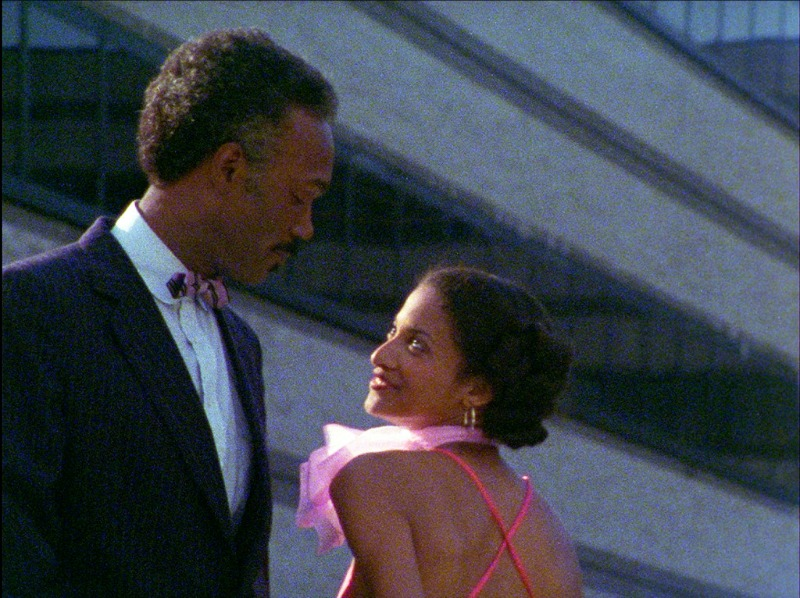
When artist Victor (Bill Gunn) convinces his wife Sara (Seret Scott) to adjourn to an upstate idyll for the summer, he has in mind a pastoral image of personal rejuvenation. While Sara agrees, this form of escape is far different from the hermetic, principled solitude she seeks to work on her summer research while on sabbatical from her yearly teaching engagements as a New York City philosophy professor. The contrast between Sara’s Apollonian formalism and Victor’s Dionysian overflow is immediately apparent in Kathleen Collins’s Losing Ground, but it is as quickly foiled. While Sara initially appears standoffish and aloof in the manner of an impartial academic, her self-governed demeanor soon reveals a roving spirit, a mind as unquiet as it is carefully controlled, and as passionate, in as many registers, as her husband, even though she works overtime to transpose her irritations into a more analytic idiom. She is presently researching an essay or two on the philosophical discourse of “ecstatic experience,” which obviously disappoints her actress mother Leila (Billie Allen), who resonates more with Victor’s emotional vision-quest. But Collins’s screenplay is supple enough to offer the characters as both abstract typologies and living humans, already a category-confounding suggestion that the modes of experience the couple seem to live by are, in fact, fluid guidelines for organizing everyday experience rather than strict regimens that must be upheld. Without denying Victor’s interest in ecstasy, Collins also catches Victor’s subtle arrogance and dismissive celebration of emotion over philosophy, recognizing that his impatience with Sara’s analytical abstraction is also its own conceptual flattening, just as Sara’s mental enclosure, despite her skepticism about emotion, attempts its own mode of ecstatic transcendence.
Neither character finds their attempts consummatory. Each encounters another than troubles their assumptions. Victor becomes infatuated with Celia Cruz (Maritza Rivera), an ostensible muse whose bodily presence disrupts his stated desire to search for “pure” abstract form and escape the prison of representational art. Gunn understands that Victor’s elated demeanor is tinged with frustration and confusion about the kind of art that channels the hypostasized idea of “purity” he is suddenly so invested in, just as Scott intuits that Sara’s ostensibly analytic demeanor belies her searching curiosity and disappointment. While she flirts with fellow academic Duke (Duane Jones), whose enigmatic demeanor seems to combine academia and bohemia, his capacity to fulfill her seems equally up in the air.
Kathleen Collins’ script, among the first written and directed by an African American for commercial release in the United States, is framed via frustrated attempts at communication, both apparent connections that give way to difference and presumed discrepancies that imply similitude. Celia, despite her burgeoning friendship with Victor, understands everyday existence in a way that he doesn’t, and she speaks with what she calls an “American” rhythm of speech that he seems aloof to. Despite Victor’s interest in her, he still exerts a self-conscious superiority of his own explanatory ability: “if she doesn’t know Wedgewood, there’s no way I can explain it,” he remarks, signaling a gap between them that figures him as the arbiter of something like intuitive human knowledge who seems to reduce her to an object, to count himself as part of an artistic elect. This is a declaration of intuition on his part, but it’s also a judgement about the anointed of which he wishes to be a part.
The connections between these characters, even those who are intended to connect to disrupt other connections, are as supple as they are thorny. No one comes to signify only any one thing, even when that seems to be their purpose. Difference abounds in the film, but its role is prismatic and not always egalitarian. “She’s not Negro, she’s Puerto Rican,” Victor remarks to Sara, but “third world thinking,” he reminds her, has complicated histories of racial belonging, implying a connection between them that may be stronger than between this African American man and his also African American wife. Yet does his interest in problematizing his racial homogeneity extend to treating Celia as a person? For that matter, while Celia and the distinctly enigmatic Duke, wearing a cape and cane like a combination of Orson Welles aristocrat and academic flaneur, accommodate Victor and Sara, they also affirm their own tenuous communion between one another in a dance scene where they emerge as more free floating, independent entities, unbeholden to the nominal protagonists’ demands fo rthem. Duke and Celia remind that they are not so easily assimilated into this family drama, that they remain ungoverned by the problems of these two people even as they are drawn into their orbit.
By the time Victor informs his artistic mentor Carlos (Noberto Kerner) that he “really resent(s) your Latin ancestry,” his easy-going mixture of breathless camaraderie and unadulterated art seems to cover up a frustration with the “cinematic moment” he mocks the other characters for trying to achieve. He claims that cinema as an art is somehow not “pure,” somehow too precious and manufactured and calculated, and yet he is all the while calculating and looking for a precious and manufactured conception of purity to belong to and call his own. His disdain for lived experience evokes his own performance of artistic grandeur, and we increasingly appreciate the elusive “rhythm of speech” that “sometimes defines the truth” that Duke and Celia are willing to play with.
Such texture Collins brings to her screenplay, and, given the vaguely theatrical quality of the dialogue and its propensity for sliding between intellectual modes, one might be excused for considering the filmmaking an after-effect of what might as well be a finely-hewed theater piece. Yet Collins is a subtle, suggestive stylist who sidles between neorealism and expressive figuration throughout, connecting forms of knowledge at varying levels of abstraction. Duke may dress like late-period Welles, but the phenomenal tracking back and forth across Sara and Victor’s dinner table at one point recalls Welles’s famous Citizen Kane dinner scene, here replacing temporal ellipsis (cuts) with continuous movement. The camera drifts back and forth before settling on the lone flower in the middle of them, stranded in the dark cloud in between them.
Not that Collins isn’t above investigating her own medium of choice as surely as she does Victor’s painting and Sara’s philosophy. When Sara returns to New York City and volunteers for a campus student film, Collins’s own camera mimics the African American students’ but with subtle discrepancies. The camera tilts downward, while it dollies forward, a gestalt of intimacy and surveillance, her camera approximating before slipping away from the students’ own and into something more intimate and self-aware. When he mock-remarks “did you catch that subtle mise-en-scène?” to his friend, in an amused image for a younger, more ostentatious form of Black artistic masculinity, Collins teasingly implies that he offers only the shadow and not the substance of her supple and searching eye. He looks through his monocle, sees Sara as the object of his gaze, reducing her to an abstraction, but when she waits for Duke, her scene partner, the young filmmaker and his second-in-command are out of focus in the background, Collins and Sara evince a more serious abstraction of the soul, achieving a truer command of the mind’s camera than he. Collins couldn’t have been anticipating the rise of a specific kind of youthful African American director schooled in a somewhat ostentatious style of classical filmmaking, but Collins’s film, with its emphasis on pregnant pauses and evanescent imaginations and inconclusive considerations and severe silences, offer a different vision of cinema and a set of reasons why this film was not only not released commercially in its allotted period of origin but largely forgotten for decades.
This, suddenly, is Sara’s cinema, a cinema of unstated sensation alive to the frustrations of expression, and if Sara later self-critically tells us that “everything she does is abstract,” the film ends up promising her a way back to the concrete world through that very abstraction. To answer Sara as a human and not a muse or an antithesis, Duke and her paradoxically require cinema as a medium of philosophical self-reflection and transformation. When the constraints of their cinematic pas de deux are explained to them with a symbolic red background behind them, they seem like archetypal figures themselves. However, in a long walk behind some plants while they are being filmed, they go on to find humanity in the self-imposed constraints of formalized performance itself, transmuting theatrical convention into an accumulation of minute, revelatory, human gestures.
Something like ecstasy and something like analysis become so entangled that it becomes difficult to oppose them in Losing Ground, as vigorous a workout in thinking with art, and in art as an act of thinking, as Ingmar Bergman’s Persona or Robert Bresson’s Pickpocket. What is the euphoria of creativity, the film asks, and how does its trance not only transport us into a state of ravishment but create a bliss that can be blinding and even interpersonally destructive? Victor, Sara tells us, “has sex all the time, with a color, a room, the way the light falls across a building. All that private ecstasy,” something which frustrates her and excites her, channeling an inner power she resents but also obviously wants to access. While her mother relates to the artistic fugue state, being “always in complete control, but I’m gone” during her performances, Sara too has an academic rapture dancing in the head, transporting the mind to a realm of exaltation that is tragically laborious, that takes an almost insurmountable amount of work to maintain, that can dance against the shuffle of bare existence and the friction of others who are your conduit and nemesis in the act of thinking and creation. While people smuggle their needs and ideas under the cover of art, and art is an incomplete mechanism of transmission for ideas that are ever-always inchoate and shifting in the head, Collins also affirms that, in mediated form, thinking is a potent and powerful force that must be reckoned with in all its forms and permutations. In the final scene of the film, Sara affirms her capacity to enact a violent ecstasy of the mind, something that can be formulated with a pencil or summoned with a keypad but can just as powerfully, and perhaps more achingly, be channeled through a prop gun, a proxy lover, and a consummation to a long summer of the soul.
Score: 10/10

