
Medium Cool begins with an out-of-focus image, a dark harbinger of unclarified forces from an apparently chaotic future. When the image centers itself, it reveals not a clear screen but a broken window, not a crystal clarifying the truth but a sudden lurch into an even deeper oblivion shattering it further. A car has run off its tracks, as surely as a world has tilted off its hinges. Truth may suddenly be nothing more than an illusion, cinema a fractured gaze, a stalled vehicle like the nation that thought it was going smoothly in one direction before it crashed into a ditch. The two men presently viewing the crack don’t have any moral investment in fixing it either. They’re just here to inspect the wreckage.
Modern viewers might think of 2014’s Nightcrawler, another film about midnight wraiths wielding cameras as death masks (to quote André Bazin) and channeling demonic forces converging on a wounded world. But Medium Cool is a film almost preternaturally attuned to its time-period. The vehicle crash was and would continue to be a prominent metaphor in the late ‘60s, from Bonnie and Clyde through Easy Rider, not to mention the opening rubble of Godard’s laconically apocalyptic Weekend. So too would the camera: Rear Window and Peeping Tom and Blow-Up and even Targets (which shares this film’s soon-to-be epochal editor Verna Fields, serrating the screen here like an unseen-shark’s tooth) all understand the camera to be an affirmation of life and an omen of death. However, while those films all figure the wielders as adepts of demonic or even metaphysical forces, Medium Cool is furiously naturalistic, not icily composed like Antonioni or menacingly controlling like Hitchcock but deviously documentarian. If anything, the film’s verité style evokes Bob Dylan’s opaque sunglass act in Don’t Look Back: transfiguring our gaze, subtly manipulating our interpretation, while claiming it isn’t doing anything at all.
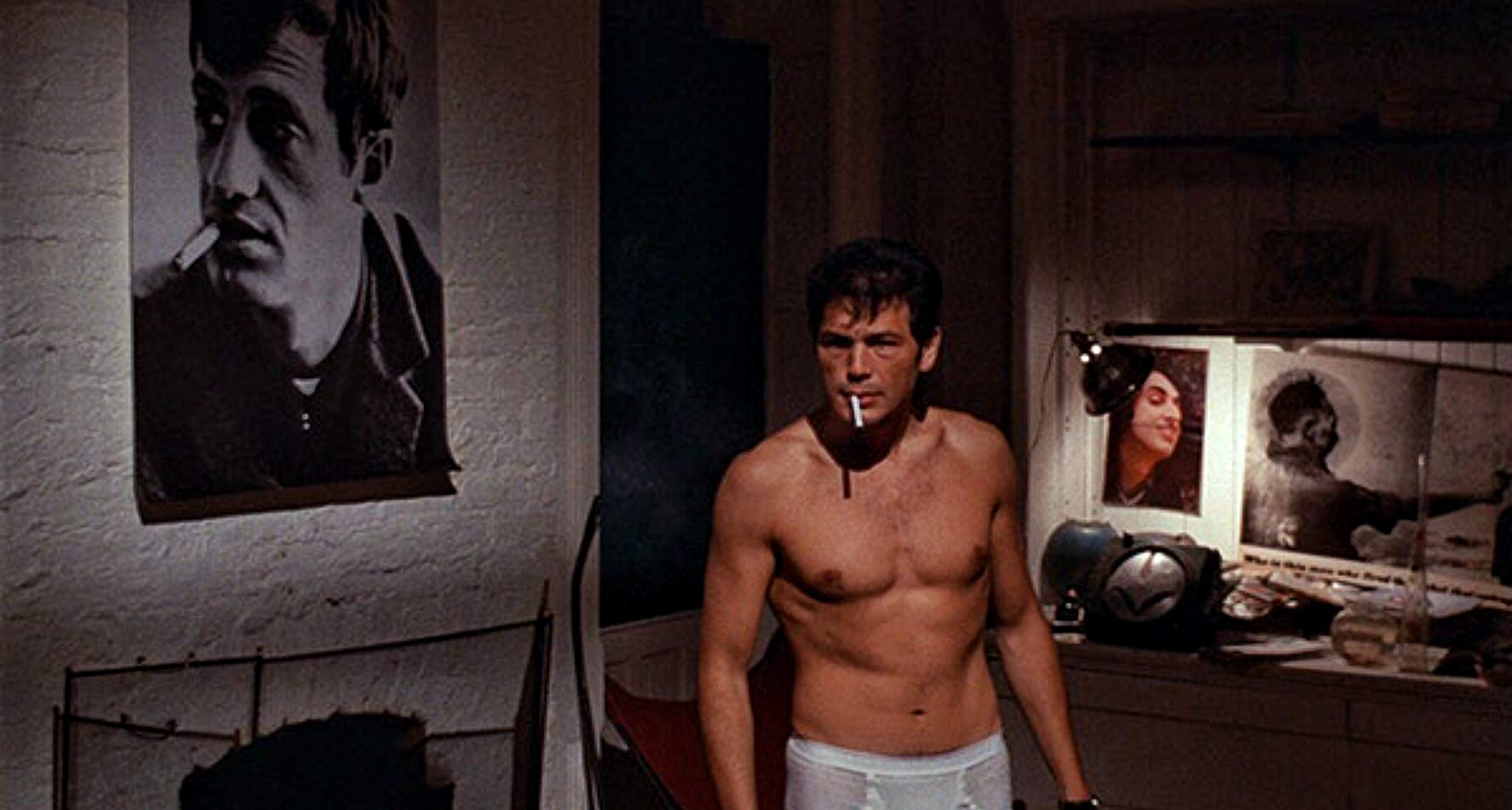
Maybe John Casselis (Robert Forster) isn’t doing anything at all. He has no designs on the universe, neither to save it nor to damn it. He isn’t exactly an otherwise idealized man, but when he is told that his footage has been turned over to the feds, he simply takes it as fact that this is a fundamental violation of his existence. This is a statement of morality, but it’s also oddly robotic, as though he is unthinkingly replicating the predigested ethics of a society that assumes journalistic neutrality as fundamental truth but perhaps has not actually internalized what it means to consider it as a reflexive principle. This self-consciously modern man aspires to be up to date, to be ready to heed the moment’s call. Yet unlike Godard’s protagonists, who are willing and eager to turn themselves into simulacra of cinematic icons, John seems to replicate the world around him unthinkingly, to be subsumed by the images of pop culture, the posters he hangs on his wall, that he claims to only witness and document. He certainly doesn’t seem curious about the value of the deaths he records, or that he is recording them. Ethically, he’s not much more than a voyeur, a disinterested and apathetic observer who derives both a sense of self and a limited satisfaction from his ability to wield a camera like a weapon and a shield. He just loves to shoot on film, an earnest artistic fascination, but he doesn’t see himself as shaping the truth in any meaningful way. But he’s also a good man, a compassionate soul who takes a real liking to Eileen (Verna Bloom) a recent transplant to Chicago looking to survive what David Riesman called modernity’s “lonely crowd” compared to her native Appalachia.
These are the contradictions traversed, perhaps embraced, by Haskell Wexler’s Medium Cool. Wexler, a cinematographer by trade and a cinematic Renaissance man, had recently won an Oscar for lensing Who’s Afraid of Virginia Woolf?, and Medium Cool was a self-critical passion project with a political conscience. Wexler’s film is an avant-garde mixture of documentary realism and Hollywood fabrication, in which actors wander, within a cut, into something that presents itself as reality and real humans find themselves trapped in a film with motivations beyond them. Cameras roam wide and loose in the Chicago streets, entering into our ideas about reality and tearing them open. At one point, after a debate about reasons for filming suffering and arguments for maintaining professional distance, the characters basically disappear into a march in abstract fields that don’t especially seem like Chicago, our stated location, at all, as though the film, or the system they inhabit and that wields them more than they utilize it, has dissipated them into the wider collective of a confused humanity.
In what we might call a “climax,” a frankly leisurely scene in which Eileen wanders through the protests engulfing the Chicago Democratic Convention, technically looking for John to help find her son, the film becomes a drift into oblivion to rival L’Avventura. Wexler lingers in apathetic shots of institutional chaos and national indecision, Eileen often evaporating from the frame, lost in a narrative that is not anchored to her. Cutting to Eileen and John only after they’ve recombined – denying us the image of their reconnection – and after we know that the son was just playing outside all along, Medium Cool renders the narrative search for meaning, for reconnection, almost incidental. In a particularly bracing audio-visual asynchrony, the television news seems to know what happens to these two before it happens, or at least before cinema is privy to what may have been a foregone conclusion all along. Television seems inescapable, even though the film tries to annotate its intrusions into traditionally cinematic territory. While cinema cautiously curates and methodically ponders, new, potentially more democratic mediums aspire to capture a reality very much like the loose pigeons that unexpectedly weave their way into the film from time to time, a ragged truth as provisional, as constantly amended, as experience itself. By the film’s end, something has ravaged the cinematic narrative project, leaving us to pick up the pieces as we walk through the detritus.
Score: 10/10

