
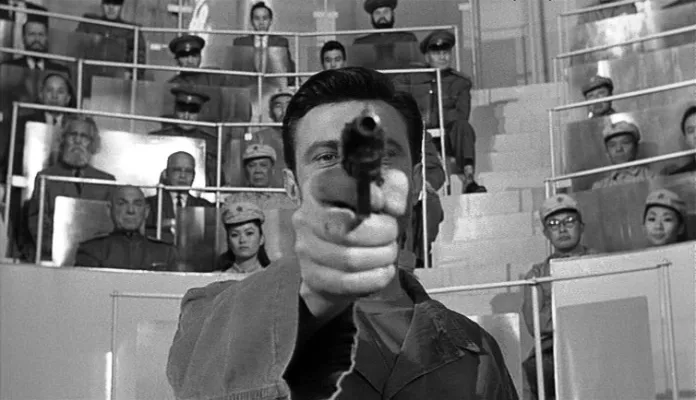
The Manchurian Candidate oozes conspiratorial energy, and it is palpably, productively uncertain about where to channel its energies, or how to even begin to place a target. Despite the film’s various attempts to direct what historian Richard Hofstadter called “the paranoid style” of American politics toward a particular culprit, The Manchurian Candidate is a deeply destabilized picture, one in which every urge to name a cause for America’s existential uncertainty overflows with remainders and excesses. The film’s search for an enemy promises a prime meridian for the instabilities of the modern world, but, in the end, the political demon infecting America in The Manchurian Candidate is both everything and nothing.
Not that the film doesn’t play into the hand of mid-century “vital center” politics. In typical mid-century fashion, communism and fervent anti-communism are ideologically equated – both are seen as controlling, anti-democratic, close-minded threats to a fundamentally open and available nation – but the real beauty of the film, with its wired connections and haywire narrative flow, its difficulty connecting its own logic and building its argument, is to lay bare how the mechanisms of social consensus, even beyond any particular ideology, work to enforce the given and narrate the kinds of control we are primed to notice and critique. We’re so busy looking for a culprit, a chimerical cabal harnessing the irrepressible energies of modern confusion, that we can’t see how the idea of such an enemy – the notion that blame can be corralled and named so easily – is itself a sleight of hand.
Who precisely is moving the cards though, and who is really being moved? In the characteristically torqued fashion of director John Frankenheimer, characters collide before they seem to have made sense of why they are here. Janet Leigh’s Eugenie Rose Cheyney is certainly the most obvious example in the screenplay, and her sudden infatuation with Frank Sinatra’s nominal protagonist Major Bennett Marco is rather, we might say, conspicuously underdeveloped. Her love nominally positioned as a natural, domesticated counterpoint to the romance of the doomed Raymond Shaw (Laurence Harvey), her willingness to support Marco, to play housewife on cue, implies something no less forced, no less constructed, than the more obvious demagoguery at work. If Shaw is a manufactured weapon devoid of personal will, her compliance to the status quo ultimately refracts back onto the fabrication of the mid-century society to which Shaw is positioned as a demonic other of but, in fact, a dark mirror to. When she expresses her desire for marriage, she lists things for her wedding like a programmed automaton, a Stepford Wife or a pod person without a soul that is, if anything, an even more effective pawn for enforced harmony.
Indeed, despite its fabricated nature, it is Raymond’s relationship that feels genuinely empathetic in a way that Marco’s nominally normative one, meant to embody and uphold the social order, never does. Raymond, the corrupted American POW turned into a walking weapon for a Communist plot, still finds real love with Jocelyn Jordan (Leslie Parrish). When Shaw tells Jocelyn to “make like a housewife,” the line eerily evokes the wider machinery of Eugenie’s own social programming, or those of her government masters. We aren’t supposed to notice that something is amiss with the former because the latter occupies our attention. What is this but consensus at work?
Jocelyn is the daughter of liberal Senator Thomas Jordan (John McGiver), whose career we discover only after we gather that he is obsessed with snakes and curing snake bites, an absurdist and off-kilter image that upends any hierarchy of relevance we associate with American politics. Here is a human being whose strangeness certifies his authenticity in a world of imposters and automatons. Despite learning that Shaw has been programmed to kill Jordan and his daughter, that sinister forces outside their purview control their future, theirs is the real humanity, the truly sincere human family, certainly more than Sinatra’s and Leigh’s window-shopped romance.
And certainly more than the family life of Jordan’s opponent in the upcoming political race, Shaw’s own father-in-law, Senator John Iselin (James Gregory). An obvious Joseph McCarthy parody, his Roman nose accentuates his own theatrical self-satisfaction and his Lincoln costume is silently mocked by a Lincoln portrait that presents the ostensibly living man as a debased simulacra of democratic life, an obvious imposter living in a costume of the real spirit of a humanistic nation.
But then again, what is humanity in this world? As the characters all search for a solitaire of the mind that eludes them, Marco and Shaw have only one intimate encounter, and it concerns Marco spending a good, long, leisurely time expressing to Shaw how, if he had sent a man who had just tried to beat him up a Christmas Card, he would have had to respond with a card as well. Marco prefers that the latter man not have to bother with the formality. This could be a genuine gesture of friendship, a “cheerful robot’s” (to use C. Wright Mills’s term) attempt at small-talk, or it might simply be another ritual of modernity that feels stage-managed even in its moments of apparent, unmanicured authenticity. Like the Senator father’s collection of improbable trivia about snakes and obsession with obscure fishing habits, this sliver of loose, dreamlike associative-ness evokes the film’s daisy ways of sprinkling in bits of esoterica to remind us of the humanity pulsing in the core of the nation even as the script scours the country’s depths, scrubbing at something buried beneath the surface that may just be more excrement.
Throughout, all these little, broken, fugitive occurrences offer us both a vision of humanity scratching its way through and an image that we are peeking behind the screen of the film’s construction only to see mere nothingness. There’s a strangeness to the film that both confirms and denies the fleshiness of its characters and the soul of its world, like the characters’ minds, and the geography’s organization, are desperately trying to patch themselves together right before we cut to them. When a military psychiatrist claims that “human fish swimming at the bottom of the great ocean of atmosphere develop psychic injuries as they collide with one another” with an odd mixture of positivist zeal and oneiric poetry, we almost follow the smoothness of the argument until we notice the loose wires literally all above and around him fraying the linkages of claims that are as tenuous as the room around us. Looking through this governmental space, an orderly world that is an apparent bastion of reason amidst the chaos, we might catch a flicker of a pantless man changing in the background for no apparent reason other than to remind us that our eyes have to be trained to look in the directions that power wants us to.
And where do we look anyway, and who do we look to? Adapted by George Axelrod from the novel of the same name by Richard Condon, the screenplay gives us a protagonist in Marco who is just as much an ironic pastiche, curiously inactive and artificially anointed, of the mid-century “practical man of affairs” as Laurence Harvey’s Shaw is a nasty parody of his own ragged, burgeoning “type”: a manipulated icon, the prototype of the new Hollywood subject, plucked out of the crowd as a potential James Dean replacement who has been jerry-rigged to go haywire, an unruly element being secretly and unknowingly controlled by forces much larger and opaquer than himself. They feel like unfired clay, blurry images that could lose their shape if investigated too closely. This is just as surely as Leigh is a makeshift parody of a submissive woman, just as knowingly as Lansbury, so wonderfully cruel and domineering here, is a constructed image of a monomaniacal, Freudian-inflected matron, one who was only three years older than Harvey in real life and wears ghoulish make-up that does not even seem to bother to want to mask her youth. They’re a full hand of face cards – the title credits make this clear enough – mannequins who seem to have mistakenly thought themselves to be human.
That’s Frankenheimer’s gift though. Schooled in early television and industrial cinema (during the brainwashing scenes, the conspiratorial audience is framed like an army of TV screens, the observers exposed as the observed in a Panopticon world), he belongs to a generation of American directors who were skeptical about their own domineering nature even as they exercised it. This is a self-consciously masterly film, but also one that is very curious about its own mastery. The whole thing is excavating underground, seemingly antediluvian currents of social control through highly-charged Wellesian deep focus, as though trying to reach into the background for a more totalizing angle to capture the conspiracy in full, yet the depth never really reveals anything, implying that there is less here than meets the eye, that the elegance and complexity of the style is just a trick of the light designed to hide another fabricated product.
The framing is strikingly baroque and architecturally complex, yet curiously loose and apparently un-manicured. It ingests the paradoxical language and mythology of American exceptionalism: spartan complexity, vigorous simplicity. When Marco investigates, he’s so laser-focused that he can’t see what is going on around him because he assumes it is both too complicated and too straightforward. There’s an Americanism to the text, a pure velocity of youthful zeal and frazzled nervousness circling around itself in search of a missing center, one that only salvages itself from decay in an ecstatic act of destructive ambition. Trapped by his elders, the young hero can only enact a flagrantly Oedipal narrative of filial annihilation that saves America by destroying the previous generation and, at great personal cost, the mark they have left on the current one. Shaw is a tragic figure, a casualty of wider systemic forces who must destroy himself in a self-sacrificial act of impotent agency. The problem is that in killing himself to save the nation he ultimately completes and extends its canonical script: that of the new forgetting, rejecting, dismissing, the old and, in this very act, becoming complicit in an age-old national spirit that asks them to do just that.
score: 10/10

