
Grubby, gnawing exploitation vessels chased by commentary on social collapse, George A. Romero’s zombies were less metaphors than poetic embodiments or evocations of walking-shuffle social alienation. Flesh wasn’t the only thing rotting and decomposing in a Romero film.While I have written about his zombie films, his obvious claims to fame, before, I take the occasion of his death to appreciate a trio of his less appreciated ‘70s films. RIP.
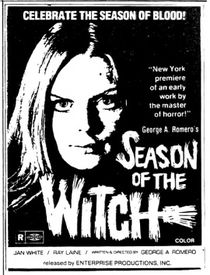 Season of the Witch
Romero’s exploitation films wielded a surprisingly dusted-off, casual, analog-refuse quality, as if transforming them into social bric-a-brac found in the dumpster that, like all of society’s “trash”, tells us more about the society’s dreams, desires, and fears than what that society chooses to elevate on a pedestal. In this case, Season of the Witch is a brazenly radical concoction, a cauldron-brew composed of unfulfilled desire, agency-dreams, and two shakes of erotica. The subject is middle-American housewife Joan (Jan White), wife of Jack, as she creeps into the world of witch-dom with skepticism that mutates into feverish elan, cottoning to the sexual quivers and enhanced sense of self that is afforded by finding her own personal world of witchcraft away from the white-washed, relentlessly squared-off frames of quotidian domesticity. Continue reading
 I can think of hundreds of better films, but Face/Off is some kind of zenith, like a pure slab of movie-making distilled. Beyond being a gleefully trashy amped-up B-movie delight, as gloriously dysfunctional as it is intoxicatingly sure-handed, John Woo’s best (and only good) American film is a blockbuster treatise on the nature of identity, the only American picture he handled that remains truly permissive to his personal predilection for films about the dualistic nature of identity and the loss and retention of self. Hard Target (dementedly designed climax aside), Broken Arrow, Mission Impossible II, and certainly Windtalkers and the abominably luke-warm Paycheck all feel like imposters, but Face/Off has the special sauce, that auteurist alacrity and deliciously eccentric sense of self that only Woo could bring to a production like this. Nervously coiled interpersonal drama interpolated with orgasmic explosions of pressured-violence, this radioactive tangle of a film is exultant movie-making from beginning to end.
 I know I should stop beating the dead horse of The Untouchables (it just doesn’t kick enough to truly live), but, Raising Cain? Now we’re talking. Five years after The Untouchables, and De Palma is back where he belongs: up to no good. Vigorously so, at that. Taking a sabbatical from tent-pole films (to be resumed soon enough with Carlito’s Way and, of course, Mission Impossible), Cain is a full-throated, fully-equipped expressionistic cluster-bomb of De Palma’s stylistic slipperiness, throwing his outre configurations of canted, dubious-perspective angles at us like a self-propagating fire. Avoiding any pretense of a sympathetic protagonist or a moral opponent for main character Dr. Nix (John Lithgow), Raising Cain lives up to its riotous name and then some.
 The depressing timidity of Brian De Palma’s mercenary The Untouchables, a paycheck directorial role if ever there was one, is consummated in the centerpiece sequence, a verbatim riff on the famous staircase rumble and tumble from Eisenstein’s Battleship Potemkin (which was itself not as good as anything in Eisenstein’s prior film Strike). De Palma’s version is technically proficient – maybe even perfect – but purposeless and entirely rudimentary, excoriated of Eisenstein’s surrealistic flourishes and political-revolution tectonics. De Palma’s detractors tend to think of him as a Hitchcock plagiarist who debases that cinematic master of the macabre, but their argument falls apart when De Palma’s hedonistic formal pirouettes and wry, audience-blackmailing comic filigrees push Hitchcock way over the sanity edge. For scholars who ghettoize De Palma as a copy-cat and a reduction-artist, the real lynchpin of their argument should be The Untouchables, which repeats Eisenstein only to render him null and void.
  Freud and Superman and Fellini and sleaze-house dens all make walk-on appearances just in the introductory passages of Brian de Palma’s Hi, Mom!, a quasi-satire, or at least a loosening up of, the malevolent Hitchcockian Rear Window. A bizarre-world antecedent to Taxi Driver, this is a film with Robert De Niro obsessively subjecting New York to his viewfinder until he is himself victim to and participant in an artistic nightmare. Relentlessly aware of its own spectatorship and shot-through with neurotic ambivalences, the film always has film on the brain, and the muscles, and the loins. But De Palma refuses to rest on this tried-and-true meta-textual laurel, instead wandering off – skipping, even tumbling – in untold and untested directions. Call him a Hitch parasite all you want, but Hi, Mom! commandeers Hitch for its own sinful purposes.
  Hectoring becomes a professional endeavor, or professional filmmaking becomes a form of hectoring the audience in John Huston’s whacked-out Beat the Devil, entirely denounced when it was first released and somehow bent and mutated even further sixty four years later. Temptation begs that I reclaim the film by arguing that it was “misconstrued’ upon release, but I’m not entirely certain it exists to be construed. That might only breed domestication, curbing the film’s vigorous unruliness. With a regular goon squad of odd cartoon shapes masquerading as people waiting around in a squalid sea-port town, the whole film seems to exist to breathe in the salt water. The most exciting moment is entirely about an aging, wheezy Bogart and a pair of portly fellows schlepping after a runaway car, teasingly dramatic music massaging out the irony of their failure to exert more than a modicum of effort. It’s awkward, heinous, mismatched, and oddly brilliant in its idiom.
  Meant to review this in memoriam for Bill Paxton earlier this year, but with Powers Boothe passing as well, I had no choice but to get around to it. Both are great in this underrated horror film from arguably the worst period for the genre in film history.
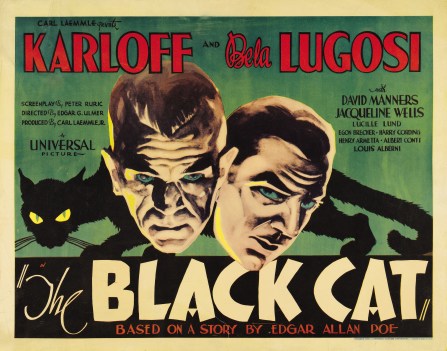 With The Mummy generally serving no one’s interests and possibly nailing down the coffin on Universal’s Dark Universe project, let us look back at one of the best – and most underrated, non-canonical – Universal Horror films, and the first to feature their two biggest stars.
 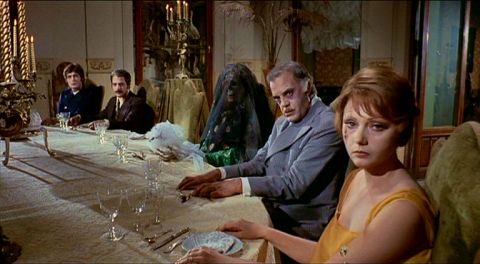 Dreamlike – and as lush as Mario Bava’s visual resplendence ever got – Lisa and the Devil is the half-crazed tipping point between the director’s earlier, Hitchcock-indebted slashers and the artistically emancipated deranged pop-art flourishes of his ward Dario Argento. Released in 1973 – and heavily recut two years later for American audiences to cash in on the Exorcist craze – Lisa is evidence not to paint Bava with the wide brush of obligatory pastiche, as though he was always performing his own idea of what a Bava film was supposed to be. Never stagnant, his films all reveal their personal eccentricities and oddities, the markers of a restless consciousness at work. A tragically comic fun-house reflection of existential panic, Lisa and the Devil recollects Alain Resnais’ Last Year at Marienbad to bridge the high and low art divide as Lisa (Elke Sommers) finds herself lost not only amidst Spanish corridors but time and space themselves.
  The title of this quintessentially ‘60s-product-of-hot-headed-Italy suggests a sex kitten romp, but the name is a much more literal in this deliciously macabre take on the spirit of Daphne de Maurier. As is seemingly the first commandment of all Giallos – to be obeyed with holy penitence – the narrative is paradoxically simple yet horrifyingly obtuse, but it boils down to the ghostly menace of young Melissa Graps terrorizing a European village around the turn of the 20th century, a village newly visited by a doctor (Giacomo Rossi Stuart) there to autopsy one of the bodies. Kill Baby, Kill also further develops Mario Bava’s formal fixation with the architectural impossibility of the mind. With one foot in the psycho-sexual and the other in the undulating tension between the supernatural and modern medicine, Kill Baby, Kill frolics with many of the thematic devils twisting the throat of mid-century life.
