 Update 2018 with Roeg’s passing: Slightly less taken with Walkabout’s politics this time out. As a critique of settler colonialism, it’s both vaguer and less eloquently abstract than Peter Weir’s wonderful Picnic at Hanging Rock, a truly poignant and critical take on a cloistered community corseted by their own haze of superiority and indifferent curiosity about other ways of life.
But I’m possibly more enamored this time of Walkabout’s metaphysical vision of sensory experience. Its vision of the conviction of colonial consciousness shuddering apart, of transfixed youths suddenly spellbound by the limits of their own minds, is problematic, but also intoxicating food for thought. And Roeg uses it to divine a film of internal ruptures and wanderings into the unknown, exploring the irregularity of human experience and the non-totality of any individual culture with frighteningly fractious editing and cinematography that veers from the acrid to the oneiric. Above all, he dares us to touch the jagged poetry of the world in disarray. It’s a flawed experience, and perhaps too nihilistic, but it boasts its own truly singular poetry, an elegiac and tragic meeting of minds that explores the fallout of cultural connection and clash.
Original Review:
Nicolas Roeg was not an Australian director, nor did he have much to do with Australia for the rest of his career. But, when he wished to explore the elusive mystery of human distance and find the frightful regions of human history and modernity in what would seem to be majestic from a distance, it is no surprise that he looked to Australia as his canvas. The always damaged mystery of the location is unspooled across the unforgiven lateral extension of a landscape leftover from history, stretching on forever into the regions of madness. Not knowing the history of the region, the fading crimson of the sun staring at the fleshy human form instills its own sweat and sickly grime on the viewer. The unforgiving chill of the forlorn landscape dotted with an abject tree or two every now and again gives off a wafting aroma of decay and empty space, selling the history of this location as an abstract space of eternal rupture, the kind ever-primed to refract social fissures and psychological shattering. Continue reading →

 After Earth is the sort of bad movie anyone could have made, which is disappointing after the release of three tried and true “M. Night Shyamalan”-encrusted bad movies of the sort that only his holiness could make. Or Kirk Cameron, maybe. But the point is there was a certain personal touch of badness on display, and following that tripartite masterpiece of anti-filmmaking, After Earth is just bad movie leftovers. Continue reading
  Edited January 2016
 M. Night Shyamalan is the gift that keeps on giving. Just when you thought he’d hit his true low, and just when you thought less creative control over his material would save the day, he pulls a fast one and comes up with something even worse. As it turns out, Shyamalan can vividly ruin a known property about as well as he can dream up mindless drivel of his own creation.
 And then he made The Happening. Lady in the Water was a collage of self-important grand movie statements about the state of the world doctored up by a man who had not one clue what the world was, let alone how to convey that on the screen. What could be a better counter to the big-boy statements of a preachy message film than an elementally chilly exercise in pure nihilism and horror? With the idea for The Happening, Shyamalan seemed to be at least listening and returning back to the muck and earthen horror of what he does best (indeed, atmospheric horror is the only thing he ever did well). Ideally, The Happening could have been an exercise in humorless style and pure cinematic horror, entirely visual and lacking in any of the pretentious import of Shyamalan at his worst.
 A note on “worst”: As mentioned before, this series is an attempt to dissect some of the alleged “worst” movies of all time, and primarily not a hope to actually find them. It is ridiculous and arguably mean-spirited to refer to any of M. Night’s films as among the worst ever made. They are a special sort of badness, and he is now four films deep into a wonderful, scorching form of incompetence, but it is wrong-headed to claim that “the worst movies ever made” all happen to be well-budgeted Hollywood films from the past ten years from a major director and with major stars.
 It isn’t difficult to find issue with Beyond Thunderdome, nor is it difficult to pinpoint the root cause of the problems: Hollywood money, and the desire to go big or go home. Both things that Miller used like a sledgehammer in Fury Road 30 years later to wonderful effectiveness, but which here see him step up and trip over the need to focus on a plot that doesn’t much go anywhere. The pure cinema appeal of the series is certainly lost (with Fury Road, Miller managed to go big without inducing a case of the talkies), but it doesn’t do well to overly criticize something for simply having a more elaborate story. Still, admittedly, the focus on “plot” for Beyond Thunderdome sacrifices the queasy, nihilistic immediacy of the original Max and the off-kilter humor and the implacable malaise hanging over The Road Warrior, a malaise brought on precisely by the fact that the film never much “went” anywhere plot wise and established, instead, a feeling of stagnancy.
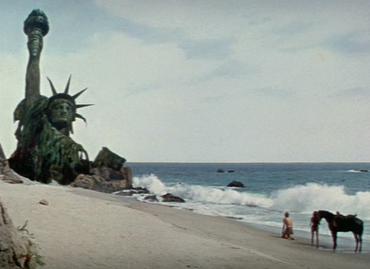 Right from the beginning, Planet of the Apes settles itself on a nexus between tactile action and implacable inaction. The prologue, set on a spaceship as astronaut George Taylor (Charlton Heston) throws his throaty baritone into a mission log, establishes the very 2001: A Space Odyssey sub-Kubrickian cosmic chill of the material. Taylor, along with Landon (Robert Gunner) and Dodge (Jeff Burton), are on an amorphous vision of an intentionally nebulous, even pointless nature; what matters is not where they are going or why, but the existential frostiness of the pallid white of the ship’s interior and the very present deadened quality in Heston’s worrisome but unconcerned voice.
 When we last left him, former police office Max Rockatansky (Mel Gibson) lost his family and his best friend, and had fulfilled a most unfulfilling form of revenge on the now lawless highways of the Australian outback. He had lost and repaid the loss only to realize that there was nothing to be won back. When we last left him, there was nothing left for him but the empty road.
 Thirty six years later, with the release of the grandly, boisterously cinematic carnival opera of Mad Max: Fury Road, it is difficult to peer back through the looking glass and glimpse the humble origins of the Mad Max fiction. It is difficult to remember that, for all its commercial and critical success, the 1979 release of Mad Max was nothing more than a budget of 400,000 dollars (a paltry sum then and now) and one of the great modern cinematic visualists doing everything they could together to disturb, provoke, and ultimately, to entertain and thrill. It is difficult to remember how intimately inhuman the original Mad Max is, how nonchalantly brutal and matter-of-factly nihilistic it is in its almost impressionist depiction of apocalypse and social malaise propped up by stunning, startling car chases of unquenchable viciousness. It is also difficult, in lieu of the great majesty of the second film in the series, Mad Max 2:the Road Warrior, to remember how effective the original grinding house classic of action entertainment is to this day.
