
Update late 2018:
With each rewatch, the sheer abyssal emptiness of The Matrix’s “social critique” is all the more apparent, and the lazier the film’s self-positioning as a messianic, imaginative emissary to “truth” feels. Rather than a real debate between multiple planes of or perspectives on reality, The Matrix sanctifies itself as revelation, its needlessly self-important tone matched only by the hopelessly blinkered texture of its philosophizing. It strikes me increasingly that the film’s problem is that its metaphysical, pseudo-post-modern ruminations on the problem of perspective imbricate upon rather than actually problematizing its resolutely, almost faultlessly classical narrative structure. Which is to say: the film remains, above all, committed to its hero’s quest storyline about the achievement of final consciousness – and “pure” truth – rather than a more fundamental doubt that this new reality is any more viable or legitimate than the old one the film fetishistically pats itself on the back for “teaching” us out of. Whenever new vision and old storylines come into conflict, the film imagines them as inimical, always and faultlessly choosing and defaulting to the later rather than trying to work through how to image a truly modernist blockbuster. For a film about the terrifying beauty of new perception, The Matrix boasts an astonishingly narrow corridor of perceptual possibilities, and it remains truly choked in its field of vision, never exposing its aporias, never curious about the peripheries that haunt it. It remains only interested in shoring up its knowledge rather than questioning it.
Original Review:
The Matrix is an aggressively, almost violently, superficial film, which isn’t a bad thing. That it doesn’t realize it is aggressively superficial? That is a bad thing, and arguably the overriding “bad thing” about genre films in the years to come since The Matrix. In particular, the sci-fi genre has descended into a mess we seem only to just be coming out of. There was a great long period post-Matrix where science fiction seemed wholly unable to exist as either thoughtless puff piece or hard-working, idiosyncratic social commentary. Films consistently and inescapably combined the two to sums that were less than the sum of their parts, questing for a maturity without earning said maturity in genuine craft, all while eventually falling back on techno-fried action as an avenue for popular appeal when the ideas of the film failed to pan out. Take Neill Blomkamp’s District 9 for one. Not a bad film, but definitely a post-Matrix work of trying to have its edgy, thoughtful sci-fi cake and trying to eat its robot-alien action cake too. Continue reading →

 There are precious few directors that know how to wield a single scene quite like Michael Mann. His single greatest moment behind the camera belongs in Heat, a mid-film bank heist that overflows into a stuttery shootout that mashes together the rhythms of an urban jungle, the pageantry of an urban carnival, and a geometric fascination for odd, cutting edits and fascinatingly counter-intuitive visual storytelling. The shootout is one of the most perfect action scenes ever filmed, one of the most perfect scenes of 1990s cinema, and a startling showcase for a director who defines life as a collection of people (usually men) wallowing in their own danger until those men overflow onto each other and bubble till they erupt.
 It is said that the best horror films traffic in the slithering, slimy replacement of the mundane by the uncanny. True, to some extent, but the best of the best posit something more. Take 1974’s The Texas Chainsaw Massacre by Tobe Hooper, a work that posits the mundane as the uncanny, locating a world where the mundane regions of American society were the most uncanny. A world where mundane and innocent society never really existed except in the romantic dreams of the American imagination. A world where everyday life is actually an uncanny abyss of demonic activity just waiting to swallow goodness and human life up whole.
 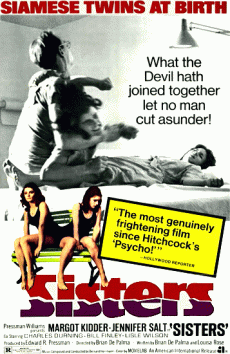 A Brian De Palma double-feature this week on Midnight Screenings.
  Amidst the sinew and cartilage of cinema during 1999, so many new cinematic talents emerged from the fray that it can be easy to overlook some of the talents who, charitably speaking, took a while to truly do any emerging. One such force, David O. Russell, spent the better part of the next decade generally hiding from the cameras and doing his damnedest to sour his indie-goodwill, keeling over his once-bright reputation until he was known more as a blistering brute, an angry young discontent of a director behind-the-camera, than as a genuine talent whose skills were readily viewable on-screen. He became an untouchable, in other words, scaring off actors as far as the eye can see and sending them scouring for the new next young upstart director.
  If 1999 is an important year in cinema history – which most believe it to be – The Iron Giant is arguably the most important single film in the entire year’s canon, beginning as it does a great trend of films both wonderful and abysmal we have not yet escaped from: films based off of Pete Townshend concept albums.
 Eyes Wide Shut was Stanley Kubrick’s final completed feature film, and fittingly for a director who did more to redefine and test narrative cinema than arguably any other director of the 20th century, it feels like the summation of his decades-long quest to test how Machiavellian cinema could be. It feels like the completion of his life quest, but it also feels pointedly incomplete, like a work that remains alive and growing to this day. A work that refuses to be batted down or defined. A work that always has something to say to us, that invites discontent and disagreement, and a work that shows a talent still learning new tricks right up until his final moments. Kubrick was a director who always seemed both wise beyond his years and too young, too reckless, and too much of a social provocateur to fit in with the supposedly mature, normative adult world of cinema. Eyes Wide Shut, inviting both the age of wither of a great old-school fable and the heedless, impulsive, devil-may-care gravitas of an unformed New Hollywood bad-boy, is the culmination of all the contrasts that made Kubrick himself.
  Edited
 Photographed by canonical cinematographer Conrad Hall near the end of his long and varied career, American Beauty is a luminously, exasperatingly gorgeous motion picture. It also makes you feel a little sick for caring about cinematography at all, especially when it is put to use excusing and gussying up Alan Ball’s amateurish, ruthlessly self-apologetic, largely confused screenplay. Ball is a fully capable writer – his television shows have their place in a society currently convincing itself it is in the midst of a sort of Golden Age of Television. But he has never been particularly suited to the cinematic medium, and his exercises in concision truncate and confuse what is given episodes upon episodes to expand itself on the small screen. In particular, he has a severe difficulty managing tone, shooting from sickeningly sentimental monologues about modern society to cruel and unusual acerbic put-downs of a great majority of its cast, not to mention the paltry, piece-meal questions raised by his simplistic treatment of the modern middle-class. American Beauty is a troublesome, troubled film, and all the beauty in the world can’t make up for a screenplay as hurtful as this.
