
 With no new long-term features hoping about The Long Take for the time being, I’ve decided to do a few short features on directors of my choice. Each should take about a week, focusing on some of their more notable films and trying perhaps to capture their essence as a director. These will mostly tackle directors I haven’t much explored yet, and will probably take on directors with a sort of noticeable aesthetic or sense about them so that their films achieve a cohesive singularity while still retaining individual wrinkles. For my first feature, I’ve decided to look back through the cinematic works of Terry Gilliam, who I think we all can agree is one of the most unique directors of the past several decades to say the least. Enjoy!
It’s a good thing ex-Python animator Terry Gilliam dreamt up Time Bandits in the late ’70s or early ’80s. I cannot tell whether he did so before the sci-fi/fantasy push of the late ’70s and early ’80s, or whether the thought of Star Wars and its success wandering around his brain and taking up air pushed him toward the inklings that would birth Time Bandits, but once, and perhaps for the only time in his life, the stars aligned for Gilliam. His previous film Jabberwocky, his first solo directorial effort, was released in 1977, and this early year, still trapped in the high-minded cynicism of the mid-’70s, was not kind to Gilliam nor to fantasy as a whole. Really, the world wanted nothing but to double down on angst and paranoia during those hard times. They wanted cinema to comment on society, to explore it. The late 1970s presented a new option: the long-lost history of the cinema as escape. And in escape, it too would comment on how society needed the cinema, and why the cinema would always be there for it.
Continue reading
 For the ’90s were also a great decade of personality-heavy American independent directors finding themselves awash in a Hollywood positively chomping at the bit to ingest them and feed their every whim. Sometimes, and only sometimes, the results are inarguable…
 But 1995 was not merely a year for corporate excess and nihilism crawling out from the woodworks; it was also a year of magic and wonder, and a childlike work of supreme, effervescent joy the likes of which cinema had long forgotten…
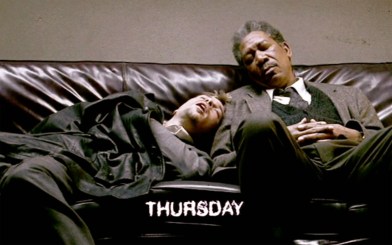 Yet 1995 was not simply a year of corporate indulgence; it was also a period where the rampant nihilist streak inherent to much of the cinema of the late ’90s and the 2000s and still running wild today came to fruition in the eyes of one music video director…
 Goldeneye
 Paul Verhoeven doesn’t know the meaning of the word nuance, and Robocop provides at least the opening arguments for why the world is a better place for it. Brash and brutal in its own quintessentially ’80s way, Robocop also chomps at the bit to lose itself to the royal flush of political satire that stamps out the dark heart of ’80s consumerist ultra-violence and the evils of capitalism with gusto and flair. Under its sleek, brawny hood lies a personality-surfeit aimed squarely at other ’80s action films. But the film never lowers itself to the tiredness of irony, instead opting for a sort of loving critique of action cinema that plays with its inadequacies and idiocies by exaggerating them and acknowledging that an anti-action film would be a hypocrisy most foul. When Truffaut claimed that any war film that wanted to hate war was dishonest because a war film innately positioned war as a form of excitement, the same could be said to apply to action cinema. Thus, while Robocop gets entangled in its conglomerate mass of neo-fascism and broad-sword crypto-leftism, it’s always glad to exist, always happy to be a film we’re watching, and never per-se anti-action … even if its political message chastising media violence considered along with the fact of its own hyper-violence may not be the most easily reconcilable tension in the film world.
 David Cronenberg has spent the past fifteen or so years milling around with Hollywood credibility and narrowly avoiding losing himself to the ether. He’s too fundamentally personal and fascinating a filmmaker to ever make an out and out boring film, but he sometimes seems like he’s trying. Maps to the Stars probably ought to be more of the same (the anti-Hollywood Hollywood tale is not exactly fertile ground anymore), but Cronenberg has selected Maps to the Stars for letting his hair down. Rather than a burst of Old Hollywood prestige with all the i’s dotted and the t’s dashed in squared-off fashion, he’s given us a burst of New Hollywood trash, a conglomerate of messy fluff and corrosive melancholy that flops around when it should push and throttles forward when it should relax. It’s not sensible, nor is it entirely reasonable. It’s the sort of film you’d expect from a New Hollywood affiliate losing themselves to their personal inhibitions at the expense of rhyme or reason, or an unformed young gun with ambition and passion to spare (neither of whom are Cronenberg). Either way, it’s not the work of a classically refined filmmaker. In fact, it’s much better.
  As a film reviewer, one gets used to films with pleasing content undone by a sense of form that just fails to measure up, but the opposite is much rarer and perhaps more depressing occasion: a genuinely decent film were it not so misguided. And misguided Kingsman: The Secret Service certainly is. Honestly, its quite difficult to make heads or tails of, but the problems, I suspect are shockingly similar to director Matthew Vaughn’s previous film Kick-Ass, although worse here for this film’s greater ambitions. Kick-Ass sought to critique the superhero individualist myth, or at least it purported to do so, but mostly ended up falling head over heels with what it sought to subvert (no wonder Vaughn was soon after hired to direct the relatively straightforward X-Men: First Class on the grounds that he had directed a superhero film and a ’60s style crime film and not placed at the back end of the pile for destroying the superhero myth from the ground-up). Truffaut once said that one cannot make an anti-war film because depicting war on film is an innately exciting act that cannot critique itself. A bold point, but not an incorrect one, and not one that only applies to war films.
 This being the second of two new reviews of 1926 films for the National Cinemas month on German Cinema (replacing a much longer essay I had planned to finish the month off with, but since it has been many months since September now I decided to formally use that essay for another purpose and not align it with the National Cinemas project, which I can now put to rest).
  This being the first of two new reviews of 1926 films for the National Cinemas month on German Cinema (replacing a much longer essay I had planned to finish the month off with, but since it has been many months since September now I decided to formally use that essay for another purpose and not align it with the National Cinemas project, which I can now put to rest).
