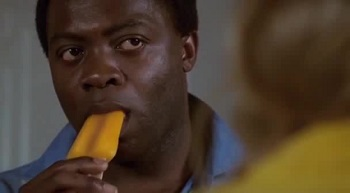
Larry Cohen is one of the great cinematic provocateurs, but Bone is one of his few films worthy of being considered genuinely troubling. Cohen’s films are intrepidly amusing and almost always mischievous with their grasp of truth, but Bone, his debut, tilts normality in a subtler, and ultimately, more forceful manner. In the image of married couple Bill (Andrew Duggan) and Bernadette (Joyce Van Patten) lounging outside by their pool, Bone frames a horridly bland image of bourgeois suburban domesticity. In the image of Yaphet Kotto (Bone) appearing out of nowhere, dressed like an escaped criminal and ready to move to a decidedly more banal prison. Lasciviously grabbing a rat out of the pool, he impishly winks “you wanna touch it.” The sexual joke is funny, but Kotto’s wryly menacing eyes and shit-eating grin makes it truly uncomfortable in a way that, say, The Stuff simply isn’t, even when the characters are exploding into morasses of liquid sludge. Cohen’s screenplay is working at a higher level than The Stuff because it goes lower, right into modernity’s cloaca.
“Is there anything I can do for you all?,” Bone asks with playful gruesomeness that exposes him as a hilarious perversion of the “magical Negro” stereotype, the black man as cosmic force who intrudes on the normal order of things in order to reveal the middlebrow monotonies and manicured calculations of their bourgeois lives. Rather than salvation, though, the titular Bone offers destruction. He comes not to absolve them of their existence, but to corrode the strictures of their being, to filter their sanity through a prism of psychological erosion. He’s the existential specter they need, a cinematic wraith who emerges, as if out of the liminal undulations of a cinema of the id, the infested impurity of their pool itself, to clarify their fears and catalyze their anxieties. When Bill walks through the city on a mission from Bone, he passes a sign that says “new adult theatre open.” You said it, buddy.
When Bone intrudes on their thin patina of domesticity, it doesn’t take long for him to expose the clutter of their identities. He walks in and self-amusedly comments on the fact that they took out a “third on their house” to pay for their standard of living, that Bill forged Bernadette’s name, that he borrowed on his life insurance to keep his surface-bound illusion running. With the idiom of the silent majority, and its law and order politics, in full bloom by 1972, Bone ultimately decides that the most menacing thing he can do is to leave them to their façade of pleasure, to expose the niceties of their life as a special ring of hell they’ve already assented to. “I was thinking of raping her,” he wryly remarks as he ties them up, “but you got trouble enough.” For Bernadette’s part, she remarks not that she doesn’t want to be tied up but that “I will not be tied to him,” referring to her husband.
Bone is an unsettling force, all the more so because he, himself, allows himself to be unsettled. He is a decidedly cinematic creation, a self-aware construct of a fictional gaze who becomes increasingly attentive to his own constructed status and the ideological prison that contains him. He is created out of their need for an enlivening threat to their lives, someone, or something, to shock them in an idiom that fulfills their established stereotypes for who, or what, ought to be a threat to them. Over time, however, he scratches at the gaze that constructs him. Reckoning with the presence of Sidney Poitier in film land and the newly resurgent specter of respectability politics in late ‘60s race cinema, he remarks “Now they’re treating us like people, you can see what kind of position that puts a rapist like me in.” When he claims “I had it made, then they changed it,” the ghostly camera hovers toward Kotto, nearly breaking up his face into particles of raw cinema while he acts like a theater actor lost in a superficially naturalistic ‘70s film, an artificial type reckoning with the fact that he’s found himself in an apparently more “realistic” and enlightened world, only to realize that it too is just another fabricated space. He’s a fugitive fragment trying to escape the cinematic imagination that conjured him, a termite in an elephant cinema world.
Parts of Bone do feel like theater more than cinema – it enfleshes icons in an enclosed proscenium of the soul – but this is live-wire stuff, a migratory and undetermined text that waylays itself in order to regroup itself, re-armoring itself in its very decentered-ness. When Bone tries to destroy Bernadette – to rape her – and she gives in, it is revealed that he can’t perform sexually without enacting the demonic ideal type foisted upon him. He needs to fulfill his image as a violent Black criminal in order to find any pleasure in his apparent freedom. Bernadette tries to teach him to love without violence, and she also notes that “white men have the same problem.” Suggesting that his violence is publicly framed as racial but is, in fact, a masculine script of power and possession, she can only imagine Bill taking Bone’s place all too well. She imagines Bill on the news, selling her death-by-rape-by-black-beast to a reporter like one of his cars, his demeanor as polished and marketable as one of his products.
When her imagined fantasy collapses, Bone’s face is refracted in their in-house aquarium, a strange, claustrophobic echo of The Graduate. In returning Bone to the watery cinematic image that conjured him, the film also develops a grotesque parody of Bill and Bernadette’s middlebrow desire to get “back to nature,” to entrap him as nature, a dream which achieves its apotheosis in their need for Bone to serve as a primal force to disorient them. Just the year before Bone, Sam Peckinpah’s Straw Dogs skewered the fragility of liberal masculinity via the intrusion of violence into domestic space. Bone is more mischievous. This isn’t about the carefully calibrated façade of civilization fracturing into primal vengeance. Here, one can’t even locate a stability to displace. Much as the characters try to hold things in place, Bone quietly reveals the fluctuating legibility of their idioms, the way every image is actually filtered through the prism of each others’ perception, the micro-adjustments of a modern life that inscribe themselves into us. It demands we attend to our capacity to be responsive to the humanity beneath capitalism’s tabulation of our lives, to our fragile ability to realize the way we are carved by archetypes not entirely of our choosing, corralled into relations of debt both economic and psychological.
This is a wily and ferocious coyote of a film about WASP neurosis, the polar opposite, but also the negative other, of the imposing obelisk of 1972 cinema, Francis Ford Coppola’s The Godfather, an austere monolith about tensions between old world enclaves and a desacralized American capitalism. I might also add that it might be the more personal film: a torrent of unreconciled energies, a kaleidoscope of self-immolating itinerancy, rather than a masterfully composed, decidedly wrought urn. If Godfather is about the collapse of a dream of reconciling aspiration and homeostasis, Bone suggests the delusion of finding home in a mangler.
But both Bone and Bernadette seem, by the end of the film, to get out, to carve out a responsive region of mutual potential between the two of them, a kind of deterritorialized space of endless possibility. Retreating to an open field of a desert by a protean sea, Bone finally stokes her to fulfill her inner frustrations and kill her husband, to break free from her bourgeois stupor. Rather than commiserating with her, however, Bone evaporates into the desert, revealing himself as a modern mirage, a vision of desire as implosive as the apocalyptic violence consuming the finale of Antonioni’s Zabriskie Point a few years before. Left alone, Bernadette attempts to reassemble herself in a conventional idiom, to gird herself by reappropriating conventional narratives of how “the black man” killed her husband. Collapsing into a cascade of scripts, she reveals the internal confusion of these repertories as they displace her story into multiple registers that, while all loosely racist, don’t cohere with each other. Her own desire to recollect her humanity via infusing it with a shock of difference has ultimately broken her more than she could have imagined, fragmenting her between different stereotypical narratives of black violence that expose the emptiness of their core. She sits in a space of the mind rendered ajar, the film imploding into a black hole of bourgeois psychosis. Rendered as an automaton mechanically repeating various stereotypes inscribed onto her, she becomes a catatonic mouthpiece for the versions of Bone she had stored within her. What initially seemed like cinema’s dream of transcending itself, of finding renewed life via the strange and the unexpected, has revealed itself as nothing less than a cinematic death-drive.
Score: 10/10

