
Updated late 2018: Still one of the peaks of modernist cinema. Modernist not only because it feverishly critiques the ideological gaps in Western society’s desire for connection to a particular trauma Europe wishes to frame as universal, as an experience Europe can “have” as immediately as Japan. But also modernist because Resnais preserves some imaginative connection, some space of shared potentiality and togetherness between the two symbolically-freighted but humanly-complex protagonists amidst the pock-marks of race, gender, and distance which are not simply counter-cultures of modernity but its various currents. A truly wonderful depiction of Europe losing its colonies and experiencing a crisis of self under the deluded belief that the rest of the world was ever truly under its moral purview rather than merely its circumstantial jurisdiction, that the non-Western world was the West’s possession to experience. Resnais imagines participation in an other’s trauma as a liberal aporia, an oscillating bridge, and a perceptual torrent.
Original Review:
How does one deal with the film that outed the single most seismic and volcanic cinematic shake-up in the entire history of the medium, the French New Wave? As much as Godard would become the face of the movement one year later, Alain Resnais’ Hiroshima mon Amour was, for many, the first breath of renewed light into the no man’s land of the once-proud French cinematic landscape. It was a film of many firsts. Of course, most obviously, it was the first Western film to seriously grapple with the horrors, both tangible and intangible, of the atomic bombing of Hiroshima. But its most important first was much more elemental and, arguably, circumstantial: it was the first movie of what would become the New Wave to devour the international box office, and the first to turn eyes France’s way for the first time in a handful of decades. Continue reading →

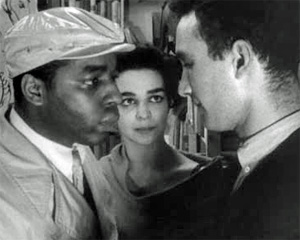 The unbecoming style of John Cassevetes’ devoutly rough-hewn social renegade Shadows belies its grandfatherly status as the giant upon which American independent cinema stands to this day. As freewheeling and robust as the film is, and as fringe-worthy as its style might seem, it’s perhaps ironic that the film has established its own tradition of dissonance and reckless anti-cinema in the hearts and minds of American beats and would-be enfant terribles for over fifty years past its initial release. Temptation begs to reduce it to has-been status, as if the film’s meaning was lost in its release and time has deluded its tempestuous critique of social norms and filmic image construction, as though its status as the head of a new order diminishes its rejection of the old order. Continue reading
  Releasing films at a mile-a-minute in the ’70s, Robert Altman was more aged than his New Hollywood contemporaries, but certainly no less rambunctious. If anything, his age only fulfilled a craving desire to destabilize the industry even further, a goal Altman set about predominantly, although not exclusively, by inverting the classical Hollywood genres of his youth. His best film, McCabe and Mrs. Miller, is a lyrical, impressionistic Western stripped of individualism that relies on dream imagery, like many Westerns, but not to reiterate the American Dream, as so many Westerns of the past had done. Instead, Altman interrogates a counter-myth where opium-caked red dreams are necessarily, and often falsely, clouded refuges from the cold blue expanse of an outside realm that humans never really conquered, but simply hid from. His next genre deconstruction was something of a follow-up, but one that met with a much different fate. While people who didn’t fully understand McCabe still fell in love with its poetry, 1973’s The Long Goodbye, a noir grabbed by the neck and set down in a time period antithetical to itself, only produced befuddlement when it didn’t instigate outright hatred.
  In comparison to Jean Renoir’s The Grand Illusion, only one film in all the annals of cinema evinces a more thoroughgoing and vividly cinematic perspective on the role of public artifice and presentation in everyday life: The Rules of the Game, the film Renoir directed only two years afterward. Although this earlier film does not quite boast the dexterous, unkempt camera vivacity of The Rules of the Game, nor does it apply that camera so singularly to dissect the “on-stage” and “off-stage” realms of human life, The Grand Illusion remains one of the most enormously well-threaded cinematic experiences nonetheless, as well as one of the most desperately humanistic.
  Robert Bresson’s second film, A Man Escaped, begins with a prelude of ruthless, unimpeachable clarity as totalizing and blunt as the film’s title. A man, Fontaine (Francois Leterrier), is trapped in a car, the camera perilously perched at the level of his hands, which threaten to open the door of the vehicle. We pan left to his fellow trapped compatriot, presumably another member of the French Resistance to be sent, like Fontaine, to a Nazi prison. We cut to Fontaine’s view of the front of car, dissected by two Nazis in the front seats claustrophobically denouncing Fontaine’s view to freedom. The door opens and Fontaine runs, but the camera stays trapped on the prisoner next to him, sullen and stagnant and aware that escape is futile. Fontaine is denied agency, rendered passive by a camera that refuses to follow him toward escape. When he arrives at the prison, Fontaine will be sequestered into angular frames, torn to bits by characters who pass in between him and us, secluding him in the frame and denying his supremacy as a character. His face will be forever denied to us by a camera that moves not with him as a friend but against him, around him, as an agent of destruction.
 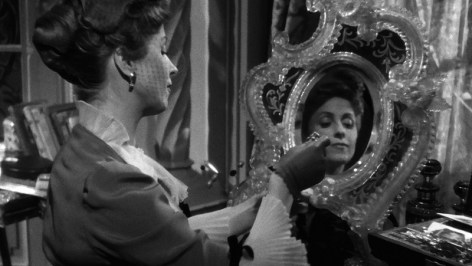 Max Ophuls’ luxuriantly mordant elegy The Earrings of Madame de … is, above all, a deeply generous film to its audience. Admittedly, it’s something scathing screenplay might suggest otherwise, and some of the most carnivorously self-devouring mise en scene in the entire history of cinema adds insult to injury for an audience expecting the formal niceties of realism. But Ophuls’ film, as deliriously dense as it is, doesn’t ask us to guess. Ophuls was a fervent maximalist of an auteur, gripping the screen in his haughty, hyperbolic hand and refusing to let go, but he was not vicious to his audience. His 1953 film is a formal masterpiece of gleeful clockwork where every slice of the cinema, every ounce of the frame, is carefully calibrated and painstakingly repurposed for the audience to dance with, but he lets us have his purpose in a handbasket right from the opening scene.
  Perhaps no canonical director rambunctiously, even violently, defies reputation and expectation like the young German enfant terrible Rainer Werner Fassbinder. Welles was the cocksure bon vivant who saw to it that Hollywood would crawl back to the primordial expressionism it stewed forth from. Tarkovsky was the impressionist shaman of grand cinematic spirituals. Dreyer the hallucinatory chronicler of personal spaces invaded and regained. Kubrick the possibly psychotic, probably anti-human mad scientist and arch-stylist. Kurosawa was a swaggering painter, Ozu gently serenaded the world into his dioramas of the soul, Mizoguchi bonded himself to ethereal, ghostly portals into the hazy nether realms of the human experience. Even Godard famously resorted to generalizations: There was theater (Griffith), poetry (Murnau), painting (Rossellini), dance (Eisenstein), music (Renoir). Henceforth there is cinema. And the cinema is Nicholas Ray”, a bold declaration and a line in the sand for the B-movie bravado of the French New Wave. And if you criticize him for his over-simplications, you can’t but tacitly endorse a couple of them.
  John Ford did more to invent the modern Western – and arguably the American dream that streamed through it – than any other film director, and he probably did more to test and warp that dream than anyone else as well. If he has any competition, however, it must be Anthony Mann, a director who knew beauty and pregnant pauses of weathered visual memory as well as Ford. However, he was also a director of profoundly small ego, never one to indulge in the opulence and gilded glory of Ford at his most boundless and operatic. Mann used color cinematography with appreciation for how its incomplete translation to full-blooming color could enhance cinema as much as bubbling, bursting color might. In Man of the West, color is not passionate; it is exhausted.
  Since all New Wave films were, directly or indirectly, fascinated with filmmaking, it isn’t exactly a surprise that one small slice of celluloid would eventually literalize this subtext. And since most New Wave filmmakers both loved and doubted cinema all at once, it isn’t exactly a surprise that the resulting film would be Day for Night, Francois Truffaut’s semi-poisoned pen love letter to the joy of making cinema. It might be assumed that the joy of cinema follows, but that is not part and parcel with Truffaut’s vision. In Day for Night, cinema production is a circus, but the film that results is a wash. Day for Night is not an ode to the finished product, the destination, but to the production, the journey. In an oddly humanizing bit of self-love, Truffaut paints a director as an enthusiast more than a madman. He doesn’t care if the figure has talent or not. The fact that they want to be making movies is enough.
  After transcribing his childhood into one of the finest character studies in all of cinema, Francois Truffaut took a cue from his sometimes friend, often enemy for his second feature. He went Godard, in other words, and like his relationship with that most temperamental of filmmakers, Shoot the Piano Player is cinema with both hot flashes and cold skin. In 1960, before the French New Wave was nothing more than a passing whisper in the international film crowd, Shoot the Piano Player managed to prelude and predict all the proclivities, both passing and permanent, of the trend. Fittingly, and without surprise, it is as buoyantly vivaciousness and infected with cinematic self-love as even Godard’s Band of Outsiders and yet as chilly and formally provocative as Godard’s Breathless (in a rare feat of simultaneous humility and egomania from Godard, that film’s name tells all).
