 Son of Saul
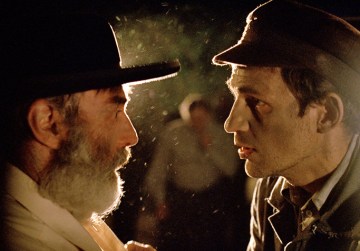
László Nemes’ Son of Saul is above all a treatise on cinematic minimalism, eschewing visual resplendence only as a way to belie how carefully modulated its visual command of its subject truly is. Tethering its audience to the face of main actor Géza Röhrig not as an anti-formalist gesture but as a haunting lament toward the unclassifiable nature of trauma, Son of Saul surreptitiously removes event to its periphery as a way to reveal that which can’t be formally, objectively understood through any direct visual gesture. It is perhaps the film to most dexterously utilize the corporeal weight of the Holocaust as a case-study for the tangled spindles of memory and cinematic representation since Alain Resnais’ seminal Holocaust feature Night and Fog. In comparison to, say, Schindler’s List, Son of Saul defies any mass-scale anthropological interpretation as fundamentally incomplete. Even more than The Pianist, Nemes’ film recalibrates the Holocaust film so that any attempt to formally order it within a cinema frame – innately containing it and subjecting it to a sort of classifiable definition – is a whiff of historical wishful thinking. Continue reading
 Cosmopolis
 Sleeping Beauty
 Oldboy
 A decidedly outre expression of childhood trauma, Pan’s Labyrinth is a wartime fantasy from the deranged, consequence-ridden non-American realm of classical fables filtered through the oblong mind of one of modern cinema’s great dreamers. A bifurcated (unnecessarily, I might add) tale of adult conflict and childhood coping set against the Spanish front during WWII (when Franco’s repressive government was fighting ragged rebels), the most poignant gestures of director Guillermo del Toro’s vision are his most voluptuous and baroquely nightmarish.
  One must undeniably validate the valor and reflexivity of one of the few cinematic treatments of the Holocaust by an honest-to-god Holocaust survivor, but a good critic must also remember that bravery doesn’t inherently beget beauty. Director Roman Polanski’s troubled, torrid life aside, The Pianist – if a masterpiece – ought to withstand the test of time on its own merits, rather than on the shoulder’s of Polanski’s personal story, difficult though it may be to disentangle the two. No one film should be a sycophant to its back-story, fascinating though the behind-the-scenes realities of The Pianist may be.
  The cabal of proponents for Martin Scorsese’s most recent Goodfellas retread, The Wolf of Wall Street, dance around the central garrulousness of the film with superficially enticing claims that its engorged, laborious pomposity is tantamount to a claim against head honcho Jordan Belfort and his trying brand of indulgent charisma and hedonistic living. The claim doesn’t hold much water, although Scorsese’s intention may have been to pummel us with the initial sweat glands of living for the moment until our body’s capacity for perspiring freezes over in the thickets of hedonism. It may have been Scorsese’s vision, I might add, because that is exactly what he accomplished many years before with his tempest-as-torpor Goodfellas, a film where every kaleidoscopic camera track and exotic edit attunes us to the characters’ struggles to methamphetamine their lives straight into the hollow caves of an early grave. Over three hours, continual fluxion begets a grave chill as expending energy gives way to perpetual enervation.
  Legend would have it that, after decades of wallowing in admittedly pleasurable crypto-conservative roles, America’s resident taciturn brute Clint Eastwood shocked the world in 1992 with an unprecedented critique of the craven, callous dueling violences at the core of the American tradition. But masterpiece though it may be, Unforgiven was hardly unprecedented to those who were looking. Eastwood’s prior directorial efforts in the genre that made him a household name had flourished nearly two decades beforehand with only his second feature, the unfinished but highly spirited (the spirit being an angel of death in this case) High Plains Drifter, a counter-myth that saw in the Wild West something more akin to an Italian giallo. More fully formed was the sublime The Outlaw Josey Wales, an often misread work of mythic Western nihilism so full-throated in its interrogation of Western archetypes that no one seems to understand it to this day.
  An uncompromising chemical reaction between Ozu-esque balance, ghostly Mizugochian afterglow, and the tremors of Kaneto Shindo’s mid-’60s horror social disturbances, Shohei Imamura’s 1989 release Black Rain revises cinematic assumptions about trauma away from fiery holocaust to a more hauntingly ashen storm hovering overhead for the duration of life itself. Hiroshima isn’t a Godzilla-like destructive catalyst in Black Rain, but a distantly raging existential void within which one’s sense of being and becoming are threatened completely. The world is not only out for vengeance, but it becomes unknowable; time folds in on itself, and your life becomes a separable ghost floating away from you. Not to be confused with the lightweight Ridley Scott film of the same name from the same year, Black Rain envisions catastrophe as a perpetual, everlasting terror. Moments of shock and awe – the in-the-flesh horror of destruction we take to be the prime of the bombing – would be, if anything, a respite from the cold nothingness of life living in the emptiness of the bomb’s wake.
  Mike Leigh’s vision is tantamount to heresy in some circles, redrawing Western motifs away from individualist assertions while also retaining the individual soul in human bodies often upended by a filmmaker like Robert Altman, who sometimes privileges a social determinism in his films. In Leigh, in a quasi-Renoirian way, individuals slide and slip around each other as they construct themselves – and as the camera envisions them – interactively, rather than individually. Individual personalities abound, but the contrasts are defined relatively rather than absolutely. Unlike in most films designed for Westerners weened on figments of Enlightenment liberalism and the ultra-dominance of the individual mind, people are not fixed, asocial beings with stagnant psychologies in Leigh – people become themselves through their interaction with the world, and with others. He saves us from ourselves, cherishing individual difference without cavorting into the deathly realms of tendentious individual supremacy.
