
 And now we’ll take a short look at Dutch madman Paul Verhoeven’s ’90s American pictures, for during the 1990s Verhoeven was one of the few mainstream directors consistently operating at heightened level of mania and adventure in the film world, ever-pursuing and challenging his particular brand of satire until it became almost indistinguishable from truly making the bad movies he was satirizing. Plus I just reviewed Robocop, so it seems like I might as well continue on from there…
Ultimately, Paul Verhoeven’s American films, especially his American action films (always the more sensible and less delirious of his offerings) live and die as much by the strength of their satire as by how well they ape what they are critiquing. Now, Total Recall, his adaptation of Phillip K Dick’s short story “We Can Remember It for You Wholesale”, is a satire of sorts, but not a particularly wide-reaching one. It’s not marinated in quite the same joie de vivre to decimate aspects of the corporate cultural capital excess and disregard for human life prominent in Robocop, but nuggets pop through. The central idea is a joke at the expense of modern American society, largely that they would rather live an imagined reality than genuine affection, adventure, or meaning found in everyday reality. And at that, they would prefer not to find real pleasure but to purchase false ones through a company, to purchase “memories” of events through a corporation rather than to actually experience them, thus turning joy and memory into corporate products. This is heightened material for an action film, especially one in 1990, and if Verhoeven explores this theme less than he would explore his themes in his preceding and subsequent American films, it is admirable that he tackles it at all. Not to mention, as with Robocop, he made a pretty damn fine action film, satire or not, anyway.
Continue reading
 After the rousing financial success of his previous release 12 Monkeys, someone finally saw fit to give Terry Gilliam a small influx of money to release one of his many long-term passion projects hounding him for what sometimes seems like decades. Of course, that didn’t end up happening and to this day still doesn’t seem to have worked out in his favor, but the man needed work, and when the long-dormant adaptation of Hunter S. Thompson’s bananas American nightmare Fear and Loathing in Las Vegas (in production as a film as early as the early ’70s) came his way, and someone actually wanted him to direct something for once, Gilliam couldn’t say no to a chance to have a little fun with a project he never much viewed as a personal commitment. Maybe it was letting his hair down a little, but what better way to let your hair down than with a drug-infused trip to Las Vegas with Johnny Depp, Benicio del Toro, and one of the great cult icons of American fiction?
  Formally an adaptation of what may be the greatest short film ever released, Chris Marker’s New Wave classic La Jetee, 12 Monkeys is another world entirely. This is not, as one might expect, a commercialized bastard son of Jetee’s postmodern commentary on storytelling and film as an art form. It is a more commercial beast, but not commercial Jetee. It is instead commercial Gilliam, very much retaining this particular director’s trenchant exploration of genre fiction, modern anomie, and social lies filtered through nasty dark-water corporate beasts not operating behind closed doors because there are no longer doors to close and hide behind. It’s sharp and prescient, well-directed and with a realist streak seen never before or since in Gilliam’s catalogue, but the film wisely never becomes “of realism”. 12 Monkeys is nothing breathtaking, and it lacks the elegant hellishness of some of its directors more conflicted and subversive films, but his decade and a half of ferocious commitment to personal vision, and three of the few legitimately great films of the 1980s, deserve a present. Gilliam always had trouble finding commercial success, and if conforming slightly to the norms of mainstream entertainment for the sake of a greater paycheck and commercial appeal is his present, who are we to deny him?
 The 1980s were, with all due respect, the worst time in history for cinematic drama. Cinema as a whole trucked along on a surfeit of fantasy and science fiction films that primarily operated on cruise control but could stumble upon a certain breezy ingenuity when need be. But cinematic art – cinema that sought to say something about cinema and/or explore the art form in a way that doubled as a commentary on the society that would use cinema as a tool of creation and destruction – was at an all-time low. It is telling that what many consider the great American drama of the 1980s (Raging Bull is the only film as consistently revered and awarded, and that was really more of a ’70s film that forget to come out in its proper decade anyway) is most famous for the fact that it was almost never released.
 If we are being honest, Ridley Scott is not a director worthy of his reputation. His 1970s were certainly pretty sterling; he entered the world with a very good, if inessential, period-piece parable in the under-seen The Duellists, and then down-tuned sci-fi to elemental levels of fear with the masterful Alien, one of the greatest genre films ever made. Not wanting to be type-cast at the turn of the ’80s, he upped himself through transposing his native science fiction into another genre, not quite as openly horrific, but with no less to say about humanity’s fears: the noir. The resulting film, Blade Runner, is his masterpiece. The ensuing three decades and more have seen him shoot sloppily back and forth between chasing former glories unsuccessfully and entering the bold, exciting new territory of … stripping the cinematic magic whole cloth from the period piece and turning the genre into a drab excuse for materialist rationalism. Again. And again. And again.
 With no new long-term features hoping about The Long Take for the time being, I’ve decided to do a few short features on directors of my choice. Each should take about a week, focusing on some of their more notable films and trying perhaps to capture their essence as a director. These will mostly tackle directors I haven’t much explored yet, and will probably take on directors with a sort of noticeable aesthetic or sense about them so that their films achieve a cohesive singularity while still retaining individual wrinkles. For my first feature, I’ve decided to look back through the cinematic works of Terry Gilliam, who I think we all can agree is one of the most unique directors of the past several decades to say the least. Enjoy!
 For the ’90s were also a great decade of personality-heavy American independent directors finding themselves awash in a Hollywood positively chomping at the bit to ingest them and feed their every whim. Sometimes, and only sometimes, the results are inarguable…
 But 1995 was not merely a year for corporate excess and nihilism crawling out from the woodworks; it was also a year of magic and wonder, and a childlike work of supreme, effervescent joy the likes of which cinema had long forgotten…
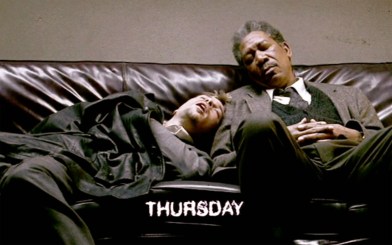 Yet 1995 was not simply a year of corporate indulgence; it was also a period where the rampant nihilist streak inherent to much of the cinema of the late ’90s and the 2000s and still running wild today came to fruition in the eyes of one music video director…
 Goldeneye
