The Ballad of Cable Hogue opens with a hilariously deflationary inversion of the famous opening to director Sam Peckinpah’s previous film, The Wild Bunch. While that scabrous cosmic moan of a film famously begins with children maliciously treating nature’s brutality as entertainment, Cable Hogue saunters into a gentle, quiet conversation between a man and a lizard, coaxing it into a humane death that affirms their mutual value on this earth. The animal is to be food, certainly, and this is a no less brutal version of survival, but Peckinpah plays it not as a wicked triumph of nihilistic glee but an unfortunate reality of interspecies relations. The man is Cable Hogue (Jason Robards), and this is his compassionate desert pragmatism. Just as he is about to quietly kill the animal in an act of poetic, tragic necessity, a gunshot blows the lizard into pieces as bloodied as they are useless. When Hogue ponders the value of such an action, he seems to be proposing a counter-narrative to Sam Peckinpah’s whole oeuvre. This sort of murderous brutality is, the film suggests, just a tad bit gauche when all is said and done.
Hogue himself is a mystifying creature. His lizard conversation is a kind of cosmic communion, a natural respect for the sacrifice the lizard is making for his survival, and he continues the film with a similarly good-natured penitence to nature’s cosmic continuity. Talking to God, Hogue self-amusedly but very seriously notes “ain’t had any water since yesterday Lord, getting a little thirsty, just thought I’d mention it, amen,” not solemnly offering a prayer but suggesting a casual reminder to an old friend. He speaks in a spirit of warm-hearted minimalism, a kind of spartan humanism embodied in every moment of Peckinpah’s tough-minded but unexpectedly generous film. Hogue even gets his own credits sequence, a ballad-backed constellation of moving and stilled images that uses the similarly stop-start rhythms of The Wild Bunch to an antithetical purpose. While The Wild Bunch viciously metallizes and bleaches-out its Western archetypes, cutting into their motion, deconstructing it, and revealing the acid emptiness beneath, Cable Hogue playfully ricochets many simultaneous images of Hogue around the screen, serio-comically elevating his everyday trials and tribulations. The former is an image of heroes exposed as fraudulent brutes. The latter is an everyday man uplifted as an accidental poet of humanity. He has no pretensions to greatness, but the film treats his mundane ethos of workaday survival and epicurean pleasure as an undyingly human spirit of ramshackle beauty.
In its surprising, almost disarming generosity, The Ballad of Cable Hogue proposes a quiet rebuke to both the classical Western’s ethos of moral certainty and mythological majesty and the revisionist Western’s spirit of recalcitrant brutality and skeptical deconstruction. Both Hogue, unusually for Peckinpah, both are merely two sides of the same coin, seeking refuge in revelation of essential truths and the promise of moral certainty. Hogue neither celebrates nor excoriates but takes the arguably more difficult, less self-congratulatory perspective that the West cannot be summed up as any one thing. The film is an act of divine perplexity, a film that treats curiosity itself as a worthwhile mode of being. Much like Hogue himself, his titular film doesn’t seem to know where it’s going, and it finds pleasure it whatever comes its way.
It is the very fogginess of this vision that paradoxically casts such an unusually clear eye on the shadow of the West in the American imagination. The Ballad of Cable Hogue is set in 1905, twelve years after historian Frederick Jackson Turner lamented the demise of the American frontier. In his view, the land was a natural deposit at once energized and empty, pregnant with great potential and yet essentially available for human manipulation. This paradoxical vision of a landscape that was complex and value-laden yet essentially docile projected a canvas teeming with human futures, raw matter for fashioning new selves.
By Hogue’s release year of 1970, the ambivalence Turner felt was largely seen as passé. American media had mostly come to accept writer D. H. Lawrence’s view that “The essential American soul is hard, isolate, stoic, and a killer. It has never yet melted.” If men and women of the 19th century “lit out” for the territories, the revisionist Western line has typically been to expose the violence of this vision, to look to the shadows cast by America’s divine pretensions of Manifest Destiny. Responding to view of the West as a sublime potential of inert matter awaiting human mastery that not only invited but demanded “strenuous” activity, to use Theodore Roosevelt’s term, the newer, tougher breed of American cinema revealed the cruelty masking as energy and exposed the mental enervation dressed up as physical vigor.
Peckinpah’s films certainly participated. They cut down Western mythologies by the dozens, sparing no one in the process. But Hogue suggests that this tactic may risk reiterating the very “hard, isolate, stoic” soul it strives to unmask. After all, if Americans were supposed to be paradigmatically touch, taciturn, and realistic, what could embody that ethos more than revealing the grubby underbelly of the nation’s fantasies of idealism and grace?
It is thus ironic how un-ironic Hogue is. The plot, such as it is one, begins when Hogue finds water underground and sets up a desert spring. On the verge of dying, he digs in the dirt for water that is, essentially, mud. In any other Peckinpah film, this would be a self-consciously grotesque gesture, a cold-blooded reminder of the fundamental depravity of the human will. Here it’s a conversational engagement, a friendly opening-up to uncertainty and circumstance that is not quite a determined plea for survival. Asking “Lord … you call it” as he smiles, he receives the muddy water as both manna from Heaven and, simply, the vagaries of chance. His face drenched in muddy water in the ground, he coarsely laughs with a quietly boastful “Told You I was Gonna Live.” But his self-aggrandizement is humanistic, rooted in shared equality rather than hierarchized distinction. He is not an apex of humanity but a singularity of it, a fabled hero who embodies its foibles and frustrations and a stubborn determination that borders on grace. When he tries to get a deed to build a spring out of the water for parched passers-by, he can only gather a measly two and a half dollars. When asked if he has anything else to add to the value, he marshals, in a line tossed-off like an on-the-spot improvisation and a channeling of almost celestial wisdom, “Well, I’m worth something, ain’t I?”
Uncharacteristically, Peckinpah’s film believes he genuinely is. Or, perhaps, it might be more accurate to say that the film is interested in the proposition that he might be. This is an unusually generous portrait of human existence for Peckinpah, one in which a series of mostly well-meaning characters struggle to etch out their lives. It is also, atypically, not really asking much of these characters, other than that they exist, and keep going. What emerges is a kind of bildungsroman of an already formed man, a wanderer who never exactly learns anything, but always seems to be paying attention to new truths that might arise if he looks hard enough. Robards is wonderful, a prickly, protective man who confronts the world as an earthen poem. Speaking in simple, taciturn sentences – “I got to mark my boundaries, build me a claim monument.” – he nonetheless radiates humane warmth, celebrating, and embodying, a poesis of raw dirt.
And, indeed, a man willing to get his hands dirty, even though he is unusually hesitant to do so compared to the men he is confronted with. Throughout the film, he has been involved in a many-years-long engagement with two men who he, theoretically, seeks revenge on, not that he is trying especially hard. Near the end of the film, they inconvenience him again by putting him in a situation where he finds his gun uncomfortably necessary. The color of his soul, and the caliber of the Old West, seems to be on trial here. Just as he is about to shoot the man, however, a “horseless carriage” – car – arrives. The man on the bad end of the gun treats this beacon of modernity as his manna from heaven, but while the car momentarily stops the film’s climax, it just keeps on going. Laughing at the two men and their simultaneously monumental and pyrrhic conflict, this modernity treats the Old West and its elemental drama as a roadside attraction to mock rather than an enigma to wrestle with. In his cunning, curt demeanor, Hogue looks on just as bemusedly, remarking “that’ll be for the next guy to deal with” as he makes sure to set up his would-be victim with a fate worse than death: taking over his spring, sitting in wait for modernity to come to him while Cable can go live a new life as a perennial traveler on the road. The car, a dark emblem of an uncaring modernity, catalyzes a kind of epiphany for him, suggesting the pettiness of their grievances, even as it implies the littleness of the life of those moderns in the car, and the beauty and terror of Hogue’s.
Of course, Peckinpah’s point is that Hogue was probably always going to save the man on the other end of his gun, working to end a years-long retribution arc on the path to a more wholesome and full-hearted existence. The film, in the very nature of its ambulatory and discursive narrative structure, acknowledges this revenge is much less important than the characters make it out to be, more a pest than a pestilence. What really matters is the fact of the spring, the feel of the water, the sense of the space, and the time shared with local prostitute Hildy (Stella Stevens), who becomes a kind of displaced love interest who comes and goes, and itinerant preacher Joshua (David Warner), who has more interest in women than anything else but does not seem to oppose this to a genuine faith in the lord.
It is this spirit, Hogue’s welcoming ethos of taking life as it comes, not getting too wrapped up in pretensions of divinity or significance, that matters to a film that encroaches on a sense of grace that feels truly Thoreauvian in its willingness to appreciate the renewed physical and mental sensation of engaged receptivity with the earth around you. Of course, Peckinpah also mocks this deflationary ethos as itself a kind of American fetish for rugged, simple living. At one point, a preacher laments “The Devil seeks to destroy you, with machines,” for “inventions are the work of Satan,” and the film doesn’t exactly treat this rhetoric as a generous sensibility. The film doesn’t really agree with the man, but it understands Hogue’s adjacent version of it as a kind of everyday pragmatism that is also, essentially, mythical. That’s pretty American, admittedly, and The Ballad of Cable Hogue mostly appreciates the peculiar mixture of circumstance and effort that defines the belief in Western possibility that Peckinpah’s earlier The Wild Bunch so brutally excoriates and sets ablaze. It’s an aspirational ethos, but Hogue is not a celebratory or worshipful film so much as an intrigued one, a film that looks for beauty in unsuspecting places, even those that we have grown to dismiss. The film taps the Western landscape in the same exploratory spirit Hogue does when he sums up how he discovered and cultivated his water supply: “I found it where it wasn’t.”
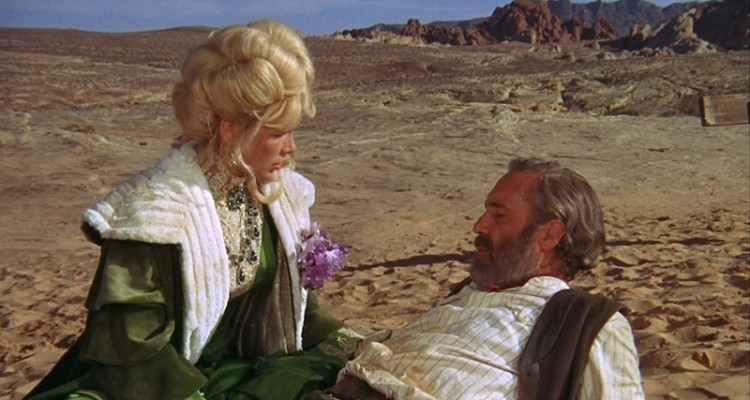
When he chooses to leave his water supply at the end of the film, to become someone else rather than be wedded to his personal property, Hogue recalls naturalist and everyday experimenter Henry David Thoreau’s own eulogy for his time living off the land: “I left the woods for as good a reason as I went there. Perhaps it seemed to me that I had several more lives to live, and could not spare more time for that one. It is remarkable how easily and insensibly we fall into a particular route, and make a beaten track for ourselves.” In a genuinely moving conclusion, Hildy returns, and just as she and Hogue are about to venture into another film, the car she rode in on runs him over. He lays out in bed, to die where he lived, in the desert. The preacher Joshua returns on his own gas-powered vehicle, and, at Hogue’s request to witness his own funeral, he delivers a meditation on the passing of the West played not as riposte or a lament or a eulogy but as a serio-comic inquiry. In its final moments, the film reflects on itself, on its own acts of self-mythologization. Hogue “came stumbling out of the wilderness like the prophets of old,” a figure who was God’s “dim reflection,” a man who might transfigure a spark of divinity but who himself wanders between Heaven and Hell.He might not be a hero, the film supposes, but he “lived and died here in the desert, and I’m sure hell will never be too hot for him.” He was, in the parlance of the Wild West, himself.
But also not himself. He only exists, the film suggests, in America’s bedtime stories about its own past, as a congealed archetype of a nation’s historical inheritance. The spring at the center of the film is an almost comically literal embodiment of the West’s promise of rejuvenation and Biblical redemption, its mantra of personal grit and hardship as the wellspring of a civic religion of self-creating, self-surpassing individualism of the type Hogue himself embodies to an extent that is both self-parodic and entirely sober.
Naturalist John Muir wrote four years prior to this film’s setting of the “Thousands of nerve-shaken, over-civilized people” who were “beginning to find out that going to the mountains is going home; that wildness is a necessity,” bespeaking a desire to conserve not only the land but the spirit that he and Turner both felt was rapidly petering out. In asking men and women to dive back into the water of natural replenishment, they implied not only a physical necessity but a moral imperative, an injunction that was, of course, paradoxical. The West celebrated escaping from civilization and it necessitated “civilizing” the region one escaped to. It worshipped natural primitivism and justified the very technological triumphalism that made the former impossible.
This is to say that “the West,” as an idea, roped together so many horses riding in so many directions and attempted to obfuscate the tensions in these paths through sheer force of will. The relatively easy thing for a film to do would be to dismiss these paradoxes. Hogue tries to inhabit them. Rather than mock or dynamite its genre’s central confusions, Ballad is usually immanent in its critique. Its hero is as pure an archetype of the Western hero as you could imagine, and the film’s most deconstructive maneuver is to expose how contingent and unclarifiable his core really was, how the archetype tenuously congealed around a core that was ultimately molten, able to mean many different things to many different people. It offers an entirely deflationary conclusion about Hogue, but also one that is essentially meaningful in its seeming meaninglessness: “he wasn’t really a good man, he wasn’t a bad man. He was a man.” The point is that the West was always working against itself, and it couldn’t not do that. How to appreciate its ethos of spartan self-making, Hogue’s everyday atmosphere of living on and living through, and to recognize the violence done in its name – to see that its sense of affable humanity was also the engine of impossible suffering and terror – remains the essential question of the most American film genre reckoning with the contradictions of its national past. Hogue’s ability to give a name to the essential in the inessential, to find beauty in the ambulatory and seemingly irrelevant life of one man while also suggesting that he may not really be worth saving anyway, answers that question with another question. How could it do anything else?
Score: 10/10