
A man lurches into frame from the side, and a declamatory text card threatens us with both the immanence of a thoroughly violent stranger and the danger of a thoroughly didactic film. But while the 1953 crime drama The Hitch-Hiker loudly proclaims its message in the first minute, the film as quickly abstracts itself into a slurry of chaotic uncertainty. As if recognizing its own apparent obviousness, The Hitch-Hiker soon descends into a fog of poetic gestalts. Ambling feet wandering down the road. A scream. A flashlight on a car. Two dead bodies, their faces invisible, in a postmortem tableau. Lights like strange forces in the desert, and then a car. We’re told what and how to think and who to watch out for, but director Ida Lupino still finds ways to project the disorientation of the world on the disquiet of the screen. The title freezes over an image of a gun, with the words “the filmmakers present” over it. This is a pistol whip of a film, a raw, steel shot that festers like tetanus.
The Southwestern desert, as many scholars have claimed, lingers in the cultural imaginary as an otherworldly region of the mind, a relatively unclaimed invitation to possibility as well as a brutal crucible where the supposed iron-clad reality of the rule of law is tested and contested, exposed as a harsh, shifting ground beneath presumptuous displays of harmony. The Hitch-Hiker, fully aware of this ambiguity, is a rural noir that doesn’t submerge us in the cloistered chaos of a city but into a netherworld that once feigned as America’s frontier heaven on earth. Beware of wanderers, the film suggests, but the highway road seems to imply that we’re all wanderers in this nebulous world.
Our two wanderers for the day are Roy Collins (Edmond O’Brien) and Gilbert Bowen (Frank Lovejoy), but The Hitch-Hiker frames itself not as a line but a cycle. We’ve already met the results of a previous expedition cut short by Emmett Myers (William Talman), a roadside murderer who ropes the two men into a parade of “a lot of dead heroes back there.” Writer-director Ida Lupino and co-writer Collier Young have already freighted things with a more metaphysical cast, making the film’s ramshackle simplicity a sign of spartan poetry, allowing this minimalist sliver of the two mens’ lives to spread outward into the cosmos. The film’s extradiegetic injunction – that they could be any of us – is cloying and didactic, but watch the film earn its didacticism with its crystalline brutality.
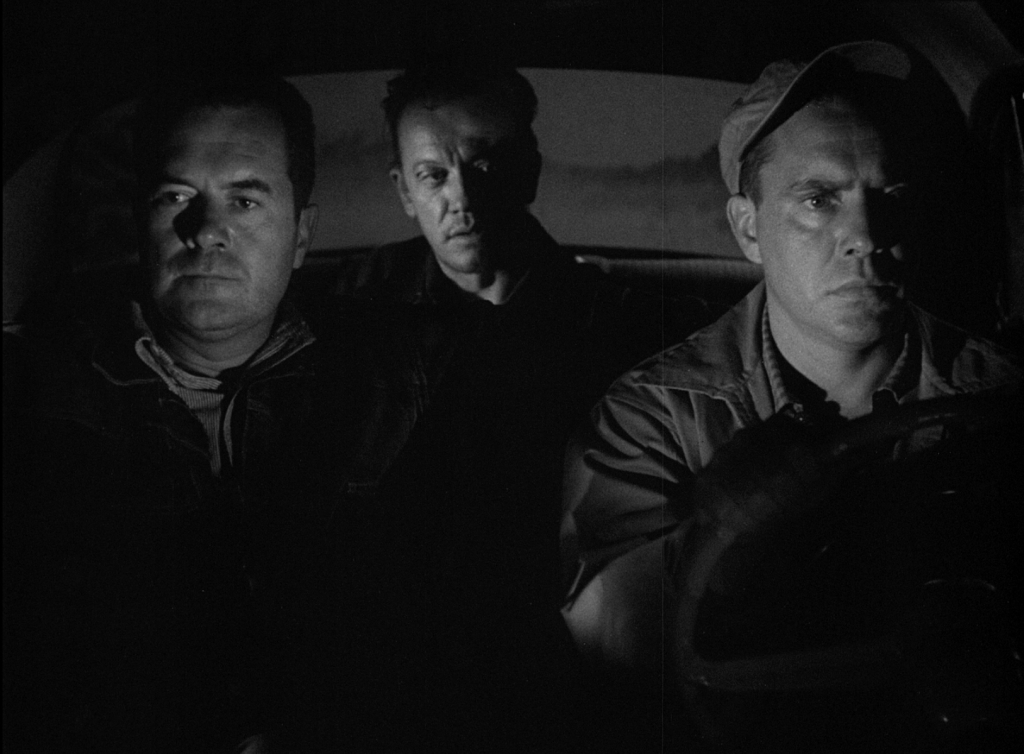
Lupino proves exquisitely adroit at negotiating not only the physicality of the suspense but the shifting, brittle interiorities of the men, as when Emmet forces Roy to shoot a can from his friend’s hand, or when they scream in front of a plane as Lupino looks on pitilessly from above, or when a routine stop to buy food becomes a soul-churning display of personal restraint. In these moments, especially the latter, The Hitch-Hiker turns its set-pieces into occasional intimations – performances – that Collins, Bowen, and Myers could be three testy friends in a violent masculine idiom rather than two friends and a murderer holding them hostage. This starts to seem like a perverse male bonding ritual, a battleground of the soul where men lack any other idiom to prove themselves other than overcoming violent adversity through machismo.
Spatially, Lupino narrows the canvas before blasting it wide open, turning the sublime American expanse into an open-air penitentiary that offers no respite. The desert, captured lustily but also necrotically by cinematographer Nicholas Musuraca in all of its intimidating infinity, becomes a demonic testing ground, a world connected to but apart from the everyday functioning of society. The car, meanwhile, becomes a perverse sort of home, a pressure-cooker that is also, oddly, an intimate refuge from the forlorn expanse of the open road. The sense that this is a space for dreamers and fugitives from reality is given a nasty ironic twist in the way that Emmet’s dim eye, which cannot close, allows him to sleep while still figuratively keeping an eye on his prey, who can never know for sure that he isn’t awake. This strange sort of violence figures the slumbering soul, paradoxically, as a Panopticon watching you, keeping you put even when it can’t really hurt you. The desert, the film suggests, is a time-space where no waking is peaceful, and where no dream is really a path of escape.
The film’s sandpaper dissection of masculinity is at its most provocative when it exposes how easily these positions could all fluctuate, an undercurrent of bone-deep anxiety about the solidity of categories like “good” and “bad” that comes to a head when one of the two “heroes” is forced to adopt Emmet’s guise to confuse the cops. Although the film stops at the precipice of the more unsettling implications of this climax, the film still understands that the moment, ostensibly a threat to Gilbert’s life, is also oddly, subversively empowering for the man who had been brought low by Emmet throughout the film. Now dawning his visage, he seems like he could have been the killer in another film, or if the cosmic lottery had drawn a different number. The Hitch-Hiker turns a lurid, no-nonsense public service announcement into a blistering private account of men adrift in an unstable world, threatened by their own capacity to embody that which externally assaults them. Lupino and Young also recognize, unlike many filmmakers then and now, that none of this has to be boldly underlined when the thinnest of lines is written in blood.
Score: 8/10

