 Two horror masterclasses from 1963 on Midnight Screenings.
Objectivity and subjectivity fraternize and jumble in Robert Wise’s The Haunting, an adaptation of a book by Shirley Jackson that traces the contours of a seemingly antediluvian manse as a proxy for, and a catalyst of, the frigid, fractured topography of a mind in mortal catastrophe. The mansion is Hill House, one of those forlorn, heavy things out of America’s New England aristocracy, and the mind is worn by Eleanor (Julie Harris). Beleaguered by poltergeist activity in her youth, she grew up to spend her adult life conscripted into caring for her invalid mother, who has recently passed when the film begins. Wracked with guilt, Eleanor’s newest lot in life is as a case study in an experiment by John Markaway (Richard Johnson), testing Hill House for mysterious happenings by subjecting it to a duo of supernatural-prone potential victims for its frisky haunting shenanigans. Eleanor and Hill House will initiate a non-verbal (although certainly not non-sonic) dialectic throughout the film, the results of which are … well, whatever they be, they’re the underwire for one of the great horror films of all time. Continue reading
 The 1955 short story Body Snatchers, by Jack Finney, supports a general reading of society but not an iron-clad exegesis. It plays out in broad strokes, not particularities or specificities. This isn’t a problem; the endless adaptability of the original text’s vagueness is part and parcel with its malleability. Always retaining blank spaces in the fable-like texture in order to cull any version a director or writer wants or any meaning a time period beckons, that vagueness demands to be filled with contemporary detail that stimulates an understanding of that adaptations’ place in the world. The text by Jack Finney is a placeholder, an easel to be massaged into a filmmaker’s, and a time period’s, own fresco.
  Of the cultural royalty ‘80s comedies handed down like comfortable, used clothing over the decades, not even Ghostbusters can go toe to toe with The Blues Brothers’ brand of schizophrenia. The defining feature of Ghostbusters, indeed the source of its disenchanted, abrasive energy, was copied, and somewhat reduced, almost wholesale from the template discovered by The Blues Brothers: boisterous Big Cinema energy fragmented by a nonchalant, almost skeletal cast vividly underplaying the lunacy around them so that they either seem hostile to the film they’re in (in Bill Murray’s case) or vaguely indifferent to the shenanigans around them. That astringent concoction of insoluble elements – bellicose bravura sequences and wizened anti-comedy – stimulated something akin to characters viewing the sudden-onset entropy of the Tex Avery cartoon logic around them as just another part of the day. With all due respect to that epochal 1984 blockbuster required reading though, The Blues Brothers probably introduced the style (although that’s questionable), but it undeniably perfected it.
  Camp is a gas pedal for a gas of a film, but it doesn’t go the philosophical distance to explaining Mommie Dearest, a sincere expression of the personal trauma of a performative lifestyle refracted through a film where performance and life are visually and tonally so inextricably intertwined that cop-out compartments like camp and drama only continue to falsify dichotomies where they ought not exist. Is this adaptation of Christina Crawford’s tell-all of the abuse she suffered at the hands of her mother, Hollywood mega-star Joan Crawford, actually campy? Only if we consider camp as drama in the first place, not as a leper to be embraced only through the lens of irony but as a style that simultaneously acclimatizes us to its own lenses and resigns others, namely the naturalist lens, to the garbage heap.
  Horror is, on balance, too often event without mood, murder without mayhem, slashing bodies without slashing the cinematic edifice, and In the Mouth of Madness’ round dismissal upon release in 1995 suggests only that audiences and even critics aren’t always ready for a film that prefers the latter(s) over the former(s). The “murders” in this film are largely structural, formal, visual rather than diegetic to the narrative. Bodies don’t fling from hooks or fall from trees; the film’s victims are, instead, classical Hollywood constructs like continuity editing and linear narrative, both ideologies the film disposes in the garbage on its path to visual pandemonium.
 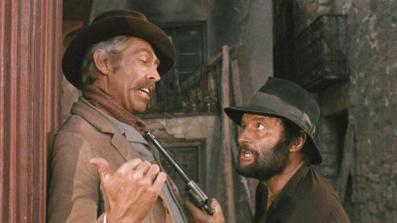 Four classics or near-classics into his career, the commercial bottom fell out of the Sergio Leone’s style, a salivating roux of lyrical, iconographic imagery and blistering aural sorcery that elevated the Wild West to the woolliest of opera halls. Released to choruses of conundrum and popular disinterest, audiences in 1972 brandished their confusion toward Duck, You Sucker! like a weapon and proceeded to fell Leone’s savage beast, banishing it to the cesspool of cinema. Which was a sure-fire come-down for a man who “did” more with the structures and iconography of the Western genre than anyone else during the ‘60s. Mere years beforehand, he’d released four indomitable works that channeled the Western into both John Ford’s rhapsodic register and Anthony Mann’s hoarse, wiry, more brutal variant of the genre. Leone’s films were alchemic, concoctions of classical A-pictures (in tone, length) and B-style hip-shooters (in mood, feel, texture, purpose even), and they were unstoppable.
  If Nicolas Cages’ battered, displaced ennui in Vampire’s Kiss implied anything about Cage’s messianic ability to incarnate an entire city’s mortal fever in his very body, it’s that he really should have starred in Martin Scorsese’s After Hours instead (the previous film from the same screenwriter). Ten years after Kiss, Bringing Out the Dead fulfills the prophecy. Etching moral quandary and personal quagmire, as well as mythic grime, out of the streets of New York City, Bringing Out the Dead finds Scorsese returning to his home turf, with his home turf writer Paul Schrader, in a film that feels like an extension and perversion of their galvanic 1976 social screed Taxi Driver.
 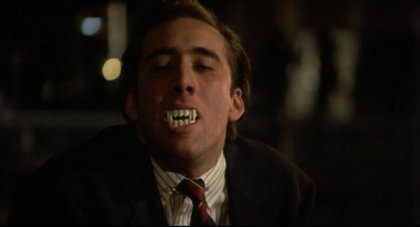 You wouldn’t know it from the film’s iron-clad second-life reputation these days as the butt-end of a joke in internet compilations of Nicolas Cage losing himself to convulsions of life-panic, but there were, in fact, other people in the room when Vampire’s Kiss was being made. At the same time, the black hole of Cage’s performance sucks in any and all vitality from the production elsewhere, energy no one else seems to have exerted in the first place. But if this is Cage’s Vegas one man show (much more than Honeymoon in Vegas, or Leaving Las Vegas even), the birthing pool of the film remains writer Joseph Minion. That’s a name you probably don’t cotton to immediately, but he’s famous in screenwriter and cult object circles for writing After Hours, a film picked almost at random by Martin Scorsese when the production of The Last Temptation of Christ screeched to a grinding halt.
 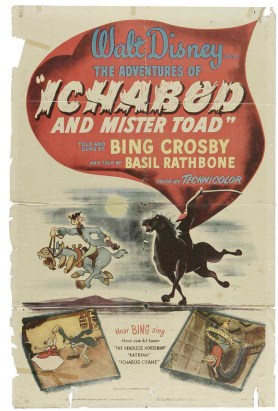 Disney Animation’s package films from the ‘40s, as a corpus, are sometimes considered the bane of the company’s existence, mercenary workaday productions inspired by a need to salvage the tatters of the company by producing anything that would make a buck, theoretically leaving their artistic inhibitions at the door. The ghetto these films have been sequestered into isn’t without purpose; compared to the brazen murderer’s row of artistic masterpieces released between 1940 and ’42 – Pinocchio, Fantasia, Dumbo, Bambi – one can see why no one is eager to pull, say, Saludos Amigos from 1942 out of the dustbin of history.
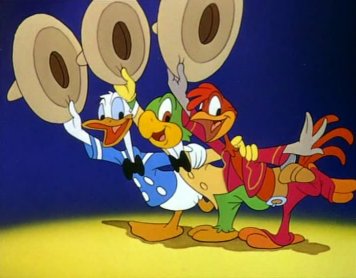 In this ostensibly superficial, altogether dazzling production about three birds in Central and South America, Disney’s near-commercial implosion arises like an avian on fire in arguably the company’s most surrealistic insurrection. Trapped in the perdition of nonexistent budgets, Disney Animation went vagabond and took a trip to, and a cue or two from, the superstars at Termite Terrace (read: Looney Tunes) with a deliberately unfussy, anarchic production for which out-of-control effusions of rhapsodic color was the only reasonable aesthetic partner. Pointless though it seems, The Three Caballeros is in fact a vanguard of the company’s continued artistic experimentation and their hunger for something a little more allegro.
