
 Gotti asks me to put my money where my mouth is. A favorite complaint of mine when reviewing movies is to critique actors turned directors for neglecting the film of their films. That they render mere theater pieces that happened to have been filmed in lieu of genuine works of cinema. Watching actor-turned-director Kevin Connolly’s bastardization of the life of John Gotti, I realize that I’ve sinned. Most actors turned directors at least display a basic competence with the camera. They merely fail to embellish their narratives in any particularly cinematic way, dismissing the possibility that the camera might be to used to achieve anything beyond or besides perfunctory realism. They treat their camera as a window or a simple observer rather than a canvas and, in doing so, their cameras’ perspective often fails to expose its perspectival nature, feigning naturalism.
Gotti puts me to shame for complaining about actors who understand the mere basics of continuity, because this film is a whole other beast entirely. Rather than lambasting other actor-turned-directors for only understanding basic continuity and nothing more, I should be worshipping them for at least getting that part right. The film’s ineptitude with cinema is immediately apparent. Unsurprisingly so, I wanted to say, but Gotti is a thoroughly surprising motion picture, confounding even the simplest expectation. It’s breathtakingly idiotic, from the faultlessly asinine politics to the thorough-goingly irreparable narrative structure that, I for one, am convinced was writers Lem Dobbs and Leo Rossi or director Kevin Connolly’s mangled attempt at an avant-garde film. Continue reading

 Luca Guadagnino’s deliberately polarizing 2018 Suspiria shows its utmost respect for the original 1977 Suspiria by Dario Argento by making an absolute travesty of it: rethinking it, stripping it for parts, inverting its essence while honoring its spirit. And then defiling even that. The original Suspiria was a thoroughly abstract mindscape, with horror as an associative framework for arranging sound, sight, and sense to tap into otherwise untouchable enigmas about “humanity” conceived broadly. Nominally, this new Suspiria is totally at odd angles to Argento’s film, as thoroughly opposed as, say, Stephen King’s psychological vision of The Shining was from Kubrick’s baroque weave of sensory experiences that only superficially correspond to questions about the main character’s sanity.
 When the central couple galvanizing Cold War’s spatial and temporal slippages first meet, their bodies are already both shrouded by and formed out of the desecrated husks of history; the weight of the world sacrifices their individuality, but the film also suggests that there is no such thing as pure individuality outside of the weave of the social, of history and of History. Wiktor (Tomasz Kot) is part of a mid-century Soviet government-sponsored research team looking to “preserve” the iconic cultural traditions of various ethnicities and nations now roped into the Soviet Empire, part of the Soviet Union’s project of multi-national socialism. Lula (Joanna Kulig) auditions for a role in a performance of Polish “traditional” music, already privy to the fact that her identity has been casted and essentialized as a “folk” person, construing her as bearing testament to the “essence” of the Polish “people,” not a sovereign person but an icon of a preserved past. Initially, the Communist government both draws from these identities and thoroughly flattens them, evaporating any sense of political acumen in the folk lyrics, locking them into the vise grip of a depoliticized time and casting the singers not as poets of modernity (capable of resisting as agents) so much as immobile totems to the past.
 When Lucrecia Martel’s Zama begins, its protagonist, Don Diego de Zama (Daniel Gimenez Cacho), is performing his own sovereignty on a beach. Decked out in colonial garb and jutting one leg outward toward the sea, he seems to be posturing to no one in particular, as if beckoning to some unseen God to witness his sculpting himself into a predefined role as an icon of mid-level colonial bureaucracy. Radiating a vision of masculine competence to himself and only himself, de Zama’s supreme selfhood ultimately discloses his supreme loneliness and pitifulness. He then enacts a self-authored fiction of ownership of and mastery over the island by spying on a group of native women bathing naked, assuming that he has the right (and ability) to look. With the mischievous, wicked temperament of a colonial slapstick, writer-director Martel’s film then immediately punctures his vision of self: they spot him and shoo him, nearly beating him up in the process.
 Impish and pious in equal measure, James Wan’s Aquaman is almost violently at a crossroads with itself. It both worships at the altar of the comic book and recklessly exposes the form’s essentially frivolous nature, giddily treating the comic book as holy writ while implicitly dismissing any desires to lard the form up with self-conscious airs. Somewhat astoundingly, it resurrects the mid-century pulp spirit of B-cinema and the comic book form, almost more Heavy Metal than DC, a spirit that both cherished and, at least sometimes, derived genuine pleasure out of that paradoxical overlap of silly and serious. The best of these comic books are somehow both eternally reverent to the value of unquestioned, thoroughly and inhumanly “good” mythological super-persons and essentially amused by this worshipful fascination. They seem almost curious about how loopily self-indulgent it is to get lost in such nonsense. Aquaman is quite conspicuously nonsense, and its melding of the ridiculous and the sublime never treats that nonsense as anything less than completely sincere.
  Loosely in honor of the MCU’s recent announcement of a new Blade picture, and in honor of a film that I think is better than any of the 22 films in the MCU.
 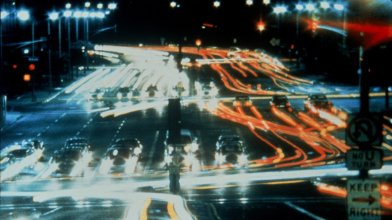 Koyaanisqatsi offers what can only be described as a radical defamiliarization of humankind, treating civilization as a known-unknown and humanity as an alien artifact. Famously soundtracked by Phillip Glass’ gloriously minimalistic score, Godfrey Reggio’s first of three environmentalist impastos offers a symphonic image of the human experience, contradictions and curiosities existing in tenuous, frictive harmony. Transparently environment and even polemical, Reggio’s film is less a plea for salvaging the environment than a call for a new kind of perspective on existence: the camera turning, warping, acknowledging its mediation of nature’s might and igniting the potential of the natural world that is often taken as backdrop, a mere resource to be plundered rather than imaginative energy to be mined.
 Bruce Lee is rather unceremoniously written-off in Quentin Tarantino’s new film, which I finally saw and thought was otherwise terrific, but it seemed a little counter-argument was necessary for Midnight Screenings this week.
 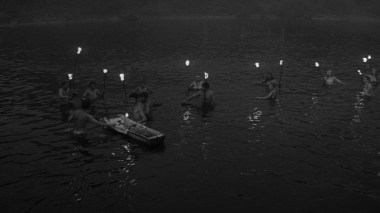 While Andrei Rublev was officially released in 1966, it was not unleased upon the world until one fateful night (at 4 AM, courtesy of Soviet censors) in May of 1969 at the Cannes film festival, and as that screening was one of the most important cinematic events of 1969, it seems entirely legitimate for the film to have a place in this short retrospective.
