
Edited and updated in mid 2015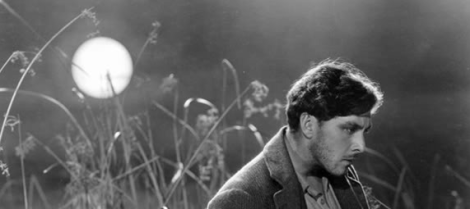
Sunrise was one of “those” films. By those, I mean the films which changed cinema, which defined “before” and “after”. While the case is often made for Citizen Kane as the singular production which advanced what film could do the furthest for its time period, Sunrise is perhaps the only film to seriously challenge that claim. F. W. Murnau, the expressionist master behind classics such as Nosferatu, brought his talents to America here, and to tragic romance. In doing so he not only created an ethereal, transcendently romantic vision of the world, but he transformed what film meant for that world.
The narrative of Sunrise is simplicity itself. It’s a story of love and temptation, intentionally rendered universal through characters whose names are literally types. They are “The Man”, “The Wife”, and “The Woman from the City”. The first and the second are married, while the first and the last are having an affair. These two plot to end the marriage and run off together, having “The Man” take “The Wife” to the city on a vacation from their country abode and drown her there. When the time comes he finds he cannot continue with the plan; the trip to the magical chaos and clutter of the city only rekindles their love. Assumed tragedy later strikes and causes “The Man” to grow angry and even potentially murderous, but love looms large in Murnau’s vision and he isn’t about to give up his puppy-dog mythos of the world without a fight. Continue reading
 Edited May 2016
 Preface: Now that I’ve finally decided to go “old” with the blog, I’m doing it in style with not just a regular “old” film, but two, and two that have ripened with age. For this week’s Midnight Screenings, the ’90s, ’80s, ’70s, ’60s, ’50s, and ’40s wouldn’t do. I’m taking it back to two of the granddaddy’s of filmmaking from the early ’30s, two of the earliest “talkies” and two supreme influences on Midnight Cinema from a time where films could be more openly playful and subversive as filmmakers were still trying to prod and poke at the medium to expose its limits and possibilities.
 Nuri Bilge Ceylan’s 2011 Turkish drama Once Upon a Time in Anatolia seems like it was made for me. A glacially slow, wistfully poetic film about finding visual beauty in mundanity (or is it the other way around?) that primarily focuses on the formal elements of film, such as camerawork and editing, at the expense of a conventional narrative, it aims to fill big shoes set out by directors long-gone, but whose mark on the film world is undeniable: Tarkovsky and Antonioni to name the two most obvious. High praise, but if you’re expecting a “but” … you’d be wrong. Amazingly, Ceylan overcomes any burden placed on him through comparison to past master-directors here, not by creating something truly unique but by learning from the best (his Sight and Sound Magazine Top 10 films list plays like a who’s who of languid art-house auteurs) and essaying their strengths for a time period sorely lacking in such provocative, deeply felt filmmaking.
  Edited
 It’s a funny thing that three years ago everyone thought the new Planet of the Apes movie, released at the tail end of summer as if to indicate the producers’ lack of assurance about its prospects, was going to suck. The original series, excepting perhaps the original feature, was never very good and is best left to the dustbins of history. Flash-forward to 2014 and it’s now fairly set as a new tent-pole franchise worthy of not only populist blockbuster status but the time and money of discerning film-goers looking for craft and character to go with their explosions. Rise turned out to be better than good and an unexpected year surprise, a rare thing in big budget filmmaking these days. Dawn faces bigger expectations coming into its release, the kind which could sink a would-be summer blockbuster. Thankfully, the film is too confident to fail, boasting a simple, elegant, if familiar, story that’s done up well with pure filmmaking prowess and solid, dependable characters. It’s hard to say which of the two films is superior, but then again we don’t need to. Both are sufficiently different (they really went out on a limb setting this film ten years later than the first and with not one returning human character) and they each work in their own way. This isn’t a game-changing film, but it’s very strong and a surprisingly sturdy second entry to a franchise everyone was surprised to realize they’d missed.
  Inception, as of 2014 still one of the most advertised and anticipated before release movies of the 2010s thus far, wants to be a lot of things: a dramatic thriller, a cautionary tale, something that pokes and prods around without knowing what it’s looking for, an action movie, a head-trip, and, of course, a dark science fiction film. If that all seems like more of a daring work of danger than the film actually is, you’re excused. Inception is somewhat self-consciously confusing, but more to the point, it’s actually not nearly as complicated as it wants to be. Maybe that’s for the best. What we’re left with is a relatively straightforward (good)action movie with science fiction trappings that mostly uses its hook as a way to mess around with the audience and to convey that puzzle-box intellect-before-emotion mood today’s audiences lap up, especially when the box comes with a little warranty sticker on the back that tells you to ship it back to Christopher Nolan Inc. if you think it’s broken.
 Midnight in Paris feels like it was released forty years ago, when Woody Allen was still finding his way and knew what themes he wanted to address in his films, but hadn’t found a compelling way to address them. Released in 2011, it’s unfortunately more of a reminder that Allen has lost his touch for humanism. This is a guy, for all his nervousness and cynicism, who has made several of the most endearing, empowering humanist visions of the cinema, someone who seems to put on the airs of mockery to satirize a world he’s truly in love with. Or maybe, it’s the other way around. Maybe he is truly cynical and hopeless but remains in love with the idea of humanity and romanticism, feeling the need to put them in all his films even when he finds them dishonest. After all, many of his films are subtle fantasies about love and longing that match bitter, insightful truth with genuine pathos and effervescence pointed strictly at the human race. This is a man who understands the joys and sorrows of life and society, and puts them at work in his films like they are his playthings, all the while feigning a cute passivity and weakness, like he’s both confused and amused at the world and doesn’t want to get away. Perhaps in his old age he’s just given up on society and enjoys the act of getting together with actors in a nice vacation-land for a few months and ordering fine food and wine with a film, his in the making, on the side.
  Was there ever a better cinematic pairing than Nicolas Cage and Werner Herzog? Well, Klaus Kinski and Werner Herzog, but here I sense a second coming. The H-man was always obsessed with something, anything, even obsession, and Cage also plays his roles with an unhinged, wild-man version of obsession, even if recently it’s been obsession for paychecks so he can go trampoline in a castle somewhere. And here they’ve produced the kind of film that wouldn’t be more appropriate anywhere than on a screen in front of said trampoline, ready to give you a splitting headache or cast you into the stratosphere. I’m not sure which.

