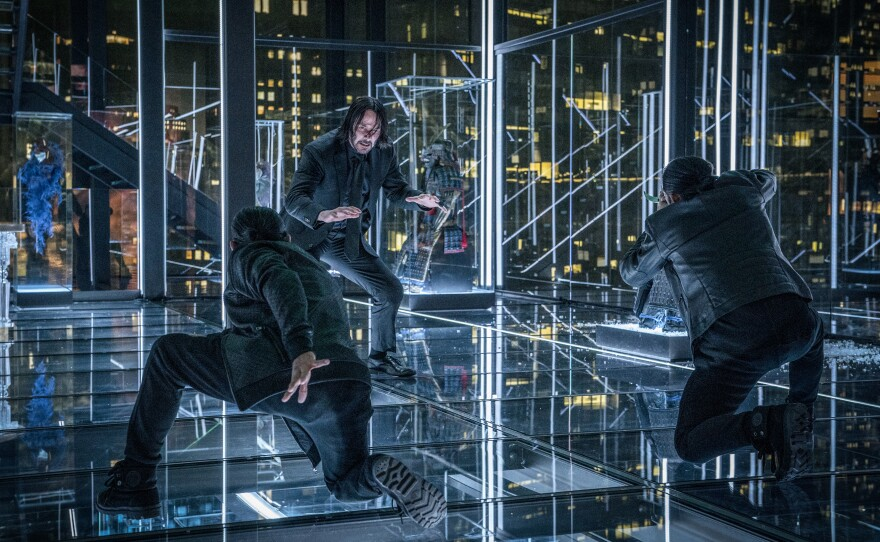
Just as we previously left him, at the end of John Wick: Chapter 2, our man Wick was hurtling down the suspicious streets of Manhattan, fearing for his life after having been recently excommunicated from the worldwide assassin community for (deservedly, in the film’s view) killing a person on hallowed ground. That ground was New York’s Continental Hotel, one of the many hubs of official assassin activity in, as we learn, an increasingly wide and complicated network and economy of murder. Its owner is Winston (Ian McShane), and he has used his power to delay the ensuing hit on Wick by one hour. We open John Wick: Chapter 3 – Parabellum mere minutes before that hit is to be sent out to, seemingly, every hit-person on earth. Parabellum’s Latin subtitle suggests – promises, really – no shortage of ego on the part of the film. And the dense and forbidding aura of its world, and the controlling and manhandling showmanship of this behemoth of a film, do not disappoint. This is a work that will summon swarms of extended forces, out of nowhere, to bear on one man who has to call forth an equally forceful reserve of will to survive, a celebration of one man’s capacity to survive a sheer, overbearing, unending onslaught of raw, leviathan-like cinema.
Wick 3 was the most highly stylized, most ornate of the series up to that point – the most continental of the Wick features, if you will, a kindred spirit of the aesthetic sensibilities more commonly associated with Continental Europe. That the one ostensible refuge in the film’s world suggests a hyper-controlled aesthetic sensibility seems to imply that the film’s aesthetic proclivities are ways of evacuating the ungovernable traces of real-world human spontaneity and uncertainty. This is a film that has been painstakingly manicured for us, to our liking, to do our bidding, to exert supreme effort and control in punishing one man and to take pleasure in his ability to survive that punishment. It asks that we revel in controlled chaos and the possibility of coming out the other side undaunted. It is pristine in the force of its construction, the single-minded brutality of its monomaniacal and thoroughly, violently uncomplicated imagination.
And revel we do. John Wick: Chapter 3 – Parabellum makes a pretty immaculate, almost indefensible, case for itself. The obvious criticism of the film is that its sound and fury signifies nothing, and that this film is so well-mounted and anointed that it can’t really register any suspense. That’s all true: we watch hundreds of people try to kill John Wick, and we delight as he kills them. In a sense, though, Wick’s over-modulated hollowness isn’t really so much a decrement as a sheer fact. While the film may seem empty on first blush, it might rather be that Wick refuses the injunction to make meaning out of its cornucopia of senses and perceptions. John Wick does not unearth some divine essence beneath all the madness, nor does it pluck any manna from heaven that unlocks the film’s mysteries for us. It just is.
Continue reading