 Fritz Lang’s infatuation with obsession, subterfuge, and the gossamer veil of social order are not precisely fascinating food for critical thought in 2016, but the progression of his fears might be. His customary debut to the big leagues of artistic cinema, 1922’s Dr. Mabuse: Der Spieler, is stupendous cinema, but it is sometimes assumed as the sarcophagus of his career, a film he more or less copied and only advanced a handful of times. Formally, the assumption is obviously incorrect; the advent of sound and Lang’s almost unstoppably innate understanding of how to inlay sound into his medium as a complement and commentator on the visual realm ensures that Lang was never formally stable or complete in the silent era. But what is often undervalued is how Lang began investigating his own image of a petrified world right from the get-go, transforming the horror of a man controlling the world in Mabuse into a vision of a world-as-thieves-den so robbed of humanity that any one human exerting dominance over it seemed almost passé and innocent in comparison.
By M, Lang’s first sound film, Mabuse had become a lie, a ruse, a figment of our imaginations embodied in a pasty, baby-faced child-man who was daringly and emphatically not the most damaging threat to Germany and the audience’s soul. The individual maestro behind the screen of our lives was now not an individual we could blame, but a cop-out, an excuse, a person to push blame onto to obfuscate and pacify our inner nightmares about our own souls. The moral rot was the populace itself, easing its crestfallen nature by looking for a singular entity to criminalize and thereby alleviate the social burden on the public as a whole. On the eve of Nazism, the statement was frighteningly apt and rebellious because it questioned the very Enlightenment values that, when corrupted, undergirdered not only Nazism but capitalism more broadly; if Nazism was a way to shift blame to social minorities, Lang posited, then it was only the nastiest and most direct manifestation of the latent nature of Western governance to interpret social rot as the failure of certain individuals. The solution to the anxiety and entropy running away with the mind was tethering the anxiety to certain “others”, stabilizing fear by linking it to a specific cause we can all unite in the harmony of blame. Continue reading →

 Bug
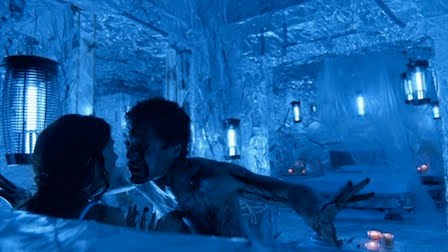
Bug If we were being prickly, we could say that David Lynch’s debut feature Eraserhead has set the director down a 40 year path of trying, and failing, to recapture the cinematic mayhem and malfeasance of his coming out party. That’s not entirely true – Dune, The Elephant Man, and The Straight Story don’t bother as much with explicit disruption, but they are failures of ambition all the more so for that very reason, effective films though some of them may be anyway. But Lynch’s greatest works – Blue Velvet, Twin Peaks, Mulholland Drive– have all been formalist fever dreams that, if expressively advancing the terror of Eraserhead’s self-censuring dreamscape, also rein the Lynchian-id beast in ever so slightly so that they are perhaps less fully capable of exploring the broken-edges of experience. Their relative – and I emphasize relative, for this is Lynch we are speaking of – formal sanity in envisioning a world bent out of shape makes them feel less honestly afflicted with the terror of the world they depict. To some extent, all of these films are commentaries (fantastic commentaries), but only Eraserhead achieves genuine embodiment. While other films strive to “mean” something about discombobulated terror, the formally spasmodic Eraserhead is discombobulated terror.
  A deep-water jambalaya of reptilian-brain sexuality, harebrained violence, delinquent cinematic disdain for social propriety, racial conflagration, and sensual tension overflowing in spurts of human combat, it is entirely fitting, and entirely Buñuelean, that one of the Spanish directors two meager English-language films manages to explode with traumatic awareness of American cultural disjunction better than arguably any other American film. A three-character barbecue of sun-scorched, humidity-flaring raw flesh left out to burn, the director’s foray into American racial and sexual politics is a political study only insofar as it slithers into the political found in the everyday terror of fighting for your life. This is no lecture, no dissertation on this director’s part; this is fetid, pungent, even foolishly carnal backwoods trauma of a corporeal, violently direct nature. It’s racial politics as out-of-the-frying-pan-into-the-fire nightmare.
 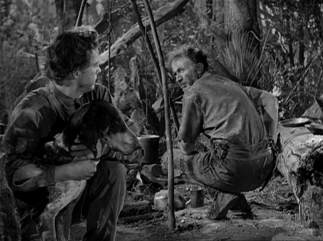 A bit of a pocket interest this week on Midnight Screenings, with two instances of foreign masters exploring the thick, sickly world of the American Southern Gothic.
  The late ‘40s were a high noon for the horror genre, easily the most desecrated ghost town era for a genre that has reinvented itself time and time again. From the irrepressible expressionist deviants of the ‘20s to the chiaroscuro nightmares of the early Universal films in the ‘30s to the sly, insidious Val Lewton carnival of the early ‘40s, horror was on a hot streak for decades until it hit the ice wall of WWII. Not that the real world horrors of the war inherently superseded the desire to thaw out the terror of the cinematic variety, but the will to nightmare was to be discovered somewhere else until the dawn of the atomic age ‘50s films, before horror would draw its fangs and get downright pernicious with the turn of the ‘60s and the prestige variant of the genre in the New Hollywood of the ‘70s. In the century of cinema thus far, only the late ‘90s can go blow for blow with the late ‘40s for sheer abandonment as horror packed up and went out to the country to cool its heels.
  Although Universal was nearly dead in the water by 1946, RKO’s Val Lewton-Jacques Tourneur B-movie cavalcade was just a few years past its prime, and Warner Bros. The Beast With Five Fingers, released in that year, isn’t a patch on the dueling acmes of that cluster: the impossibly well crafted Cat People and the impressionistic, lyrical I Walked with a Zombie. So obviously, and honestly, we’re grading on a curve with The Beast With Five Fingers when we champion it – after all, this was a year in which the near-dead quasi-corpse of the genre was struggling to let its vaguely beating tell-tale heart be heard. But, with Warner Bros. playing Universal Horror for the only time in the whole decade, The Beast With Five Fingers is about as studious and sturdy an update of the even-then hoary Old Dark House format as you might imagine a struggling studio to release when they were stepping their toes in the sand of a genre that wasn’t really their own.
 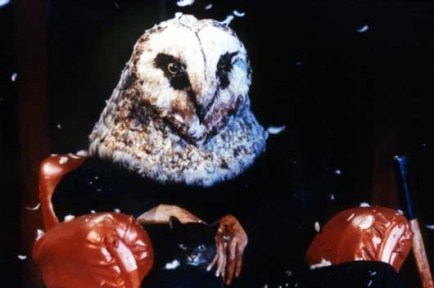 Years of experience with Lucio Fulci and Dario Argento, the reigning post-Bava Italian giallo masters, will give you Stagefright. For Michele Soavi, actor and assistant director to the masters turned first-time director here, this meant conjuring up this 1987 pseudo-slasher as his big come-up. The original title, Deliria, being vastly more apposite, this is less a slasher dressed up in giallo airs than a giallo putting on slasher clothing to sneak into the mainstream so it can uncloak its true self when the moment beckons. Like any good disreputable giallo, Stagefright is a bodacious concoction of performance-art murders choreographed like installation pieces, on one hand, and pure, unbridled instinct and impulse on the other. So while the kills may be judiciously filmed and planned, Soavi never lets anything as trivial as common sense or good taste trounce on his funhouse; his film is orchestrated but never programmatic.
  Aesthetically-minded avant-garde director Nicolas Roeg, daringly immature puppetcraft impresario Jim Henson, and nasty-whimsy peace-negotiator Roald Dahl is one of those divine, demonic accidents of circumstance you didn’t really know you needed. Easily Roeg’s most commercial film, but not a cash-grab judging from his delectably devious direction and satisfyingly cryptic editing, The Witches was still a commercial misfire. Which isn’t a surprise; even by the standards of the late-‘80s run of vaguely dark and dreary children’s horror pictures either adapted directly from Dahl or owing kinship to his spirit, The Witches is an insidious little devil of a picture, vastly more warped and spidery than even the Grand Guignol likes of Return to Oz earlier in the decade. It settles more for naughty than nasty, but the effects are heinously satisfying nonetheless.
  The ‘Burbs
