
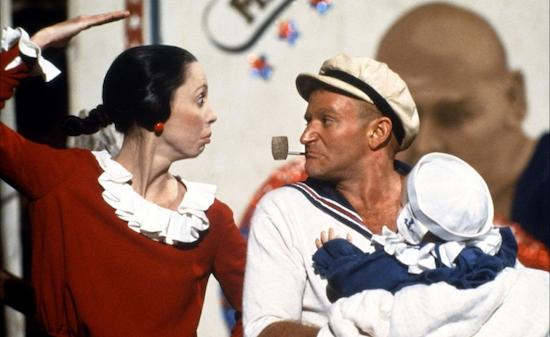
Whatever may or may not be true about the demise of the New Hollywood in the late ‘70s and early ‘80s, the story practically writes itself, and it certainly helps spice up the films. Michael Cimino’s oneiric Heaven’s Gate, Francis Ford Coppola’s dementedly luxuriant Apocalypse Now and his heartfelt, slovenly One from the Heart, and, of course Robert Altman’s own Quintet and Popeye all went grossly over-budget and wear their exaggerated passions on their sleeves. But, unlike the others, Popeye was nominally intended as populist entertainment! And it is as thoroughly scatter-brained and bedeviling and dumbfounding as any last one of them, a truly suis generis slice of creative hack-work, as perplexing as the crystal Mrs. Miller looks at, searching for an impossible answer to America’s riddles at the end of Altman’s masterpiece McCabe & Mrs. Miller. Much like Coppola’s One from the Heart, it is fundamentally about Great Depression popular cultural, and like One form the Heart, it is absolutely deranged. As with Coppola’s film, it went colossally over-budget producing a set that it could not possibly justify (and yet does!) that was constructed, in Altman’s case, on location seemingly with the intent of evoking a soundstage. Or to serve as Altman’s backdrop for a production-length coke party. From Shelley Duvall’s note-perfect, almost impossibly serendipitous performance as Olive Oyl, to Robin William’s dangerously committed, deliberately alienating turn as the titular outsider who genuinely seems to occupy a different world from everyone else in the film – and because the film is so thoroughly estranging, therefore the same world – this is an absolutely uncompromising dispatch from another cinematic world. It is so feverishly committed to its own disturbed wavelength that it feels like it could have been directed by John Boorman, although probably without the Sean Connery nut-slings.
Still, it’s an Altman film, through and through. Many of Altman’s films were, in one way or another, a dissection of how America related to its own visual and aural iconography, finding (at times accidental) truth in fiction. Popeye, at the time chastised as Altman selling out to the pop cultural lexicon he so often dissected, explicitly tackles a recycled consumer property by name, and under the belly of the Hollywood studio system. Opening on a shot of the animated Popeye, black-and-white, speaking directly to the camera, informing us that he’s “in the wrong movie,” the film smash-cuts to a stormy seaside town as “A Robert Altman Film” appears overhead, usurping the titular character’s authority with a decidedly different breed of central figure. Popeye initiates itself by dissociating itself from the fiction audiences might expect, already foregrounding disharmony and hinting at the difficulty, even the incomprehensibility and delirious idiocy, of making a live-action adaptation of E.C. Segar’s comic franchise and the Fleischer Studios animated cartoons at the end of the 1970s. The introduction is a direct descendant of Altman’s Brewster McCloud, where the iconographic MGM lion roars with the audio replaced by René Auberjonois’s “I forgot the opening line,” another confrontational fiction-breaking abnormality and a promise on Altman’s behalf that the story we expect has been distorted and defanged.
Continue reading

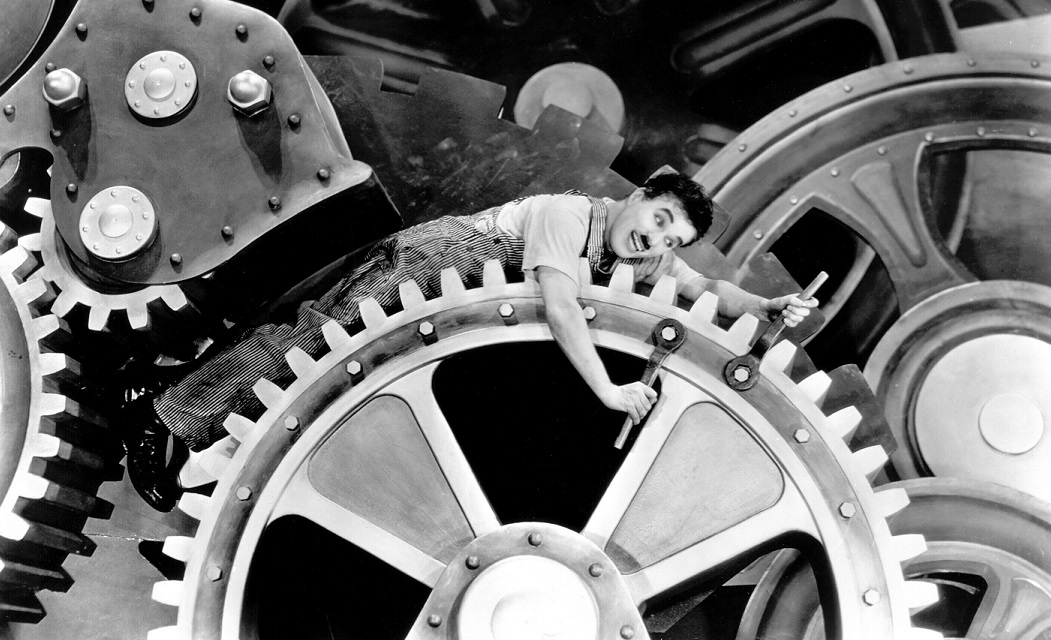 Charlie Chaplin was one of Hollywood’s earliest and largest stars, a filmmaking polymath who performed, directed, composed, produced, and wrote all of his films, a one-man brand who in Modern Times subjects himself to a possibly fatal question: whether he can escape being branded by the hot iron of capital. A British socialist who grew increasingly frustrated with American capitalism and Hollywood business practices throughout his career, he eventually left Hollywood and returned to his native England. Like many silent filmmakers, many of his earlier films explore questions of new technology and skeptically arouse the possibilities of modernization, thinking-through the relationship between new technological forms – both industrial and cinematic – and asking how one navigates modernity. Of course, many of his anxieties about industrial technology were also motivated by his own issues and frustrations with the rapidly growing Hollywood industry, exposing parallels between industry on-screen and industry in Hollywood that seem more prevalent in Modern Times than in any Chaplin film before or since. This is the film in which the personal will displayed in The Kid – where his Tramp character strategically manipulated capitalist products for new purposes with his mental ingenuity – seems to have been finally overpowered by capitalism’s singular ability to manipulate his body as the ultimate tool to its own ends.
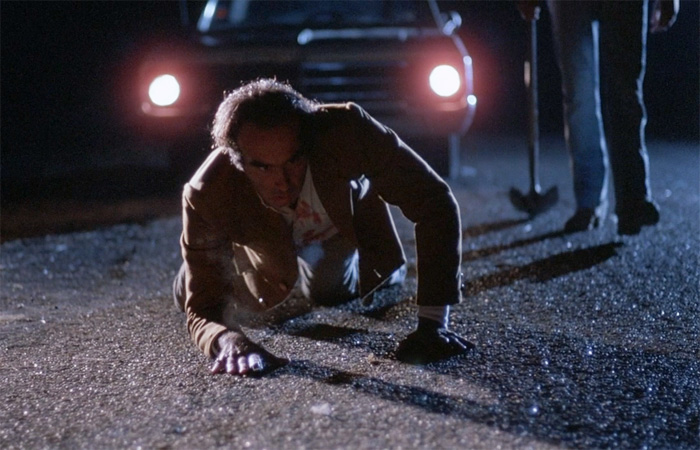 Until 2007 when they unchained No Country for Old Men on unwitting audiences, Blood Simple was the black sheep of the Coen Brothers family. Their second feature Raising Arizona is, on the surface, its diametric opposite, a harried, maniacal fracas of disheveled lunacy and Southwestern loneliness. That latter film has, more or less, paved the way for many of the Coen Brothers’ more famous features, inaugurating their reputation as the pied pipers of modern artful screwball. But Arizona shares two central components with its predecessor despite Blood Simple’s reputation as the wild card in their canon. Tones aside, both films are mordant, fiendishly cunning grasps of dour, melancholic tragedy, both comedies-of-loneliness. And both are acid-washed images of people in need of an escape hatch. The sheer surfeit of mood aside, Blood Simple frequently feels like a premonition of the Coen Brothers’ entire career. Considering Blood Simple reveals the crestfallen image of a destitute US and stunted, criminally miscommunicating people that skulks, almost subterraneanly, within the notionally-chipper heart of many of their later films.
 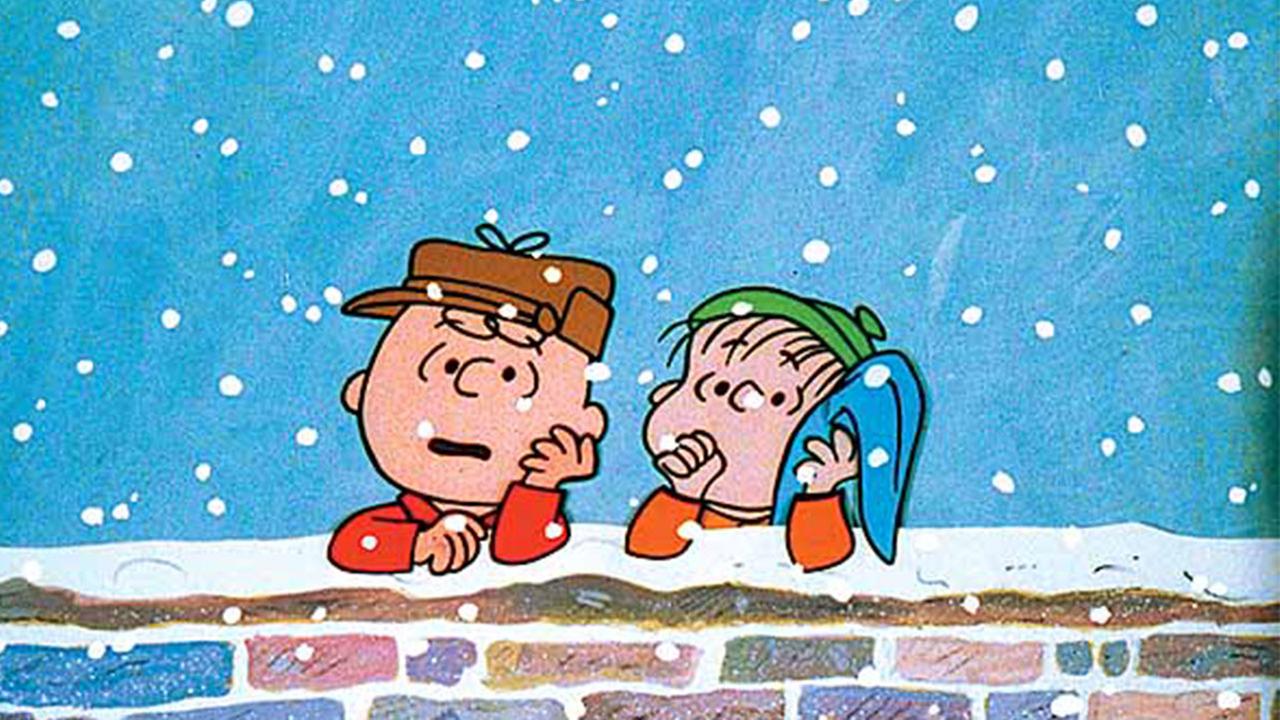 I’ve been away for so long … Here’s a holiday classic to re-inaugurate the site.
 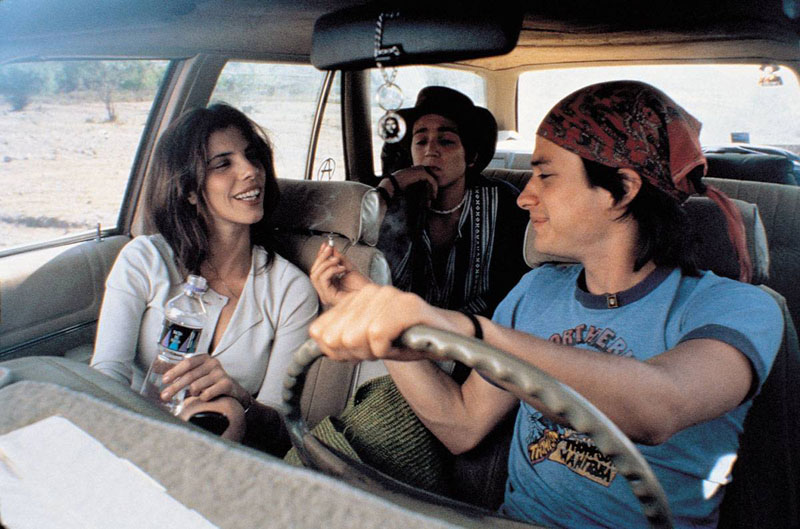 Y Tu Mama Tambien is inauspicious, but like many great films, it reaches for and touches the world and humanity in everyday actions and seemingly small gestures. Here, for instance, we have teen sexuality, laid out with all its romanticism and reality, filled with the kinds of empty-but-meaningful gestures that define humanity’s desires and their foibles. Director Alfonso Cuaron is a highly personal director, but he’s always most interested in defining his characters in relation to the world they inhabit. His two protagonists here are immature and petty yet deeply human, reflections of a society that won’t admit it has given birth to them and which they, initially, want no part in. He gives us a profoundly human story, built on the eternal humanness of sex as a marker of adulthood and childishness, and given life by Cuaron’s wonderfully and contrapuntally painterly version of sloppy, slovenly reality.
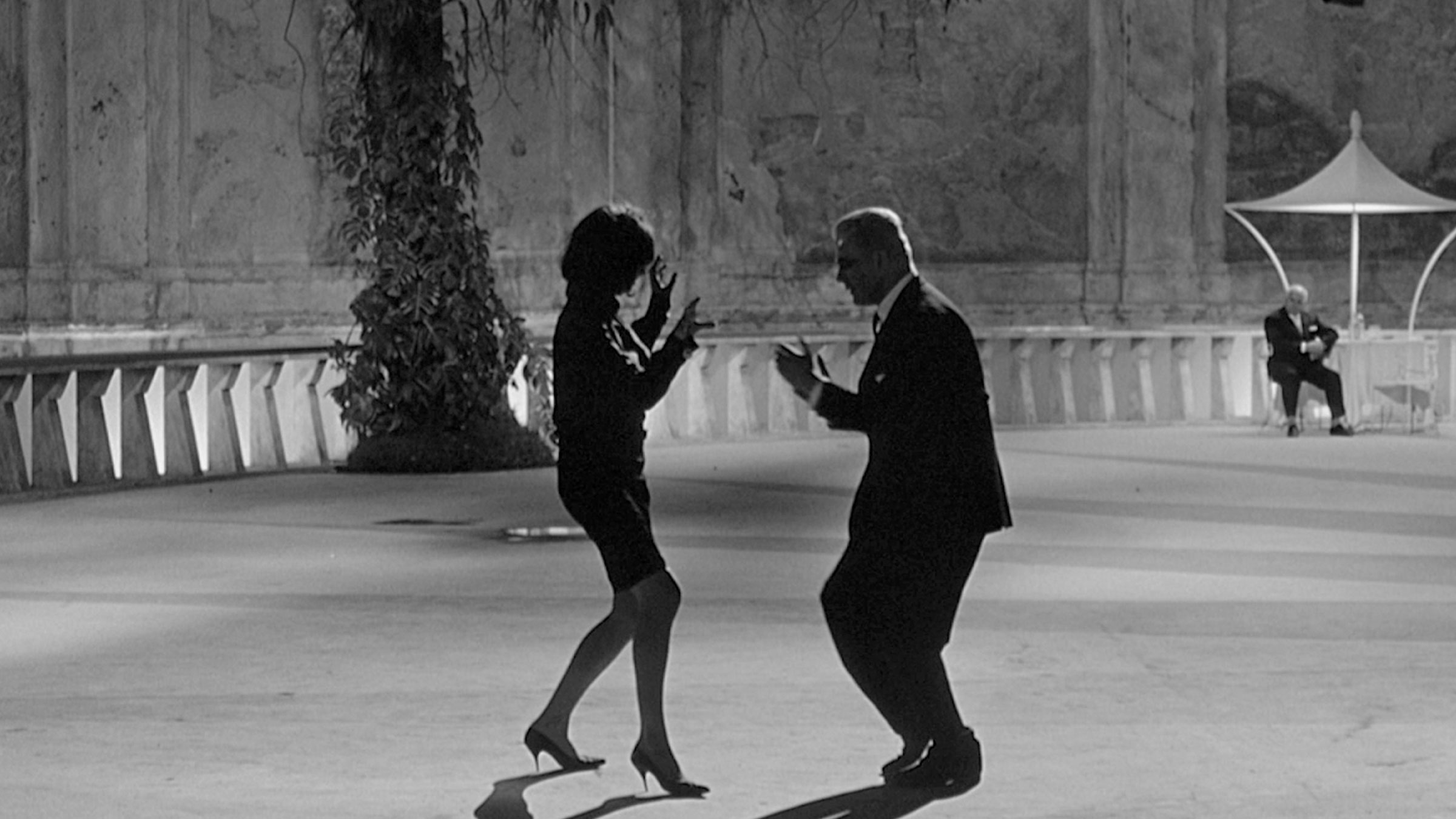
 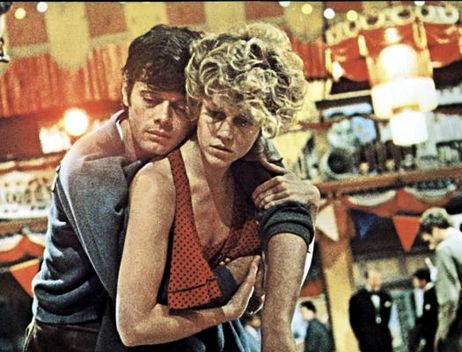 An astonishingly hopeless anti-myth odorized with the stench of failure and bloodstained with the tattered remains of hope, They Shoot Horses, Don’t They? twists the idiom of dance away from its usual home in restless fantasy, treating human gyrations as the small-scale reverberations of a slowly-tilting edifice ready to crumble to the ground. For Sydney Pollock’s film, dance movements are first particles of movement that exist not to fling us into a hopeful future but to topple us from below, subsuming us to the movement of our feet that seem no longer tied to our minds or our personal agencies. Our bodies are no longer uncertain adventurers carving out a bold future but frantic chasers of a dream deferred, hoping to catch up to the scraps of nothingness thrown our way. They Shoot Horses is a parable of America as a collection of lost souls wandering into dancehall marathons – brandishing hopes and dreams of Grace Kelly and Fred Astaire, or the Charleston – and succumbing to the barren, unforgiving economic destitution that undergird and consume the romantic aspirations that nominally lacquer the surface of these activities. As Pollock sees it, bone-dragging, fall-out-of-bed-and-stumble-upwards days are the only ones America had in the ‘30s, and maybe ever again.
  The wide-ranging berth of writer-director Jia Zhangeke’s multipartite, all-across-China film, A Touch of Sin, cannot deny its impeccable eye for the specificity and complication of even the least of its individual tales. A Touch of Sin is obviously the story of a society; its nature is polyphonic, paralleling four individual tales and hinting at many others, asking us to look at a wider portrait of the world, even one in which many souls feel atomized and alienated. But, despite the length and size of this film, it never feels like a belabored or overly-grandiose obelisk, a sky-high statement that attempts to encompass all of China. Its rhythms are minute and intimate, its portrait of modern-day China finding its genesis not in any declamatory, macro-level statements but in the tight minutiae of four tales playing out on canvases of inward regret, internal dissolution, and people yearning for other selves.
