
Edited
Chinatown has two lead characters, and as dictated by the logic of the film noir genre, one must be male and one must be female. And they too must share something, usually a sense of loss, an alienated nature, and a distance from society. Chinatown’s male lead is JJ “Jake” Gittes (Jack Nicholson), a private eye initially contracted by a woman claiming to be Evelyn Mulwray to find proof of her husband’s infidelity. Soon enough, he thinks he does so, only to learn he’s in for something much deeper and scarier. The lady who had presented herself as Mulwray was pretending, and when he meets the real Evelyn Mulwray (Faye Dunaway), she insists on his involvement in a different aspect of the case, one involving her husband’s now-dead body. Complications and complications arise, as they do in any noir. And this is a plot out of any noir. It’s been done hundreds of times before and since, and it seems appropriate to start here because this is Roman Polanski’s jumping-off point for paying homage to the noir genre while turning the whole thing on its head with Chinatown.
Continue reading
 Update 2018: Touch of Evil’s introduction is still genius, a blurring of perspectives and races as the camera recklessly unfurls itself across porous national and moral boundaries, ambivalently flaunting its ability to contest America’s certainty about racial and national borders even as it questions its own ability as cinema to escape those borders. When the bomb blows up, prematurely concluding and interrupting an interracial kiss, the film confronts the moral, legal, and visual limits of its time-period and quite literally explodes in attempting to find a way out. What a way for Welles to return to the nation that abandoned him, and that he abandoned.
 Edited
 Edited and Updated 2016
 Edited June 2016
 Edited
 Arguably the finest example of the Italian neo-realist cinema movement during the mid-1940s, Bicycle Thieves is a fascinating and moving examination of faith, desperation, love, and society, all under the guise of a film about a man searching for his bicycle. It also re-wrote the textbook on the notion of story, emphasizing narrative feeling over plot event and exploring character and emotion in the mundane rendered dramatic through filmmaking prowess. It’s a remarkably simplistic, primal, elemental basic premise; essentially, the movie unfolds as a man and his son look for a bike that was stolen from them. It sounds like relatively light viewing initially, but Bicycle Thieves is among the most powerful explorations of the human experience essayed on film. Its seemingly simplistic nature exposes a powerful statement about post-war Italy and the heartbreaking portrayal of what desperation and fear can do to a person; it is both uniquely and earthily of its own time and location and a broadly human experience applicable to any situation. It emerges as a film of great desperation and fear, but also one of the cinema’s most profoundly humanist and even uplifting statements, all captured under Vittorio De Sica’s plaintive, mournfully poetic camera.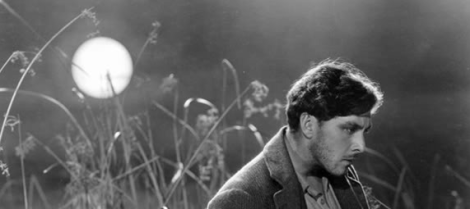
 Edited May 2016
 The Master is many things, but the only safe and sure descriptor I can come up with is “mis-marketed”. Explored pre-release, it was a film about L. Ron Hubbard, the founder of Scientology. Indeed, Phillip Seymour Hoffman’s Lancaster Dodd is a facsimile of L. Ron Hubbard, and one can certainly draw comparisons to the much-maligned religion (some would not agree with calling it that). But Anderson’s film is not only about Dodd or the “cultlike” group he leads. It’s a much more ambitious, confounding affair, highly impersonal, yet enrapturing. Technically it centers around a religious cult, but focusing on this controversial aspect of the film does it a grave disservice. On the plus side, it allows me this one measly paragraph to save myself from not saying anything I feel confident about throughout the review. This comment about the mis-marketing of the film ends the part of the review where I’m relatively sure I agree with what I’m writing – the rest of the film, as I think Anderson wants, is me entering the wild and hoping to come out the other side.
  The Long Take