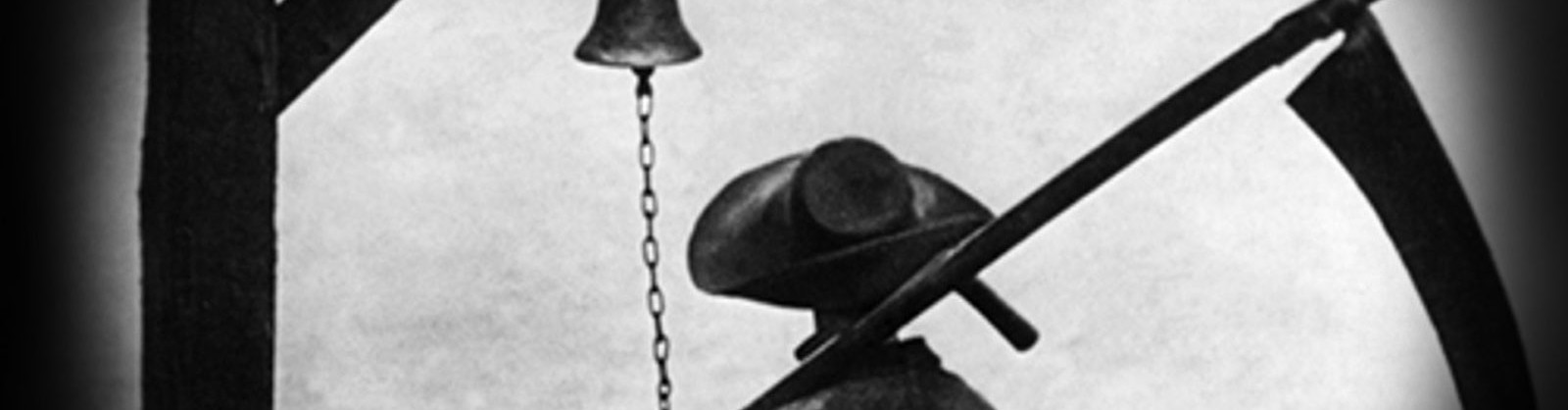
Update 2018: Uhhh these early reviews from my youth burn my eyes so. Vampyr is too sublime a film for the quality of review below to do it any kind of justice, yet there is never enough time to revisit even such a foundational film in writing. (I mean, it is only the banner image of my website!) Of course, part of the reason that I don’t have time to fully explain the film is that a work like Vampyr so capably resists any definition or sedimentation. All these years later, my favorite thing about it remains that, despite its heavily imagistic texture, Dreyer’s conjuration seems to resist imaging, to thrive primarily below the perceptual barrier, like a shadowy outline or impression discarded on an abandoned wall.
Dreyer’s work is quite pragmatic in this sense; its images burn into our brain not with the tendentious force of a grand theory but with a worrisome in-definition, a sense in which the images aren’t solidified enough to “represent” anything. They dislocate us with their refusal to additively mount-up as most films do. Instead, they seem to unfurl outwards without emanating from any perceived essence or center, not even a portal to hell. Thoroughly estranging in its refusal to declare, the only thing Vampyr mounts are moments of severe uncertainty, curiosity, active deconfiguration, ultimately effusing a bewildering refusal to illustrate certainty to us, a prophetic inclination to decline revelation. Instead of subterranean tunneling toward essence, Dreyer’s films hover over unstable, constantly fluctuating foundations, in this particular case witnessing space as a diaphanous flutter while remaining thoroughly removed from it.
In this sense, the film’s modality is truly singular, resistant to any definitive statements. Despite frequent comparisons to German Expressionism, the film’s contours actually incline quite a ways away from that estimable Weimar tradition. Absent in Dreyer’s phantasm are any of expressionism’s aspirations to manifest the latent, to tear apart the exterior surfaces of the world and extract the psychological interior beneath. Vampyr holds no psychological pretensions, no suggestion of access to the furthest reaches of the human mind. Perhaps because psychology can so easily tilt from modernistic advance guard of the mind to rote regurgitation of heavily prescribed, obviously underlined meaning emboldened in cinematic boldface, carefully keyed to “tell us” what the characters are thinking and feeling, Vampyr’s resistance to the sublime actualization of crystalline imagery is all the more intoxicating today. Its meaning seems not locked in a time and a place, to have been actualized on the screen in the film’s present, but to come from some far gone past, or some alternate plane, and whisper into our future.
To the extent that this is frightening, it is quite a different psychic turmoil than Weimar Expressionism usually offers. If Expressionism tortures us with the realization that our psychological selves will never be as complacent and composed, as whole, as they seem on the surface, Vampyr terrorizes us with a more spectral appreciation of a more fundamental indefinite(ness), one which cannot be reconciled by “telling” us what psychologically dwells beneath that surface. Dreyer’s later films advance this question further, but already in Vampyr, his films seem not sculpted for accessible meaning, but rather divined, even necromanced, from another system of meaning entirely. A system, in this case, where characters are not so much inlaid with psychological architecture – the work of the film being to unpack this architecture as the “core” of the person – but iconographic. They are figures in the wider montage of an artist.
So if Vampyr’s images rhyme with the rest of the world, they are nonetheless all their own, allowed to freely resonate and reverberate on their own terms and at their own frequencies as a portrait of a specific imaginative location. Without any fashionable post-modern opacity, Vampyr lurches about alarmingly at a sinister, slothlike tempo, struggling to represent the seemingly unrepresentable, to visualize a seemingly occult knowledge that seems to be obscuring itself as it comes into being. Not because the film is trying to confuse us, but because it seems to have tapped into a genuinely uncomfortable, unsupportable base, to encrypt a truly ephemeral sense of ontological decomposition, to truly and unabashedly ponder cinema’s fundamental aspirations toward knowledge and truth. Continue reading →
 Edited
 Perhaps the most infamous “classic” American film ever released, Bonnie and Clyde was not just an important film but a signifier of something more important occurring in and around its release, a seismic shift in American filmmaking. 1967 is often considered a watershed year for American film with Guess Who’s Coming to Dinner, In the Heat of the Night, and The Graduate tackling difficult issues of race, class, gender, and age in ways American cinema hadn’t before. But while those films vary in quality (from kind-of terrible to merely good, unfortunately) and revolutionary status, none stand taller today than Bonnie and Clyde, director Arthur Penn’s explosive examination of Depression era American culture, and implicitly, the culture of the late ’60s in America struggling with social unrest. The film was one of the first to signal a New Wave of American Cinema, films which not only tackled more difficult subject matters but were more subversive in the way they tackled them and borrowed and expanded upon filmmaking tactics prominent during late ’50s and early ’60s European cinema. As such, it remains perhaps the earliest gasp of a fruitful future fifteen years of cinema which would redefine the nature of going to the movies.
 Edited mid-2015
 Edited for Clarity
 It is the unfortunate burden of Nicholas Ray’s In a Lonely Place that it is almost never treated separately from two other films released in the same year with similar subject matters: Sunset Blvd. and All About Eve. Both films, of course, are Hollywood royalty. This is perhaps ironic considering they both deal with Hollywood royalty, although one is nominally about Broadway to create, perhaps, thinly-guised distance from the hand that feeds. Like those films, In a Lonely Place deals almost entirely in brittle cynicisms and barely contained self-deprecating snark, aimed squarely at mommy dearest: Hollywood. It’s astounding that three of Hollywood’s most disturbing and grandly disparaging self-mutilations came out within 12 months of each other. Perhaps something was in the water (more on this later). Strangely, while those two films now bump shoulders with the likes of Citizen Kane of Casablanca, In a Lonely Place has been somewhat demoted to “lesser classic” status. That’s a shame, as it’s a true dark horse masterpiece of self-hating, jaundiced malaise that expends its dying breath clinging to any tatters of hope it can find illuminated amidst the dense chiaroscuro of Ray’s irrepressible visuals .
 Update mid-2018:
 Update mid-2018: I never fully concur with the writing in these early reviews, but I still agree with my score on this one, perhaps Scorsese’s best – yes, you read that right – and certainly De Niro’s most incisive work, revealing basically everything about a man whose most frightening feature is how simultaneously transparent and opaque he is, how incapable of reflection he is and how this makes him somehow perversely both a blank slate and a black hole. Their gruesomely innocent vision is of a cracked-mirror protagonist, a figure who gives us nothing and everything and who steadfastly refuses to grow precisely because he’s already reached a social apex in his mind. Yes, Raging Bull visualizes masculinity and Americana as unfettered, unmediated attack dogs. But King of Comedy masks its murderous masculinity in the disarmingly gentile visage of male self-victimization, making it a uniquely singular dissection of its moment, our moment, and “nice-guy” masculinity, superficially domesticated but all the more sinister for it, in America. It’s far easier, but no less valid, to decode Travis Bickle’s messianic aspirations as an interrogation of American masculinity in Koch-era New York, but Pupkin is equally deluded, and more presciently frightening for his ostensible innocence.
 Halloween was writer-director-composer-producer-fanboy John Carpenter’s introduction to the world of the cinematic masters (befitting his name, he probably is a carpenter too for god’s sake). It is, above all else, a master-class in pure style as well as a reminder that in horror, filmmaking skill and raw dread drive the narrative rather than the other way around. It’s economical, ruthlessly efficient, and spare. There’s a sense that every shot holds a purpose, and that Carpenter knows how to stage his camera for maximum impact. The film feels planned, rigorously so, and ruthlessly composed to a point bordering on obsession. It’s a masterpiece of slowly unnerving tension that builds at just the right amount throughout – every image adds to the film, and edits don’t so much transition as ransack the previous shot and take control. It’s fitting that its creator bears the last name of a craftsman – this film is all ruthless, clinically potent, monstrously well-constructed craft. If, in fact, he did hold the profession of his surname, this would be an oak chair assembled guerilla style and with little funding or time (the film was shot on an extremely meager budget), but which would bear the love and care of someone who truly loved woodwork and put every ounce of his skill and passion into making that one chair. That it would be the devil’s throne is just the other half of the fun.
 The Long Take