Tag Archives: Confrontational Classics

Bonus American New Wave: The Conversation

Update 2018: I know Coppola’s film is famous for its sound, but there’s an indescribably elegant moment in the middle of the film that not only encapsulates The Conversation but sums up the American New Wave. When Hackman’s character witnesses what he believes to be a murder after a drawn-out waiting game, a bloody hand lashes out at the frame, the film graphically matches to Hackman’s hand rising in terror, and the rest of a scene which had so elegantly wound-up its suspense in perfect continuity style now unwinds itself into a pit of abjection, the continuity of the editing ripping to shreds as if the film is scratching at its own celluloid in itchy paranoia. Hackman returns into his hotel, his fears clarified, but he can not ensconce himself in the safe haven of continuity cinema anymore. The film practically undoing itself before our eyes, it’s an incredible visual, and an even more incredible visual metaphor for the US in the ’70s.

Original review:

Francis Ford Coppola arguably had a more sterling streak than any American director, or any director bar nation, throughout the 1970s. Partially, this is because he brought only four films to screen during that decade, but this argument elides the quality of those films. 1972 brought the most famous, the romantic, classicist The Godfather which moved with rhapsodic, soulful flourishes, and its 1974 sequel only went further by adding on narrative heft to the point where it functioned less as a film and more as American opera of capitalism and criminality.

Not content to release one of the grandest statements of all time on the American condition without also almost killing himself in the process, Coppola then had to set out to do exactly that on a four year trek that nearly claimed his sanity and the lives of many crew members. The production of Apocalypse Now famously became the story of the film, replicating the jungle-fueled haze of the narrative as Coppola and company became lost in disease, destruction, and their desire to put to rest the ultimate American story of the ’70s and to create and perfect the very of idea of opulently grimy filmmaking in the process. The voodoo of location worked its magic on them a bit too well, but the location was not the jungles of the Phillipines; it was the jungles of the mind. That mind was one of the most committed, perfectionist directors of the ’70s, a mind that almost got the better of him but one which took America to task in a way few other New Wave directors even attempted.
Continue reading

Film Favorites: Black Narcissus

black-narcissus-1947-644x356Update late 2018:

Upon another re-watch, I remain enamored of Black Narcissus, not only the truly sublime potency of its art but its more silent intimations of unknown forces and mysterious evocations beyond the mental capacity of its protagonists, and possibly us, to register. With Black Narcissus, Powell and Pressburger, with an irrevocable assist from cinematographer Jack Cardiff, conjure the transcendent powers of terrifying, exhausting melodrama. Not melodrama as it is usually understand, as a beacon of deceit, but melodrama as the possible reality which we repress from considerations of the rational, the moments and suggestions and sensations which fluctuate and flutter outside the bounds and demarcations of European rationalism’s vision of realism and reality.

Insofar as the narrative is essentially the push-pull of colonial forces colonizing the boundaries of the sensible, to cop from Ranciere, the most telling intimations in Black Narcissus are not the ones which seemingly corrupt the missionaries at the heart of the tale but the ones which intoxicate and haunt the film’s periphery, the ghosts of other realities and mysteries which are not assimilable to that colonizing vision of what kinds of images can and should be “sensible”. It is the alluring mystery of Black Narcissus that the film transcends the “sensible” reality the protagonists would wish to impart upon it. Not so we can transcend to a higher reality inaccessible to them, but so the film can evoke the unknown intrinsic to any state of being. And, unforgettably, to revoke the supposed ability of British empire to truly colonize that unknown.

Original Review:

Michael Powell, especially when paired with his long-time partner in crime Emeric Pressburger, was a director cripplingly ahead of his time (although they shared credits, Pressburger favored writing and Powell handled most of the behind-the-camera work). Literally crippling, in fact, for his provocative, lurid, deeply confrontational 1960 horror Peeping Tom, at that point perhaps the most daring and subversive commentary on filmmaking and film-watching ever released, essentially killed his career. Dark-hearted in a way even Hitch’s fellow 1960 release, Psycho, never approached, Peeping Tom grabbed a world not ready for it and shoved itself right up into humanity’s soul with voyeuristic, directly implicating POV filmmaking and sickly green hues to induce malaise and shock. It was an atomic final gasp on one of the all-time directorial careers. Continue reading

National Cinemas: L’Avventura

Edited June 2016

With Fellini long lost down the surrealist tube and intentionally distancing himself from his earlier realist days, someone in the early ’60s had to fill the neo-realist hole left by the likes of Rossellini and De Sica. Of course, it wasn’t going to be Michelangelo Antonioni, the chilly director of physical space and undersexed human boredom, but he would do in a pinch. Yet, if Antonioni studied the neo-realists well, he was his own beast altogether. Neo-realist classics like Bicycle Thieves attained a certain warmth in their intentional focus on human activity elevated to the realms of mythic quest, but Antonioni was very much fascinated by human inactivity.

Furthermore, he didn’t follow the neo-realist mantra of letting his people do the talking while his camera shakes and rattles about. Instead, Antonioni took a hands-on approach, positioning his characters delicately, defining them in wide compositions that sequester those characters into personal hells. He calculated every frame with a spatial dogmatism akin to Bresson or Hitchcock, but his mantra was more geographic, more geometric than those individual-centric directors. Antonioni, more than any director before, acclimatized his audience to the physical space around his characters. While the typically open-oyster cinematic world usually carves space out for individuals to thrive as the focus, Antonioni curdles space into a malevolent force that fights back. Antonioni’s genius is in how he exposes his characters’ world through methods his characters might approve of; his filmmaking is detached and rigid because his film is about the detached and the rigid. He was making a film for his characters, but a film that deeply laments those characters as they eschew a world of connection and turn the human-world relationship into a war of attrition.
Continue reading

Film Favorites: Vertigo

A man is tempted by an insidious, curvaceous force that feigns the feminine form and he slowly finds himself wound up like a ball of yarn for the cats’ night out. That’s how Vertigo begins, but only in the most superficial sense how it dissolves. It stars James Stewart as Scottie Ferguson, a private eye hired by a friend to spy on the friend’s wife Madeline (Kim Novak), whom the man believes is possessed by a familial specter who has long overstayed her tenancy in the human body. Soon enough, Scottie finds himself in love, and perhaps so too does Madeline. Things truck along in ghostly romantic chiller fashion from this point on, but director Alfred Hitchcock couldn’t resist slopping some blood on the tracks.

In 1958, Hitch was on top of the world, but he was about to blow the roof out. Over the next three years, he would release perhaps his tripartite masterpiece, spinning wildly from the psychoanalytic modernism of Vertigo to the boisterous, brash thrills-a-minute of North by Northwest, and sticking the landing with the black-hearted chiller Psycho, which would forever redefine horror filmmaking. All apologies to his latter two efforts, Vertigo is his time-capsule piece, and arguably the most singular and unclassifiable American film of released post-Welles. The reason for the film’s success is simple: it is quite clearly Hitchcock having the most fun he ever did behind a camera, cackling some of his most dementedly grotesque chuckles in the process. It’s a maddening, cataclysmic, ungodly little curio that plays a downright mean trick on the audience, and goes home laughing all the way. Continue reading

Midnight Screening: Shaft

600px-shaft_ds_8Update mid-2019:  With the release of a jokey, essentially hesitant new Shaft film that seems more frightened of the possibility of a serious African-American hero than skillfully parodying the same archetype, the original 1971 film’s defiantly un-hesitant seriousness is bracing to this day. Cutting both American politics and the elephantine girth of ’60s Hollywood productions down to size, there’s a fugitive simplicity at the core of Shaft, a no-nonsense vision of black empowerment that simultaneously seems uncertain about whether it is truly achieving anything politically. As a film, it’s both a blunt portrait of a rapidly neoliberalizing America and, despite its black heroism, a skeptic when it comes to the question of whether this “sex machine to all the chicks” is truly the hero who will lead us after the fire next time.
As lean as its name, Shaft benefits considerably from director (and former photographer) Gordon Parks’ sensate, resolutely non-metaphysical worldliness. While the titular character has an undeniably phallic forward motion, there’s always a more communal undercurrent, a sense that Parks is rekindling his days photographing the black working class for the Farm Security Administration, albeit here with a more assertively urban slant. Which is to say: while the main character may be the black cat who won’t cop out, Shaft is more polyphonous than its demonstrably individualistic title suggests. While Roundtree is strutting through New York City, Parks finds time to scour the periphery for intimations of collective woe. He wrestles tiny particles of racial anger out of the malaise of the post-’68 moment.

Shaft struggles, of course, with any kind of permissiveness to gender issues, but the film’s will to explore the shifting matrices of blackness in the early ’70s and to question the moral architecture of the classical Hollywood hero (while still succumbing to its individualism) still hold up, especially in that amazing introductory shot. A coup de cinema, the intro imagines the titular character as a shark cutting through the New York streets, paying no heed to the white film stars who are trapped and immobilized in the film posters above his head, unable to truly commune with the city or exercise any motion at all. Thus, while it’s been easy to mock the film for its performance of black masculinity since its release, it also stages a potent drama of American fissure, fingering the jagged grain of post-civil-rights America in a way few films had before, and surprisingly few have since.

Original Review:

To paraphrase Isaac Hayes, and my intro for my review of The Warriors, there are many ways to begin talkin’ ‘bout Shaft, but I, perhaps by necessity, will begin by talkin’ ‘bout Shaft. And by Shaft I mean Richard Roundtree’s Shaft, the film’s central character, and the way the film is so fascinated with him even when it seems to be going through the motions of an honestly rather tepid plot-line. Yes, Shaft has to spent the majority of his film Shaft, and it is his film mind you, searching about for the daughter of a black gangster, kidnapped by a white gangster. And yes, he needs to find her to prevent an all-out race war from flooding the streets. But that really isn’t important – what is important is Shaft himself, not so much what he has to do, but the sheer fact of the man. More simply put, what makes Shaft work is not that what Shaft is doing is particularly noteworthy, but that it is Shaft himself who is doing those things, and having his way with them. Got that?
Continue reading

American New Wave: Taxi Driver

Edited for Clarity

Taxi Driver seems to take place in New York circa 1976. Perhaps it does, but the New York it essays is a thin façade stretched over a more hellish imagination-scape where the real essence of the city brews to a boil. This is a nightmare version of poverty-stricken urban life that bears a resemblance too close to reality for comfort. It’s an empty, soulless urban jungle. It produces men and women who accept it, who hate it, who love it, who are indifferent toward it, and a few who try to fight it. It produces men like Travis Bickle who is all of these things even when he won’t admit it.
Continue reading

American New Wave: Dog Day Afternoon


dog-day-afternoonEdited

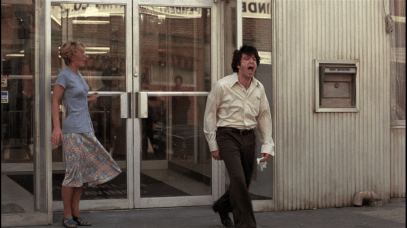
In what is often considered the greatest decade of American cinema, 1975 was perhaps the single greatest year of “American” film. This isn’t to say it produced the “best” films from American production companies – that’s far more open to debate. But 1975 was a year when many filmmakers took their hearts to exploring the then current state of “America” and what it meant to be an American at the time. Among the fresh crop of 75 is Dog Day Afternoon, often undervalued in relation to the other pillars of that year’s Oscar showdown (Jaws was the first American release to hit 100 million dollars box office gross and ushered in a new era of blockbuster filmmaking, One Flew Over the Cuckoo’s Nest would take most of the glory at the Oscars, becoming one of only three films to win the Big Five awards, and Nashville is, well, the greatest and most definitive examination of American life ever made).
Continue reading

Film Noirs and Cinematic Scars: Kiss Me Deadly

Updated mid-2015

Kiss Me Deadly, released in 1955, is one of the last great classic period film noirs, but it wasn’t often acknowledged as such originally. It was fought by politicians and “moral” figures at the time of its release, seen as the kind of film dangerous teenage types went to see in hopes of engendering social subversion. And this concern, about the danger it posed to accepted, conservative social mores, was valid: not only is this a lurid and exploitative film, but it has the gall to elevate these qualities to high art and use them to reflect on the luridness and exploitation perhaps intrinsic to human nature. Continue reading

Midnight Screaming: The Shining

Updated mid-2015

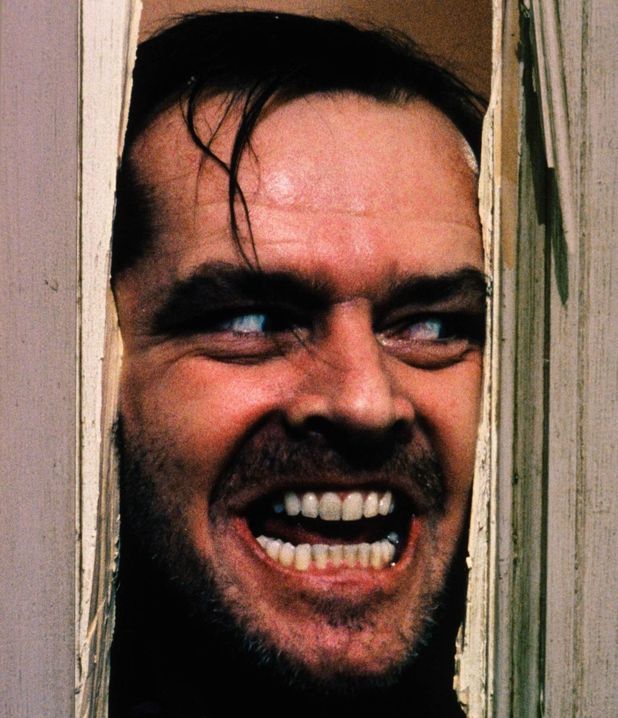
Stanley Kubrick spent a long time lost in the wilderness of The Shining, and perhaps fittingly for the famously brutal director, it has a back-story to match its on-screen horrors. Most famous is the off-screen feud between Kubrick and the author of the book the film is based on, Stephen King. King’s voice was becoming increasingly popular when the film was released in 1980; he was on his way to becoming a genuine pop culture phenomenon, and his famous distaste for the film drew much media attention, so much that it threatened to overshadow the film itself. Thankfully, Kubrick was an imposing, conniving, controlling maelstrom of a director, the kind of man who, for good or bad, would never release a film that would stand behind its backstory in import. Perhaps because of all the tensions surrounding the film’s production, he had no real choice but to up and direct a masterpiece. He succeeded.
Continue reading

American New Wave: The Wild Bunch

wildbunchhedEdited

Few genres run the gamut of nervy nightmare to clear-conscience mirth like the Western. Some films have used the medium to push deeper and deeper on the world’s great un-bandaged wounds. But, traditionally,  the genre has been enjoyed for its ability to set the mind at ease. Filled with  grand, black-and-white archetypes which convince us of a world long-gone predicated on righteous morality,  the Wild West is less reality than a dream, a moral vision of America’s mid-century hopes for a conservative world in an era where the world’s complications were increasingly boiling to the surface. In the 1940s and 1950s, the genre was the ultimate in cinematic comfort food.

Continue reading