
 A little switch-up, if you will, because I couldn’t watch a 1961 Cannes film at pace, but will get to it soon enough. So 1961 and 1962 have been flipped, after which the order shall return to normal…
Luis Buñuel’s triumphant return to Spain after many years working in Mexico was short-lived but unequivocally rabble-rousing. The lone film he produced was as provocative a film as the world has ever seen. 1961’s Viridiana won the Palme d’Or, was rapturously received by critics, and revolted the Spanish government right from under their noses. The production was, charitably, pure havoc, subject to rigorous and ruthless censorship, and produced with the help of tricks and masquerades on Bu>ñuel’s behalf. It is one of the quintessential works of world cinema, by all means, but it came with a toll. Jagged knives aimed at the Spanish government, it seems, couldn’t but get a little blood on Buñuel’s face. Continue reading
 In my review of Nights of Cabiria, I noted that Federico Fellini grew more fantastical and whimsical with age, and he became forever less entombed in the limits of pure realism. True, and it might be assumed that with whimsy and fantasy come happiness and warmth. To some extent, they did; Nights of Cabiria ends on one of the most singularly uplifting notes in all of cinema. But whimsy does not automatically imply joy, nor a new leaf. Fellini was still an angry, tormented, complicated man; he had simply developed a new filmic vocabulary for exploring his emotions, whatever emotions they may be. New storytelling mechanisms dictated how he would explore emotions, and not what emotions he would explore. His application of Hollywood romance and Italian/ French romanticism was not always an uncomplicated acceptance, but more often a dare. Fellini would follow romanticism and melodrama to their limits and see if he could come out the other side a believer. With La Dolce Vita, melodrama is a slaughterhouse, and you unravel from the other side in shreds.
  After Pat Garrett and Billy the Kid, Sam Peckinpah would move away from the 1800s, although that doesn’t mean he left the Western behind. Bring Me the Head of Alfredo Garcia is without a doubt a Western; it is as cracked and craggy as any of Peckinpah’s prior films, and its thematic content is almost identical, although it takes place in the 1970s. This is fitting, and perhaps the only way Peckinpah could have progressed as a director. His prior two Westerns saw the end of the era, with Peckinpah tackling the transition from the individualist, outlaw lifestyle to a more socially sanctioned form of violence bred by corrupt and violent men being buttoned up on the outside without actually curbing their violent tendencies on the inside. The Wild Bunch and Pat Garrett and Billy the Kid were about the end of the West, but also about its continuity, its persistence in the modern era. The deserts and the ten-gallon hats had been replaced with institutions and machinery, with the industrial revolution and government. But the raspy habit of men fighting the only way they’d been taught how, and the curdled fact that these men were being destroyed by these ways, remained.
  It is easy to view Pat Garrett and Billy the Kid, Sam Peckinpah’s first Western post-The Wild Bunch, and examine it as a follow-up to that seminally shrieking exercise in wolf-like nihilism. It would be easy to do so, and probably correct, but also incomplete. Pat Garrett, which follows ex-outlaw turned lawman Pat Garrett (James Coburn) as he vengefully hunts down his ex-partner Billy the Kid (Kris Kristofferson), bears an outline that is almost identical to The Wild Bunch. In both films, an ex-outsider who becomes a man of respectable society is strangled by his dogmatic commitment to hiding the memories of his lawless days by killing the last reminder he has of those days. In both films, the violence of wild society gives way to the violence of so-called “civilized” society, and in both cases, the social outlaws must die so that the corporate, conglomerate violence of civil people can live.
  If you are a cinephile, it is a fair guess that you have seen your share of war-time romances, one of the stodgiest of all film sub-genres. But that does not mean you have a Soviet war-time romance, nor have you seen a Mikhail Kalatozov war-time romance. Kalatozov is one of the masters of world cinema (his later Yo Soy Cuba is both a passionate ode to a lifestyle and a perplexing, dumbfoundingly beautiful exercise in pushing the heights of camerawork to impossible achievements). He is not nearly as well known today as he ought to be (but the same can be said of all post-Eisenstein Soviet cinema, excepting Tarkovsky), largely because political lines in the sand were well entrenched by the time Cranes was made. He was bound to the lingering death of existing in a world with more interest in denouncing art than expressing it. At least Cannes got it right, putting political qualms aside and awarding The Cranes are Flying the Palme d’Or for its luminous artistic achievement, transcendent performances and craft, and its stunning ode to love and loss in a world that no longer knew the meaning of the former term.
 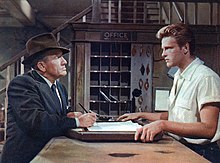 John Sturges, mostly famous for his two later rugged process-driven films, The Great Escape and The Magnificent Seven, drew out a mostly forgotten niche of manly not-quite-action films. They weren’t really violent, but they had the soul of action entertainment in their braggadocio and mechanics-first brand of raspy storytelling. His two most famous films are given at least the repute of minor-classics, but he is not particularly associated with them. He was a man who worked with groups of talented actors, and they often dwarfed him in the final analysis, not because he was appreciably under-skilled, but because he always subsumed his skill to the mechanics of the narrative, and we as a society tend to focus on actors and narrative at the expense of directors. He didn’t have a truly unique style, so to speak, but he was an ultra-competent director, and arguably the ultra-competent director. And his competence never tipped over into out-right genius quite like it did in Bad Day at Black Rock.
  With the culmination of the month-long Worst or “Worst” feature on some of the alleged worst films ever made, what a better way to return to the weekly Midnight Screening series than a great film about the guy who made some of the alleged worst movies ever made…
 The Wages ofFear, Henri-Georges Clouzot’s famed French-Italian white-knuckle thriller was and is almost incomparable as an exercise in hair-raising. It is so well edited, choreographed, acted, and composed that one almost wishes to reduce it to the level of thriller alone (not that, with this skill, it would be “reducing” per-se). Yet Clouzot was not, nor was he ever, simply content to thrill. His scabrous films simply used the conventions of thriller cinema to chill to the bone, to indict and valuate, to scare, to hope, and to leave nothing in their wake. His 1953 work is absolutely one of the most thrilling films ever released, yet this does the texture of the piece a disservice. If it is Hitchcockian, and Hitch is the director Clouzot is almost always compared to, then it evokes Hitch on all his levels, not simply thrilling but tacitly provoking and confronting society’s very base construction and the nastier aspects of the human condition under a thin membrane of sharply composed set pieces.
  There are precious few films about childhood. Many aim for an audience of children, but most look down upon them in their assumption that they will eat up any and all immature entertainment simply because it is handed to them. It is the rare film that tries to peel back the layers behind childhood and to give us a look at what growing up entails. Because it is difficult to focus on children in film without rendering them types, either immature simpletons who do not understand the world or wise-beyond-their-years precocious types who “know” better than the adults around them, it is rarer that a film succeeds at presenting childhood with a quiet sigh, knowing a certain maturity without ever losing itself in the adult desire to judge and moralize to children. There have been a number of great films about childhood, but none stand taller than Francois Truffaut’s debut film, the work that kicked off perhaps the most important movement in film history, the French New Wave: The 400 Blows.
  In honor of their seventy-fifth anniversary in 2015, I present a pair of reviews for my two favorite Disney animated releases, both released in the same year, 1940, and both far more challenging and transformative than any feature film the company has yet released since. The two introductory paragraphs of the reviews are identical or nearly identical, but the meat of the reviews are film-specific.
 The Long Take