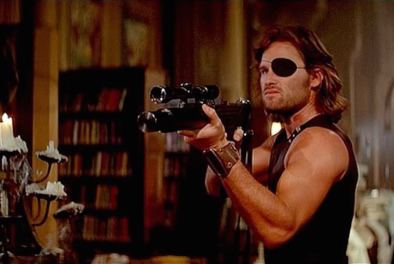
 Update June 2019: After a rewatch, I’m struck by how much Escape from New York’s essentially anti-authoritarian stance also feels like a quintessentially early ’80s response to the failures of the liberal project of the ’60s and the New Hollywood project of radicalizing cinematic form in the ’70s. Carpenter’s film undeniably paints a picture of the powers that be as deluded autocrats and maniacal functionaries, but its post-hippie validation of anarchy defines itself individually and skeptically rather than communally and with a utopian accent. On balance, I don’t know how I feel about this any more than I do Carpenter’s deliberately fearful Assault on Precinct 13, where a black cop and an old-school white criminal learn to get along only while under siege from an interracial army of cinematographically-zombified gang members putting aside their racial differences to assault the status quo. That said, while Assault merely updates and urbanizes Western conventions, Escape ironizes its, offering up cinema’s greatest ode to and takedown of the John Wayne archetype, one who refuses to coopt societally-accepted norms of the “good” (even if it means doing “bad”). Plus, it’s pretty great filmmaking nearly forty years later, a phenomenal exploration of Carpenter’s singularly elastic ability to massage visual absence into a vision of apocalypse, be it at the level of the individual (Halloween, faceless evil), the local (The Thing, evil in our own image), or the world, as in this film.
Original Review:
Scruffy and stubborn as a mule, Escape from New York is probably a failure for director John Carpenter, but it is a treat for anyone else all the same. Carpenter has been vocal about his genre-DJ dreams of hopscotching from horror to action to Westerns to fulfill his inner-desires of throwing pebbles toward all outsider genres under the sun. More pragmatically, he sought new genres to avoid type-casting as a master of horror. Trouble is that Carpenter’s soul, despite his brain telling him otherwise, was a horror director, and his eye followed his soul. Even Carpenter’s best action material – 1986’s Big Trouble in Little China for one – doesn’t work so much as an action movie; it’s more a deconstruction of American action movie tropes that tickles the rib with how foolish American action movies could be. Whether or not that was Carpenter’s intent, the arguably accidental success of Big Trouble reveals a director who didn’t have much of an eye for conventional action directing, for his action directing was too sluggish and stilted to function as a serious work of the form.
Continue reading →

 With Jurassic World’s 500 million global first-weekend box office take, it is already commonplace to glorify the return of a franchise that has been some combination of long-dormant and actively awful for almost two decades now. Championing its return to quality is not a new point, although it is an incorrect one. Jurassic World is a bad film. Not only that, it is peculiar and abnormal in its badness. A great number of corporate tentpole blockbusters are soulless and mediocre – look at Age of Ultron just a month post-release – but seldom are they bad in a particular and notable way. Corporate spending on audience-testing mandates that blockbusters will be spic and span, not necessarily good, but not disconcertingly or notably bad. They may be corporately bad, or bad in a sterile way, but not specifically bad, and not especially bad. Jurassic World does a great many things that are specifically, especially bad, and that is, if not a good thing per-se, at least an accidentally worthwhile one. Continue reading
  Because that other “Jurassic” movie just went and had the biggest opening release weekend in film history…
 It is both poetic irony and a great shame that Tomorrowland shares two features with its fellow May 22, 2015 wide release, Gil Kenan’s Poltergeist remake. First, both films boast directors who are inordinately perfect for the films they were matched with. Second, in each case, that director didn’t do their job, or found themselves victims to outside interests. In both cases, the acquisition of the ideal candidate for shepherding a certain film did little to actually ensure said film was any good. If nothing else, this phenomenon tells us one thing: auteur theory, and the idea that a director can do anything to ensure their films will reflect the core of their talents and personhoods, ain’t everything when all is said and done.
  By and large, this adaptation of David Mamet’s 1984 update of middle-century tales of economic middle-American woe is a trenchant, vital work of writing enlivened by a cornucopia of destabilizing performances of the highest order. It is, admittedly, hard to square with the cinematic adaptation when so little of the piece actually benefits at all from being made into a film, visually speaking. But sometimes the felt force of the writing is so affective on its own you just have to let measly little things like “filmmaking” slide.
 Since his debut in 1939, the midnight man who capes and crusades has never been out-of-style. Sure, the gee-whiz ’60s and the bruised, cynical ’70s brought out the mightiness of new kids on the block Marvel Entertainment, but DC prevailed and only came back more haunted in the dark days of the gaudy 1980s. With Batman brought back to his roots in garish German Expressionism in the late 1980s, the character became all the more fittingly haunted for a fittingly haunted turn-of-the-’90s America undone by the failures of Reaganomics and the harsh realities of urban living. The character was also, alas, all the more apt for chauvinist, fascistic abuse by the likes of Frank Miller, who eventually took to dumbing-down the figure to the levels of America’s latent (and often very much more than latent) fixation with harsh individualist justice and uncritical depictions of masculine men keeping the evils of society at bay. A philosophy that was, boiled down, the card-carrying crux of 1980s fiction at its worst.
 A little late on this, but in honor of Tomorrowland, here is another, more successful, Disney attempt to turn a theme park attraction into a live-action film, a success that has haunted their follow-up attempts to this day…
 At its best, horror cinema works like a trance. From more esoteric, cryptic works like Dreyer’s Vampyr to pressingly, pulsingly modern joints such as It Follows and Under the Skin, the genre cuts through the fat and almost approaches us on an unconscious level. At its best, which isn’t nearly often enough, the new Poltergeist almost gets there. Director Gil Kenan is, at a conceptual level, the perfect shepherd for the material – his animated Monster House is almost an animated Poltergeist anyway. Unfortunately, it ends up being a much better Poltergeist remake than the one he would go on to direct a decade later. The one, you know, called Poltergeist.
  Christopher Nolan has always had a problem with his inner thoughts drowning out his ability to make compelling cinema, and the companionship of David S. Goyer in the writer’s chair has never been rectifying. Case in point: The Dark Knight Rises is a belabored mass of hang-ups, side-treks, false starts, hasty endings, and ignoble intentions. On the latter, the film’s villain Bane (Tom Hardy) – who turns Gotham’s poor against its wealthy so that he can profit in the end – is a troubling figure of social dejection and husky sooth-saying radicalism, and he is, without a doubt, a symbol for the false intentions of working class leaders, or Nolan supposes. If the superhero genre is a card-carrying caretaker for traditionalist individualism, libertarian democracy, and the American Way, The Dark Knight Rises is the flag-waving stalwart with a mouth for the status quo. It makes no bones about its fear that the working class is a raving groupthink machine defined only by its inability to restrain itself, lying around in wait for an opportunity to search and destroy and just hurting for an anarchist fight.
  Edited May 2016
