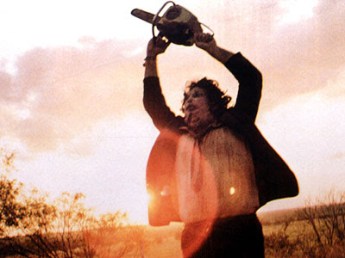
 Updated mid-2017 after another rewatch – such an amazing, amazing film, not particularly violent in a diegetic sense, but one which feels as though violence has been done to it.
This post being in honor of the film’s fortieth anniversary this upcoming Wednesday, October 1. Here’s to forty more years of soul-deadening terror.
The story of five nobodies wandering through rural Texas and running afoul of America’s hidden secrets, The Texas Chainsaw Massacre is infamously violent, which is curious because it’s hardly violent at all. The body-count is shockingly low and deaths happen mostly off-screen, relegated to the abyssal margins of an already poetically empty screen space, one which seemingly voids participation in a wider social milieu. But if the movie feels violent more than it is violent, that’s because it feels positively disgusting. This is grimy, disturbing filmmaking in every possible way, almost toxically fugitive in its disobedience to propriety. It may be one of the grossest-looking famous movies ever released, somehow both punishingly direct and monstrously, mystifyingly oblique, like it’s showing us everything head-on while veiling more submerged truths about American discontent. The film grain, even for the time, is knowingly poor – it feels like a documentary more than a film, lending it an unsettling and grimy immediacy, but also an evasive sense of ambiguity. The film-grain scratches which are testament to the authenticity of its expression of reality also suggest the film’s curiosity about a reality that is ultimately inexpressible, a sense of horror which is both extremely forthright – sometimes breaking through the film screen itself to confront us head-on – and obliquely suggestive of terrors we aren’t, and perhaps can’t be, privy to.
Continue reading →

 As we keep on barreling forward toward Marvel’s Phase Three films and pretending it will be meaningfully different from Phase Two or Phase One, Marvel continues to pass the time along the way by merrily trucking along with more of the same. Well, I should be generous – each film is ever-so-slightly different while still managing to lie easily within the series’ collective less-than-notable ambitions. For this 2014 sequel to the competent 2011 cheer-fest, things get a little bit darker and more socially confused as the filmmakers choose to mash-up their consummate action-stravaganza with a political thriller that aims to reshape the Marvel Cinematic Universe (that the filmmakers are under the impression the Marvel Cinematic Universe is well-defined enough to be meaningfully “reshaped” speaks more to the egos at play than anything else, as well as the film’s self-conscious bid for serious-film status). Unfortunately, and as is becoming a common problem for this series, the film’s ambitions are somewhat undone by the all-encompassing fact that it just had to go and be a Marvel film. That it is one of the better ones while still being essentially an also-ran should tell you all you need to know about how you’ll come down in the end. But either way, solid filmmaking in the name of a somewhat tepid goal continues to be the name of the game, for better or for worse.
 It’s a thing of wonder that filmmaker JC Chandor made the mostly silent All is Lost, his second film, directly after the dialogue-stricken Margin Call, a corporate thriller (perhaps the most dialogue-heavy genre in existence), his feature debut. Of course, the difference between the two is more one of taste, but this second film, which knows not the realism of dialogue and must rely on the more affectingly filmic lens of pure imagery, is more satisfying as an elemental wonder and a parable of human loneliness. The narrative is archly straightforward, uninterested in fussy complication or false villains. We have an old man (Robert Redford) and we have a sea (well, the Indian Ocean), and these old friends find themselves for once on the opposite sides of an argument. We follow them as they resolve it.
  Edited
 Where-as most film series tend to decline in quality with age, time has been kind to Tom Cruise and his chosen cash-cow, the Mission Impossible films. While this 2011 entry lacks Phillip Seymour Hoffman’s deliciously bored villain, no small part of why III was the best entry in the series up to that point, it’s an improvement in just about every other way. Above all, and most surprisingly, it has a sense of humility. In its treatment of its characters less as too-kewl-for-school icons and more as confused, kinda-wacky cartoon personalities defined less by their self-serious gloom than much smaller, much more affecting and endearing character moments, it finally approaches a sense of identity for a series that often seemed happy-go-lucky to ape other franchises. This is a “big” film, but it doesn’t feel “big” in the way other blockbusters do – it has a lived-in quality, less about one man doing stunts than a team struggling to get along and admit they’re enjoying themselves while doing it (although it certainly has plenty of the former as well). At times, it even mocks the self-seriousness of other blockbuster franchises, and implicitly, itself in the process. It would appear what they say about looking back on your misfortune with a smirk is true. At the least, MIIV believes it is true, and it wants us to know it too.
  Star Trek is so light on its feet and cheerfully reckless it is almost impossible to dislike. Except that it does a whole lot worthy of disliking. This is a film wholly dedicated to lean, mean, efficient summer-blockbuster filmmaking. And if it is a decent entertainment for this reason, it sure isn’t interested in doing away with many of the flaws found in modern mainstream blockbusters. Yes, when it came out in 2009 it was the perfect fix for weary summer movie goers tired of sequels and superhero films, and, as the icing on the cake, it filled a void for Star Wars fanboys who couldn’t get over George Lucas’ recent efforts. Except…apparently what they wanted was a rather competent blockbuster so concerned with action it fails to concern itself with anything else. This achieves the rather depressing goal of creating a fairly solid and sturdy action extravaganza, while also somewhat sapping the film of most of its heart and soul.
  Update fall 2018: Been a few years since I last saw this before the current viewing, but After Hours remains truly unstable, and clearly too brutally crazed to be labeled a psychoanalytic “portrait” of Scorsese, with all the easily-contained clarity and visibility the notion of a portrait implies. After Hours is much more of a working-through than it is a legible work of art; it’s the rattled consciousness of a director obviously exposing himself to nervous tendons in search of transcending them, and it’s gloriously untamed.
 Terrence Malick didn’t crash into the film-world – he stumbled into it, but the impression he left wouldn’t convey the truth of it. A philosophy student at Harvard who studied Kierkegaard, Wittgenstein, and Heidegger, he went on to teach at MIT after a petty disagreement with his advisor while studying as a Rhodes Scholar at Oxford (although in the world of philosophy, everything and nothing is petty). At some point along the way, he decided he felt like making a movie, and the world was never the same. That film, 1973’s Badlands, is so stunningly like every other kids-on-the-run crime film from the American New Wave from a distance, it’s almost comical. But from up-close (or even medium distance), it’s so glaringly apparent that Badlands is the antithesis of the films it’s often compared to (ahem, Bonnie and Clyde) that the initial comparison seems so superficial as to not even be worth noting. Badlands is unlike any film from the period, and American cinema more genuinely. It is a singular experience, and a towering, titanic one.
