 Update 2019: Another viewing, and the sensibility of The Warriors intrigues me even more than last time. While Walter Hill’s film feigns late ’70s New Hollywood realism at times, it’s a mislabelling, and perhaps an intentionally teasing one. Rather than presuming access to the “reality” of the lives of these youthful characters, Hill creates a world out of time, a big, poisonous apple that animates its characters’ interior psychologies – their aspirations to stave off the doldrums of youth by abstracting their own identities and turning themselves into heroic caricatures – but seems to keep the protagonists at a melancholic remove. It’s as though the city is their playground, but it can’t be their home.
The excessively affected, even stilted milieu of the film stands totally at odds with the presumption that it will offer a ragged portrait of gritty street-level realism. Instead, Hill offers an effusion, perhaps, of the inner abstractions these characters use to authorize their own sense of play. The film’s poetic weave drops them into this world and characterizes them via their actions, not references to the lives external to the world the film has created; it offers no sense of what they might be doing when the camera is not upon them. The elegiac tone of the film traps the characters, suggesting, tragically, that these wayward youths are embalmed in a tableaux, locked into some eternal struggle, or one they imagine to be eternal, that seems to deny them a sense of life outside this caricature.
It is as if the film is aware that its flattening of emotion, the way it stages the characters in a predetermined theater, robs them of the ungovernable beauty of human spontaneity. This New York is a purgatory of riddles, conjured as a vampiric entity that Hill sketches with a disturbed, almost demented aura, sucking the characters’ possibilities dry even as it scaffolds their imaginations. This is the diametric opposite of a Cassavetes picture, in other words, but The Warriors leans into its limits, and thereby exposes them, and perhaps transforms them into a strength, a sorrowful portrait of characters who seem doomed to the fate that the world, and the film, has dealt them.
Original Review:
There are all manner of things to begin with when discussing Walter Hill’s vigorously urgent 1979 comic book dissection of youth culture (read: action movie focused on gangs in the inner city), but I will choose to begin as the film does: with its opening titles. Fading in on a stark, abstract image of the neon lights of a ferris wheel off in the distance, alighting the blackness with a sickly, neon-tinged purple spinning around, the image then cuts to a similarly stark, darkened shot of blue lights moving across the screen which soon reveal themselves to be the windows of a subway train. A train, a ferris wheel…everyday objects both, but the film distances them from us, suffuses them with an unholy aura, and elevates them with an alien quality, displacing them into a world we do not, and possibly can never know. It’s haunting, a shockingly mellow, plaintive, introspective opening gesture for what is by all means a surface-level blast of energy, but it signals the film’s eye for cinematographic abstraction and its fable-like, neo-classical texture where characters are less people than figures in an icon painting.
Continue reading →

 Repulsion
 It’s been a couple weeks, so here’s a double-dip of classic cult comic book movies for you, and some prime so-bad-its-good filmmaking on both counts.
  It’s been a couple weeks, so here’s a double-dip of classic cult comic book movies for you, and some prime so-bad-its-good filmmaking on both counts.
  Update mid-2019: With the release of a jokey, essentially hesitant new Shaft film that seems more frightened of the possibility of a serious African-American hero than skillfully parodying the same archetype, the original 1971 film’s defiantly un-hesitant seriousness is bracing to this day. Cutting both American politics and the elephantine girth of ’60s Hollywood productions down to size, there’s a fugitive simplicity at the core of Shaft, a no-nonsense vision of black empowerment that simultaneously seems uncertain about whether it is truly achieving anything politically. As a film, it’s both a blunt portrait of a rapidly neoliberalizing America and, despite its black heroism, a skeptic when it comes to the question of whether this “sex machine to all the chicks” is truly the hero who will lead us after the fire next time.
 I apologize for the temporary absence of the weekly Midnight Screening from this blog for the better part of the month of November. I was too busy elsewhere and found myself too distracted with other reviews. I justified it to myself by reminding myself I had published three full length reviews instead of the usual one for the final week of October, but, seeing as I didn’t tell you all playing at home about this, that’s not an excuse. I’ll try to be better about staying consistent and giving a heads-up when things are to change. On the positive side, I can’t think of a better film to re-start the series with than this week’s entry. Consider it an apology. Enjoy.
 For this week’s Midnight Screenings, being that Halloween is upon us and all, here are reviews of three modern would-be Halloween films destined for years of “Midnight” Screenings all throughout the land.
 For this week’s Midnight Screenings, being that Halloween is upon us and all, here are reviews of three modern would-be Halloween films destined for years of “Midnight” Screenings all throughout the land.
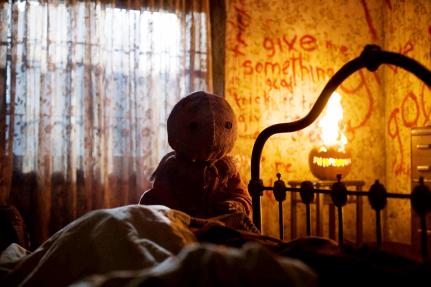 For this week’s Midnight Screenings, being that Halloween is upon us and all, here are reviews of three modern would-be Halloween films destined for years of “Midnight” Screenings all throughout the land.
  I Walked with a Zombie was the second film Val Lewton produced once given complete control of RKO’s horror unit, and it was released only a year after Cat People, his most famed horror film. Given this, one might expect a retread, but I Walked with a Zombie is certainly not the film anyone then or now would be expecting. A tension seethes in the air and grasps all, but the film doesn’t demand in the way a work like Cat People is so tersely constructed to fight for our attention. Absent are the soul-deep colors of Cat People which lighted up the screen with black energy. And in place of the rampant diluted German Expressionism of American horror throughout the ’30s and ’40s, all caught up in harsh and angular nightmares, we have something that more closely approximates a hazy dream, a curious cross between an English period drama and a work of French impressionism that centers mournful, elegiac long takes and has room enough for lost secrets deviously begging to get out . It is, above all, wholly distant from anything resembling horror logic, and it is all the more fascinating for it.
