
 So, “comedy sequels” right?
In the modern era, funny films have become almost non-filmic, layering a thick slab of verbal humor on top of antiseptic, unfeeling visual composition and also-ran technique. The worst of the lot don’t even get us that far, barely even introducing “writing” to the mixture and crutching themselves entirely on the often game talents of an actor or two. Comedy sequels, meanwhile, are bottom-of-the-ladder throwaway gags at best, not so much non-filmic as anti-filmic abominations. That they tend to run through the predecessor’s jokes is the least of their problems. That they tend to be actively painful is probably higher up on the list.
Addams Family Values is a comedy sequel with a difference, and that difference is director Barry Sonnenfeld. Not only Barry Sonnenfeld, of course. Writer Paul Rudnick’s screenplay has a wonderfully droll eye for ’60s sitcoms and a deliciously sideways slant on how to turn middlebrow Americana on its head, and it provides game food for a veritable cornucopia of scenery-tearing actors playing to their ostentatious, blistering best. It’s not quite agitprop, but for a blockbuster comedy with a relatively girthy budget, it plays shockingly recklessly with its audience and comes close to holding its knives right to their face. A great deal of this critique is openly part of the text of the film, with a sub-plot featuring two of Charles Addams’ pugnaciously demented Old Money family members, Wednesday (Christina Ricci) and Pugsley (Jimmy Workman), going to town on the smarmy corporatized Main Street Americana icon that is the summer camp.
Continue reading
 With the culmination of the month-long Worst or “Worst” feature on some of the alleged worst films ever made, what a better way to return to the weekly Midnight Screening series than a great film about the guy who made some of the alleged worst movies ever made…
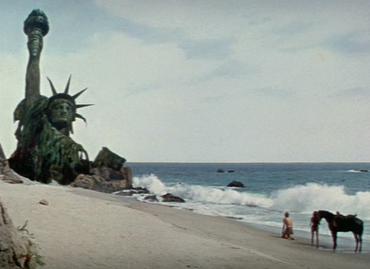 Right from the beginning, Planet of the Apes settles itself on a nexus between tactile action and implacable inaction. The prologue, set on a spaceship as astronaut George Taylor (Charlton Heston) throws his throaty baritone into a mission log, establishes the very 2001: A Space Odyssey sub-Kubrickian cosmic chill of the material. Taylor, along with Landon (Robert Gunner) and Dodge (Jeff Burton), are on an amorphous vision of an intentionally nebulous, even pointless nature; what matters is not where they are going or why, but the existential frostiness of the pallid white of the ship’s interior and the very present deadened quality in Heston’s worrisome but unconcerned voice.
 What a strange, messy phenomenon the Pink Panther franchise is. When it began in 1963 as a slight, indifferently pleasant movie about a jewel thief (played by the ever-smarmy David Niven, who was given the lion’s share of the run-time) and an inept side-character vaguely pretending to hunt him down , expectations for a sequel, let alone a cottage pop culture phenomenon, were little. Now, the first film, The Pink Panther, did not exactly set the world on fire, nor does it truly qualify as a phenomenon. But relative to what it might have been – a throwaway ’60s fluffy star piece with some entirely game actors in the distinctly ’60s laconic-swinging mode so ubiquitous in 1963 – something caught fire.
 Another relatively short new feature to round out the month, this one about so-called “entertainment” films for the masses in the 1960s. Even when they weren’t doing much of anything else, films from this decade, the golden-age of gee-shucks entertainment, sure knew how to pop!
 Yankee Doodle Dandy really doesn’t make it easy for itself. Consider the strikes against it. It is a Grand Old Biopic madly in love with its own subject matter. It is filmed by a director, who, for all his multitudinous strengths, was never all that invested in subverting or transforming his screenplays, a filmmaker who drew his vigor and interest precisely from the subject matter and the screenplay he was tackling. It is also a quintessential work of matching a great actor to an important historical figure, just about the biggest talent-suck set-up any film could possibly dread. With a performance and a subject to fill the box office and wow the middlebrows, a director has carte blanche to indulge in all the soporific tendencies of a screenplay, to blindly and blandly fill the screen with blasé Important Moments rather than to actually prop up the storytelling with invigorating artistic gestures. It is, in other words, a work that was dead in the water – artistically speaking at least – even before its release.
  At some level, we must concede that Michael Curtiz was more of a filmmaker of efficient craftmaking than superlative artistic ambition; this sense of getting-the-job-done pervades even his masterpiece, Casablanca, but gosh darn it, well-oiled-machine filmmaking has never been more delectable than Michael Curtiz filmmaking. The perpetually underrated master of the craft was no auteur, nor did he want to be, but his films sparkle with single-minded clarity and blunt craft like nothing else from the Hollywood machine in its early days. Again, he was a studio guy for Warner Bros and he always operated with a sort of humility to his stories that saw him not so much take control of them and do with them as he would; rather, he focused on a propulsive forward movement to his tales, a sort of inescapable quality that made the stories feel like they were telling themselves first and foremost. Yet Curtiz was always there, making functional filmmaking the food of the gods and cutting through the fat to produce films that, if not entirely perfect or challenging in the most overt of ways, were at east the most perfect versions of themselves.
  It must be said: excepting The Matrix, no single film has done more harm to the modern cinema industry than Pulp Fiction. The old “every filmmaker who saw it made their own movie” card is the great equalizer, uniting genuine talents and hacks alike. But in the case of Tarantino, the results were far from equal. A few genuine craftspeople followed in his wake, but they were diamonds in the rough compared to the far more significant cohort of filmmakers who whipped Tarantino into a frat boy’s wet dream and perverted his vision of cinema from the ground up. Largely, this has to do with Tarantino’s supposed “cool factor”, the superficial blanket hanging over all his films that has beckoned first-timers the world over to ape his penchant for slick, sick violence, whirlwind camera jerks, and self-consciously fantastical style. This style has always been a noose around Tarantino’s neck, and it has strangled the world of cinema for years to come.
  In order to properly understand Starship Troopers, one needs to understand its casting. At some level, casting is the de facto entry point for any of Verhoeven’s American films over the decade from Robocop to Starship Troopers. Total Recall, although somewhat muted by its need to be an Arnie vehicle, definitely gestured toward using the big lovable lug as a critique of the idea of an Arnie film. More successful was Basic Instinct, where Verhoeven cast a seemingly unaware and genuine Michael Douglas more for his weathered, aged wrinkles and flagellating variant of all-American thuggery. And one doesn’t need to explain Showgirls these days, a work where Verhoeven cast (cruelly so, at that) the young whippersnapper Elizabeth Berkeley and forced her through all manner of gross, grotesque abuses on screen in a meta-commentary on the way in which her character, and young Hollywood starlets altogether, are forced to go through the wringer to find success, leaving others in their wake and losing their dignity and respect for themselves as they forced to do the unthinkable.
 Having finished the extended yearly New Wave series that somehow held me hostage until well into the mid ’90s, I’ve decided to go back to a couple of reviews I had milling about but didn’t make it into the yearly bit. Both are related formally in that they star Gene Hackman and more existentially in that they illuminate important realities about the cynical ’70s that frighten like few films we can think of, and which may be more relevant today.
  The Long Take