 Update 2018: How I do love this movie. If Altman’s oneiric fluctuations and clouded, evasive truths are as wonderfully resistant to crystallization as always at the beginning of 3 Women, they eventually sour into full-on psychotropic nightmare by the conclusion. By the film’s end, Altman holds life in a Janus-faced state of simultaneous free-fall and resting haunt. It won’t be for everyone, but catching this film’s wave-length is uniquely rewarding precisely because it is so slippery, its mind so hauntingly unquiet, ever-still but always subtly shifting with a frightening lack of clarification.
What’s so fascinating about 3 Women is that it retains so much of Altman’s typical sensibility, from his evocative sense of place to his shaggy, non-committal attitude toward the forward push of narrative, but it twists those features into an entirely different, slantwise milieu. To wit, 3 Women elastically mobilizes Altman’s typically wide, expansive canvas, for instance, not to conjure a community-spanning horizontal weave, as in Nashville, but to probe the psychological lonelines of two women locked into a particularly demented pas de deux of self and other.
Compared to Altman’s typically wistful realism, then, 3 Women is a more mannered vision, a West that doesn’t shuttle us into the chaotic instability of the social world so much as stage a difficult, near-unfathomable tableau for us to parse, one where the fractured, contorted intimacy of two women is more than enough to disorient our conception of selfhood. Like several of Altman’s earlier films, this is still a vision of a dilapidated West. And this “West” is no less a canvas for the self, no less a place where people go to find themselves, even more than 75 years after the “death” of the “real” Wild West. But in Altman’s wonderfully misshapen variation, the West, and Western fiction, is also where identities blur and bleed, where spectral figures wander across the land and seem to diffuse into space itself, where one’s sense of self is tested not against the might of an unforgiving landscape but against the soul of another. Call it McCabe & Ms. Ullmann (and Andersson).
Original Review:
Robert Altman is not about to be forgotten. The man directed a proper handful of esteemed classics in the early ’70s and surged back into the limelight in the early ’90s with a pair of brusquely bitter late-period highlights. For good or ill, however, the greater film community tends to look sideways whenever a good portion of his lengthy, dense filmography is on trial. Say, for instance, anything between 1976 and 1991, a period in which the director made almost a baker’s dozen of fresh films for dissection, many of them rightfully moved past but quite a number truly audacious, brash, deeply personal, and worthy of analysis in their own way. It’s strange to call Robert Altman “underrated”, but the man made a lot of films, and sometimes it seems as if those who love him think time got lost between the early ’70s and its twenty-year later counterpart, the early ’90s.
Continue reading →

 And now for something completely different, although not that different when you really think about it.
 Stop Making Sense is, and this is not nearly as common and ubiquitous a statement as you might imagine, a truly singular film experience. Sure, there are great concert films; Martin Scorsese’s The Last Waltz is very likely a superior concert film with more to say about the nature of music as it exists in the ether. But Stop Making Sense isn’t a concert film, at least in the traditional sense. It is a film about cinema, and about what cinema can do to transform the ethos of a concert beyond what a concert is in person. If this extends it beyond the realm of a concert, it also does more to make us think about what a concert entails as a realm for voyeurism and socio-spatial art. Stop Making Sense does not merely hit the mark for a concert film; it transforms it.
  The 1980s were, with all due respect, the worst time in history for cinematic drama. Cinema as a whole trucked along on a surfeit of fantasy and science fiction films that primarily operated on cruise control but could stumble upon a certain breezy ingenuity when need be. But cinematic art – cinema that sought to say something about cinema and/or explore the art form in a way that doubled as a commentary on the society that would use cinema as a tool of creation and destruction – was at an all-time low. It is telling that what many consider the great American drama of the 1980s (Raging Bull is the only film as consistently revered and awarded, and that was really more of a ’70s film that forget to come out in its proper decade anyway) is most famous for the fact that it was almost never released.
 If we are being honest, Ridley Scott is not a director worthy of his reputation. His 1970s were certainly pretty sterling; he entered the world with a very good, if inessential, period-piece parable in the under-seen The Duellists, and then down-tuned sci-fi to elemental levels of fear with the masterful Alien, one of the greatest genre films ever made. Not wanting to be type-cast at the turn of the ’80s, he upped himself through transposing his native science fiction into another genre, not quite as openly horrific, but with no less to say about humanity’s fears: the noir. The resulting film, Blade Runner, is his masterpiece. The ensuing three decades and more have seen him shoot sloppily back and forth between chasing former glories unsuccessfully and entering the bold, exciting new territory of … stripping the cinematic magic whole cloth from the period piece and turning the genre into a drab excuse for materialist rationalism. Again. And again. And again.
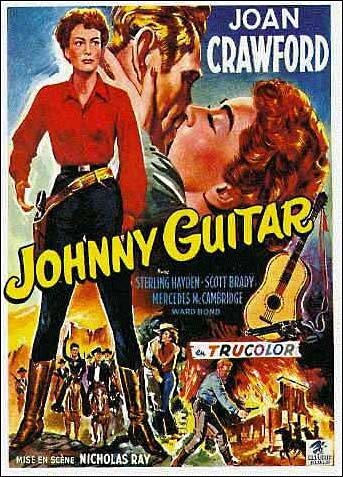 Is there any way to announce a consideration of Johnny Guitar other than the now famous Jean-Luc Godard quote about Nicholas Ray being “cinema”? Famously, the director expressed that Ray was among the first, if not the first, American auteurs to do with cinema as only cinema could, taking up the poetry of dialogue and the untarnished, painterly quality of art and the distant timelessness of theater and encircling them with the vulture of film, engorging itself on the carcasses of other mediums and ensuring they lived on, in altered, transmuted form, inside cinema.
 Everybody’s been talking about it lately, but the Academy is on a nervous show-biz kick recently, with The Artist, Argo, and most recently Birdman winning Best Picture awards in a new glut of the much vaunted “films about films” genre (even if, in Birdman, as it is in many other works, film is only ever sub-textual). Shockingly, you really have to go back sixty five years for another film about the art of stagecraft to win a Best Picture award, and since nearly every review of Birdman has compared it to a certain self-hating implosion from Joseph L. Mankiewicz, I figured Birdman’s award last Sunday is as deserving a reason as any to actually edit and post the review of All About Eve I wrote sometime around like last August (I was busy in the ensuing half year, it turns out). Enjoy!
 The Wages ofFear, Henri-Georges Clouzot’s famed French-Italian white-knuckle thriller was and is almost incomparable as an exercise in hair-raising. It is so well edited, choreographed, acted, and composed that one almost wishes to reduce it to the level of thriller alone (not that, with this skill, it would be “reducing” per-se). Yet Clouzot was not, nor was he ever, simply content to thrill. His scabrous films simply used the conventions of thriller cinema to chill to the bone, to indict and valuate, to scare, to hope, and to leave nothing in their wake. His 1953 work is absolutely one of the most thrilling films ever released, yet this does the texture of the piece a disservice. If it is Hitchcockian, and Hitch is the director Clouzot is almost always compared to, then it evokes Hitch on all his levels, not simply thrilling but tacitly provoking and confronting society’s very base construction and the nastier aspects of the human condition under a thin membrane of sharply composed set pieces.
  There are precious few films about childhood. Many aim for an audience of children, but most look down upon them in their assumption that they will eat up any and all immature entertainment simply because it is handed to them. It is the rare film that tries to peel back the layers behind childhood and to give us a look at what growing up entails. Because it is difficult to focus on children in film without rendering them types, either immature simpletons who do not understand the world or wise-beyond-their-years precocious types who “know” better than the adults around them, it is rarer that a film succeeds at presenting childhood with a quiet sigh, knowing a certain maturity without ever losing itself in the adult desire to judge and moralize to children. There have been a number of great films about childhood, but none stand taller than Francois Truffaut’s debut film, the work that kicked off perhaps the most important movement in film history, the French New Wave: The 400 Blows.
  The Long Take