 Update 2018: JFK is such a wonderfully misunderstood film, and one that opens itself up so heroically to criticism. For instance, it would fit so well into Frederic Jameson’s analysis of post-modernism as the cultural logic of capitalism, where any semblance of truth, social fixity, or totalizing connection between layers of society is totally unmoored, leading to a dangerous relativism that occludes how capitalism reinforces its own social structures. In this criticism, post-modernism dreams a liberation from the social structures that bind us, a dream that dangerously inclines toward individualistic narratives where we all control our own futures, where no social structures confine us, where truth doesn’t constrain our options and is simply a ruse. The form of relativism JFK traffics in – nothing is true or fixed, everything is a lie, etc – veers toward a vision of uncertainty that would probably veer for Jameson toward hiding, rather than revealing, how capital and the oppression caused by capital is the truth which creates and limits possibility, which master-hands reality, which decides who wins and who loses, etc.
It’s easy to disown JFK along these lines. Except that JFK’s abiding well of skepticism for classical guarantees of legitimate truth are heavily tied to both its conscious critique of capitalism’s manipulation of fact and its visual and aural explosion of the capitalistic technologies and visual regimes – tv, film, media – which technologically and stylistically embody modernity and construct reality. Perhaps this makes it more of a modernist film – aware of social totality but skeptical of our ability to visualize it – than a post-modern destruction of any true social totality. But there’s something so conniving and devious about Stone’s vision that it seems to simply decompose the distinction between modernism and post-modernism altogether, as though suggesting that one can argue that truth exists and that truth doesn’t exist and that this is no contradiction. Or that it is a contradiction, and that the best films, Stone’s or otherwise, live within contradiction rather than beyond them.
Frederic Jamerson’s classic analysis of the “conspiracy” aesthetic also applies to JFK, at least on the surface – it’s easily one of the most infamous and infamously perturbed conspiracy films of its decade. Conspiracy stories fail, of course, for Jameson, because oppression isn’t a conspiracy masterminded by a select few autonomous higher-ups conscious of all their actions but a much knottier, more tangled social fabric. Media which can only imagine a conspiracy controlling us visualize the forms of oppression which shape society but can’t surpass the limited view that there are a handful of individuals to “blame” for this oppression.
Nominally, JFK also falls prey to this critique, but its relativistic mise-en-scene, heterogeneous, fragmented audio, and impossible sense of perspective all suggest, at a formal level, something far more perplexed, garbled, and impossible to pigeon-hole than the conspiracy that opiated-masterpiece Kevin Costner’s character divines out of his rattled brain. Playing with its own reality as much as ours, the film offers no incontestable position of mastery over its narrative environs, and it never treats its story as one inarguable truth replacing the one we thought we knew. It does not simply “give us” a conspiracy to explain the JFK assassination; rather, it effuses a skeptical energy, cultivates an inquisitive tendency, handing us a piecemeal truth that the form of the film is already actively questioning and contesting as it is being given to us. It asks us to question its own pessimistic conspiracy as much as we are meant to question the prior optimism of mid-century Americana that the JFK assassination itself dissolved into the ether. Antsy to the bone, Stone’s film seems to be wriggling away from us as it is being composed in the first place.
Original review:
Twenty-five years later and it would take a flotilla of steamrollers to drive over the knotty indiscretions and lapses in logic that stitch (or don’t) Oliver Stone’s JFK into an argument, leading to the common critique of this much-maligned film that it accomplishes nothing so much as a conspiracy nut’s wet-dream power-point about the JFK assassination. That argument is airtight but misdirected, laboring under the assumption that film should only bear witness and testimony to reality, especially historical reality. As most pro-JFK critics have retorted, this is the part where I would say “it’s only a movie” and wipe the slate clean to judge Stone’s film as mere fiction, thus neutralizing the question of whether it is history in the first place, of what actually happened, and of the film’s relationship to historical investigation. Continue reading →

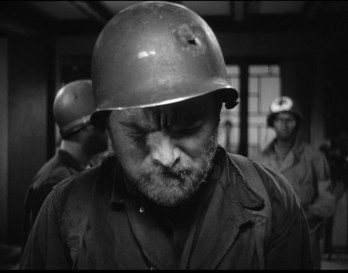 The first Korean War film, Steel Helmet was released mere months after the war formally began, and it benefits from the kind of irrevocable, in-the-moment anxiety that all of director Sam Fuller’s films do. Frankly, the master narrative about the war was still a bundle of unconnected nerves with no central focus yet, so Fuller did what a good Fuller was accustomed to doing: he grabbed the nerves by the claw and jostled them even further. Steel Helmet is infused with a ramshackle vitality and a sense of vicious, viscous dirt seeping into every crack that Fuller so astoundingly tightens up with garrote wire. This is catgut filmmaking, muscular and taciturn and brutish in the manner of a war of attrition mixed with a combustible blitzkrieg, and more importantly, its expediency ensures that the film cannot bother with the tangled geopolitical board-room ideologies of war in a broad sense. Because the war had no overarching narrative (yet), the film only had one choice, the Fuller special: to leave the board rooms behind and make things deeply, uncomfortably intimate, as in camera-too-close-to-the-character-sweat intimate. Continue reading
 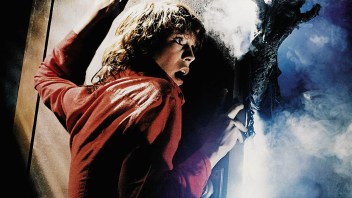 In late ’70s and early ’80s, an era of rapid-onset gigantism from both young blockbuster wannabes (see Lucas, Spielberg) and the then-old New Hollywood dogs who hadn’t learned new tricks but sure dug learning how to spend more money on the old ones (see Coppola, Cimino, both of whom I adore), John Carpenter was a breath of shedding, frigid air. His run from Assault on Precinct 13 through Halloween, Escape from New York, and The Thing is simultaneously a breathless rush and malarial lurch (that contrast being Carpenter’s hometown) through old-school B-picture primitivism updated with hungry young carnivorousness. Smack dab in the middle was the ugly duckling of the bunch, his somewhat forgotten ghost story The Fog, another obvious ode to Carpenter’s youth in the form of a relatively classical, compositionally sound ghost story. Although its reputation hardly precedes it, The Fog is an always humble director at his most humble, maybe his most straight-faced, and, well, not his best per-se, but nearly his moodiest.
 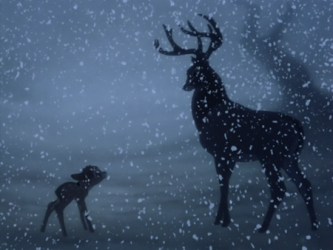 This review published, belatedly, in memoriam of the death of animator Tyrus Wong at the ripe old age of 106.
 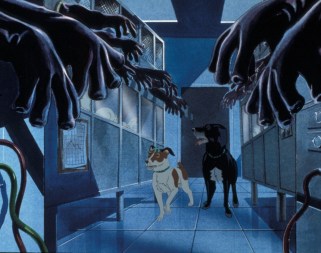 This review published, belatedly, in memoriam of the death of author Richard Adams.
 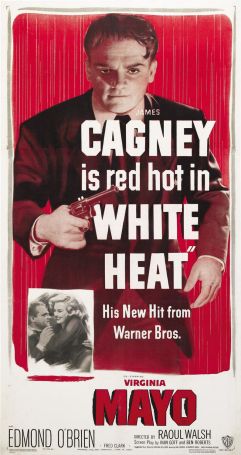 Raoul Walsh’s cold-blooded reptile of a late-period gangster picture finally stills itself only when the genre reaches its apocalyptic acme in the death-scented denouement, the fumes permeating outward off the screen. Even when the credits crawl, the film refuses to be dismissed. The title doesn’t lie – shards and splinters of visual and sonic phosphorous sparkle right into your eyes with infectious charisma – but the punch and gusto are also counterpointed by chills of loneliness and murmurs of exhaustion. Released in 1949, White Heat evokes a genre’s last gasp, a style ready for a nervous breakdown, bracketing staccato bursts of violence to harried melancholia to disheveled, droll comedy. Gone is the wiry little slugger of star James Cagney’s youth found in the likes of The Public Enemy, replaced instead with a self-worrying work that examines its own rat-in-a-cage tempestuousness and ultimately embodies a missing link between Hawks’ Scarface and the downright pernicious onslaught to come in Bonnie and Clyde.
 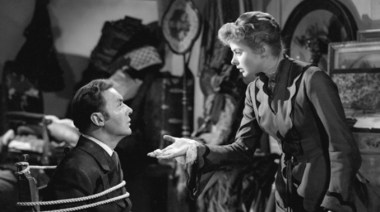 George Cukor’s slightly creaky but undeniably spirited psychological thriller is quite a bit more “potboiler” than it is willing to admit until the Guignol denouement where the old fuss-and-stuff middle-of-the-road “please Knight me now” respectability of the diction and mise-en-scene pounces right into the ditch where it belongs. A B-picture in A-picture threads, it’s only when it unstitches its chest-caving corset that Gaslight finally has room to breathe. Which is to say: Gaslight is a little over-determined and too dignified in its prestige-pic wax to embrace the deliriously illicit trashiness at its core. (De Palma has essentially remade the film three dozen times, and while that statement may be hyperbole, how does one tackle De Palma without exaggeration?). Old Hollywood smut can be oh-so-gallant in its strewn-from-the-gutter and out-on-the-edge charisma when it just smacks some of that musty old regal upbringing right out of its properly-dictioned self. Yet Gaslight, while often killer, spent a little too much time in finishing school, dotting its I’s and crossing its T’s, and not enough time out on the streets learning how to play in the dirt where its heart truly lies.
  A little old-timey cartoon before a feature for you all.
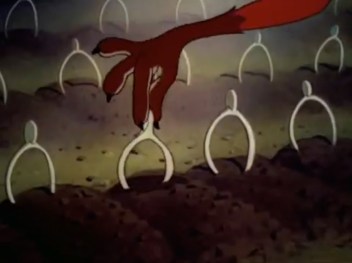 Chicken Little
 I know the post is a little late, but at least I managed to watch these films on Halloween.
