
 It’s hard to deny that a palpable misogyny suffuses The Brood, and director David Cronenberg’s post-divorce fractured attitude toward main character Nola (Samantha Egger) does malignantly spread throughout the film. But as the nexus between Cronenberg’s bodily, corporeal grindhouse films from the ’70s and his more cerebral psychoanalytic studies, The Brood is a more troubled affair. For one, this tale of marital fallout is calibrated for a tenebrous blamelessness, with Cronenberg’s austere style vacillating between perspectives to reform our preconceptions of which parent is truly justified in this atomic deconstruction of the essentially self-sabotaging nature of the nuclear family. Continue reading
Midnight Screaming: The Brood
Leave a reply
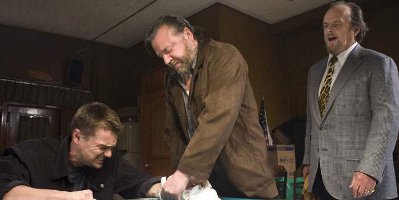 The Departed
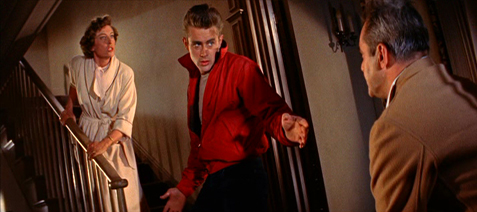 It’s a double-edged sword that Rebel Without a Cause is simultaneously the raison d’ etre for many a cinephile’s knowledge of director Nicholas Ray at all, and that it is, simultaneously, a black hole suffocating energy and consideration from Ray’s cinematic canon elsewhere. Not to mention, for most people, the name associated with Rebel is not Ray, the underdog of American film in the ’50s and perhaps the missing link between the classical Hollywood melodrama and the angry young hooligans like Godard and Cassavetes of the ’60s. Instead, the claim to fame of Rebel is the hot-headed bundle of nerves that was James Dean, arguably the pop culture icon of the ’50s as well as an embodiment of the very spirit Nicholas Ray epitomized as a filmmaker: pulpy but passionate, lean but expressively sensitive, expressionistic but timid, and above all trembling with the unspeakable, implacable throb of constantly spinning out of control.
 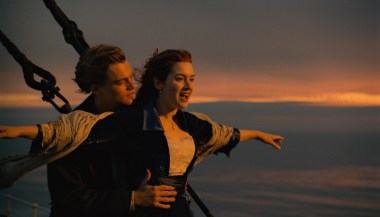 A self-actualizing, self-arousing, and ultimately self-validating Herzogian feat (without the psychosis) that is only occasionally self-enervating, Titanic ultimately stands as not only a chronicler but an embodiment of the spirit, and the hubris, of its subject matter. A three-hour aphrodisiac engorged with cinema, you might say, if you were inclined to peruse the halls of the Freudian catalog that heroine Rose so clearly mobilizes when remarking on the prodigious self-congratulatory caliber of the ship that the industrial revolution and its classist girders would almost drown in.
  Political scorn has embarrassed Forrest Gump for two decades now, with the most common source of critique being the film’s glimpse of the rise (or return) of the American right in the mid-’90s, a revolution led by Newt Gingrich, a Southerner like Gump, although a considerably more blustery one at that. The attacks aren’t unfair – for a film that sometimes aggrandizes itself on a second-by-second basis, its social conscious is valid critical fodder, and the film’s exclusionary attitude toward gender and racial unrest proposes an almost oblivious Southern wait-and-see gentility toward civil disobedience. Gump is in fact an almost willfully obedient motion picture, with its then-new-school technology a masquerade for its rigorous cinematic traditionalism.
 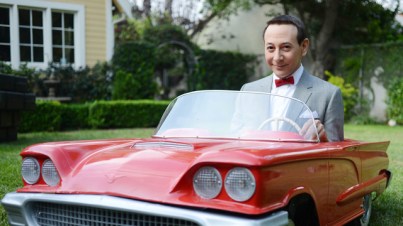 Pee-wee’s Big Holiday
 Like most of the great experiential directors, Terrence Malick has dedicated his career to the embodying of feeling and internal emotion in external perception, rather than – as is the wont of most self-conscious, overweening youthful filmmakers – embedding meaning in hidden artifacts to be glimpsed only by those who know how to look. Malick understands the beauty of the external world as a manifestation of the internal, relying on the gliding fantasia of his always-discovering camera to define humanity, and cruxing emotional growth in the sublimity of his god-glimpsing light and shade dynamics.
 Proposed to producers as a hippie-dippie psychedelic fallout shelter for the grooving ’60s to escape to in case of mass assault by the impending cynicism of the ’70s, Donald Cammell and Nicolas Roeg’s vituperative Performance is, instead, a sulfurous and fluorescent molotov cocktail thrown straight into the decade-long party the ’60s had been having with itself. Announcing itself with the foreboding funk of a hearse-like car careening across the countryside, the cryptic seizure of the film’s editing then immediately interjects with an explicit sexual tryst that sours into a fiery throttling match between fleshy shapes that soon enough barely even resemble the human form. We’re a minute in and we already cower in fear for the sadomasochistic holocaust the co-directors are about to unfurl upon us.
  JJ Abrams probably needs to be stopped. He’s managed the Ford production line for the prepackaged cinematic spirit of the times more abominably than any of his fellow new-school blockbuster savants, and like most of them, he’s a genius marketer in a mostly soulless filmmaker’s body. The albatross of his films is also their raison d’ etre: their desperate, unquenchable desire to be answered. He’s turned the Christopher Nolan puzzle-box A-to-B-to-C filmmaking style, distressingly linear and devoid of personality, into a cottage industry, propping up mostly serviceable but unexceptional films devoid of personality with marketing constructs that obfuscate and ossify his products around and within layers of carefully calibrated, ultimately pointless mystery.
  The Bitter Tea of General Yen
