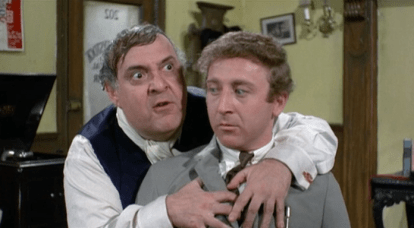
 Mel Brooks turned a gloriously-still-kicking 90 years old this week, and as a happy birthday I’m sure he’ll never read, a review of his debut feature length film.
With Mel Brooks’ directorial debut The Producers (naturally, the writer-by-day writes as well), his most hostile, and therefore best, gesture is to perforate and embrace the Borscht Belt fascination with the essential and unerring failure of life itself. Its mantra being the incompatibility of the self with any semblance of success, the film’s bent is that even in attempting to fail, the only possible outcome for the universe to right itself is for you to inadvertently succeed. And, naturally, fail at your goal of failing. It’s high-concept-y, but more or less to The Producers’ benefit, Brooks plays it all low-brow, helping the film’s philosophical scripture feel more carnal and low-to-the-ground than presumptuous and high-minded. Continue reading
 A pair of reviews from a series last year I never got around to publishing…
 A pair of reviews from a series last year I never got around to publishing…
 It does not take a historian to note how malnourished and jagged the late 1960s were in American society, or to point out the cataclysm that was the destruction of a nation whose identity had for centuries been predicated on turning the other cheek and smoothing over tension with a facade of nationalist fervor and small-town boot-strap pulling. Things erupted in the late ’60s, the nation fell apart, and film went with it, using that dislocation and terror to create a new breed of films that felt bruised and alienated and hurting from that social apprehension down to their very bones.
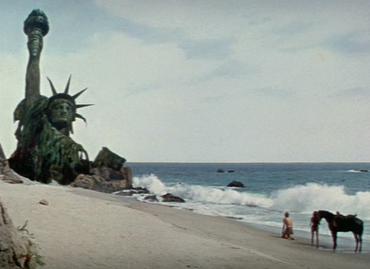 Right from the beginning, Planet of the Apes settles itself on a nexus between tactile action and implacable inaction. The prologue, set on a spaceship as astronaut George Taylor (Charlton Heston) throws his throaty baritone into a mission log, establishes the very 2001: A Space Odyssey sub-Kubrickian cosmic chill of the material. Taylor, along with Landon (Robert Gunner) and Dodge (Jeff Burton), are on an amorphous vision of an intentionally nebulous, even pointless nature; what matters is not where they are going or why, but the existential frostiness of the pallid white of the ship’s interior and the very present deadened quality in Heston’s worrisome but unconcerned voice.
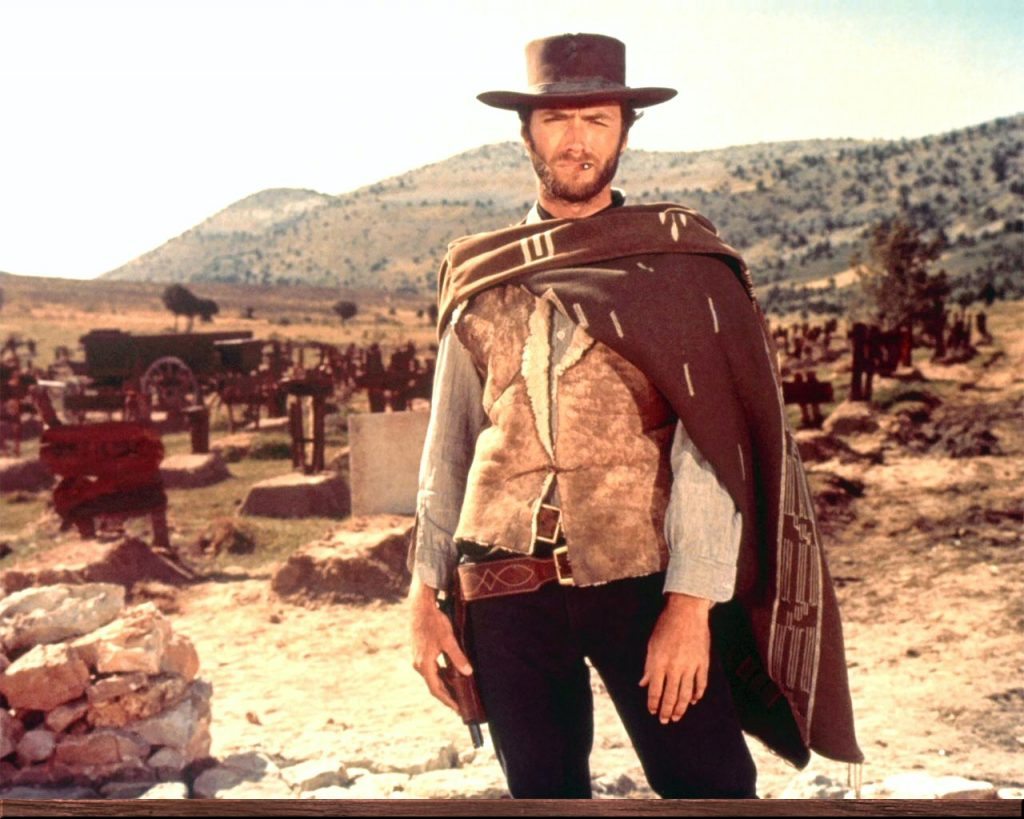
 Reviewing the quintessential Euro-cool movie of the 1960s gave me the idea to add on a little bonus review of perhaps the most European of the “cool American” films of the decade, a truly great work of experimental pop from the master of not deciding whether his film would be amazing or awful, John Boorman…
 Edited
 Our Man Flint is not the best film to wield as a cipher for the amorphous concept of “camp”, but it is sufficiently campy to justify bending an analysis in the direction of camp. Arguably, a better film would be the following year’s Batman: The Movie, but although Batman is probably the better film as far as outright absurdism goes, Our Man Flint feels more honestly campy. This may seem patently ridiculous, but a further dissection of what exactly camp is (and exploring pop in the ’60s absolutely insists on a discussion of camp) helps us understand why Flint is a work of camp while Batman moves back and forth between camp and something more openly satiric. The privilege of Batman is the privilege of satire, namely that it has the confidence of its own superiority to the world of the “serious”, and that is not something Our Man Flint even considers.
 What a strange, messy phenomenon the Pink Panther franchise is. When it began in 1963 as a slight, indifferently pleasant movie about a jewel thief (played by the ever-smarmy David Niven, who was given the lion’s share of the run-time) and an inept side-character vaguely pretending to hunt him down , expectations for a sequel, let alone a cottage pop culture phenomenon, were little. Now, the first film, The Pink Panther, did not exactly set the world on fire, nor does it truly qualify as a phenomenon. But relative to what it might have been – a throwaway ’60s fluffy star piece with some entirely game actors in the distinctly ’60s laconic-swinging mode so ubiquitous in 1963 – something caught fire.
 The Long Take