 Psycho is often reductively referred to as the grandfather of all modern slasher movies. In some sense, that is perhaps true. It’s one of Hitchcock’s most clearly defined “horror films” (along with perhaps Frenzy), and it is ultimately about a killer. On these notes, it is undeniably effective, with Hitchcock’s sense of mood and atmosphere slowly burning their way into the viewer’s psyche and his editing and film construction famously giving more than a few people a lifetime fear of a certain means of personal cleansing.
But Psycho is much more than a superior slasher picture. Its center lies in audience expectation and implication, an exercise in subversion first and foremost. The first half of the film makes it quite clear that Marion Crane (Janet Leigh, a big star at the time as well as a typical Hitchcock blond and thus naturally the film’s star going in) is to be the main character, a woman looking to embezzle money in order to run away with her lover, Sam Loomis. For nearly the first half of the film, we watch her meticulously fulfill her plan before arriving at the roadside Bates Motel, where she meets Anthony Perkins’ Norman Bates. He’s friendly but slightly unnerving, a little creepy, and socially awkward, and he seems tied down to his mother in ways we don’t yet understand. We expect that the film will end up being about the relationship between the two. Furthermore, we assume Perkins will slowly come to obsess over Marion.
Not only do we assume this, but Hitchcock no doubt intended it. Many of his films, including almost all of his masterpieces, are about obsession in one form or another, and the structure of Psycho takes the audiences’ awareness of this to be fairly self-evident. The difference here would be a female main character, perhaps finally reflecting Hitch’s willingness to commit to a furious full-on criticism of the male gaze by moving beyond Vertigo’s uneasily likable but nonetheless ruggedly classical Scottie Ferguson and toward a more fundamentally passive male figure, someone who was ultimately less powerful than either of the film’s two female characters. Backing this up are the repeated visual images of Norman’s mother in shadow, ever-glancing and high-perched like a vulture from up in the Bates’ house behind the motel. She never physically appears, and exists only as an enigma, and yet she still has full power over Norman. In this sense, Hitch’s set-up isn’t simply “subverting” narrative expectation, but perverting our awareness of Hitch as a filmmaker.
Then, suddenly and with the confidence of a master, Hitch pulls the greatest trick ever played on an audience in a film. We all know by now that the obsession story ends with the shocking murder of Marion by who we assume to be Norman’s mother, still bathed in shadow. The scene, famously taking place while Marion is in the shower, is a masterwork of framing and editing. Its mastery of technical manipulation runs a mile wide, but the more notable include jarring quick-cutting, an ear-piercingly slashing and now famous score by Bernard Herrmann that sounds like humanity’s nightmares on a chalkboard, the film’s stunning black-and-white monochrome, essential to enhance the nightmarish detachment of the film, and a diabolical zoom outward from Marion’s eye post-mortem. The scene has been written about to death, rightfully so for its astounding construction. Yet, we wonder where the film leaves us from here. Surely, the film isn’t over?
The functional plot twist, it turns out, is no mere sick joke; it rearranges the texture and the nature of the film at a core, elemental level, playing on our expectations about stardom and cinema and slashing them to bits. It is not only narratively shocking but thematically subversive, rooted purely in audience expectation and Hitchcock’s methodological, obsessive desire to control his protagonists and his audience as well. He toys with his prototypical blond female, his favorite such figure, by literally setting her up as the main character and unceremoniously writing her out of the film. And he toys with the male lead by depicting him as a passive loser and yet essaying our sympathy toward him for his helplessness – we actually start to question ourselves and come to move back and forth between wanting Norman to escape his mother’s grasp and seeing him as complicit in the actions as well. We become implicated in Norman’s own personal tragedy, a tension expounded upon by Perkins’ own slightly-off-center enigmatic jagged nerve of a performance. It’s a scary proposition to court sympathy for such a character, but Hithcock was always about scary, unnerving propositions, something he never pulled off better than here.
If the film has a flaw, it’s a small one. Late in the film, after the climax, a psychiatrist spends a couple of minutes delivering exposition about Norman and his mother that is downright saddening. Not only are these kinds of things best left unsaid, but the film has already gone to great effort to show us what it here feels the need to say. It’s didactic and displays a lack of confidence for the usually assured Hitchcock, but it’s a minor issue that does little to damage the reputation of a true masterwork.
Counterbalancing this however is the film’s pure visual craftsmanship. It remains, for all its sub-textual questions and problematic concerns, replete with Hitchcock’s finest camerawork and editing, even beyond the famous shower scene. Later on, there is a famous murder where a victim falls down the stairs while dying, given a hallucinogenic edge that captures better than anything in Vertigo (not a film about the fear of heights anyway) the vertiginous, surreal sensation of having the world unceremoniously pulled out from under you. And of course there’s the conclusion, whose defining feature is a light-bulb swinging back and forth as it illuminates and darkens the unfolding events like a garish, atomic ball of pure energy, a flickering dispatch from hell. Howard Hawks once said a “good” movie is a film with three great scenes and no bad ones. Well, this film has one bad scene, but at least three (aforementioned) monumental ones, along with plenty of great ones, all of which isn’t to mention the very game-changing narrative bending of the film, something never done before nor repeated with the success seen here. Besides, I’ve always been more of a cohesive “full experience” viewer than the kind who weighs positives and negatives, and this film, as a full experience, is unnerving, subversive, and downright terrifying, a disturbing descent into a moral abyss.
Of course, some of the impact has been diluted over the ensuing fifty years – it’s less emotional than intellectual now, since many of us know how the story proceeds and have seen the multitudes of films which borrow heavily, and indeed owe their existence, to Psycho. Today, the film feels slightly more like a time capsule work to appreciate rather than to experience, but damn if that doesn’t just make it all the easier to admire. Perhaps no other film in the history of cinema marks a before and after like this one – narratively, Hitch completely rewrote the book (for English language cinema at least; one need look no further than Antonioni’s own L’Avventura released the same year for a foreign-language film that spent as much energy on completely disfiguring the logic of narrative filmmaking, but far fewer filmmakers have seen that film so by definition it is less “important” to the development of film). In a sense, this may be the most important film ever released.
But importance and film history, and even thematic nuance, take a backseat to Psycho’s worth today. That’s because Psycho has never been about thematic nuance – it is, at the end of the day, a direct distillation of just about the purest cinema Hitchcock ever produced, something ruthlessly efficient and purely dedicated to its own craftsmanship. It’s his greatest stylistic achievement and his most visually energized and oppressively constructed film, designed with every scene to confuse and confront us and our expectations. He winds us up painfully and refuses to let go. If that wasn’t enough, it is also a rather breathless commentary on filmic expectation and audience voyeurism that never once (well, only once) tells what it can show. The idea that a certain character must inevitably survive the film, that a certain lead actress must be the star, that films should follow a certain structure as they take us along with that star – all are dismissed gleefully by the film’s narrative structure. Hitch steadfastly and destructively confounds expectations and throws our role as an audience under the bus by quite literally rubbing our faces in our understanding of role and character. Best of all is that Hitch accomplishes his technical mastery and his thematic wonders in perfect harmony, never once laying his themes on top of the film but always tackling the more difficult question of how to create the theme in the film itself. Theme in Hitch, as it always should, comes from form, even when so many other films make the mistake of doing it the other way around.
All of this, and it is a real wonder that Psycho is really nothing more than the famously bald director letting his hair down and playing with us. For what reason you ask? Sure, he plays for the sake of a commentary on filmic viewership and on masculinity and the male gaze. But his real reason is far purer and giddier: he woke up one morning and thought it would be a fun thing to do before teatime. Remember, this is Hitch, a man for whom diabolical malevolence was synonymous with fun; he scrapes us along his ragged, angular celluloid surface like butter on the crumpet he eats to congratulate himself for a good day’s fright.
Score: 10/10

 For this week’s Midnight Screenings, being that Halloween is upon us and all, here are reviews of three modern would-be Halloween films destined for years of “Midnight” Screenings all throughout the land.
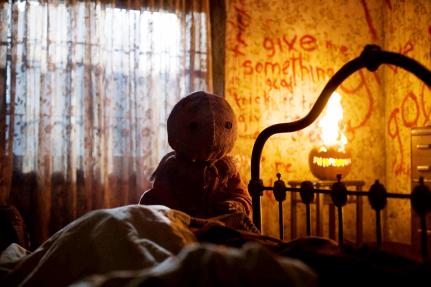 For this week’s Midnight Screenings, being that Halloween is upon us and all, here are reviews of three modern would-be Halloween films destined for years of “Midnight” Screenings all throughout the land.
  The Conjuring
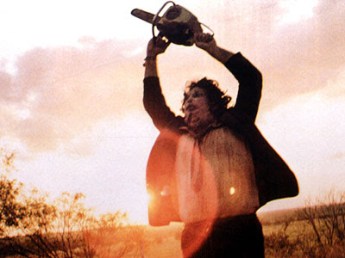 Updated mid-2017 after another rewatch – such an amazing, amazing film, not particularly violent in a diegetic sense, but one which feels as though violence has been done to it.
  With the summer release of Jeff Mickle’s new film, Cold in July, set to prove him as a director of considerable skill who’s in it for the long haul, it seems appropriate to look back on his two previous, relatively unknown and under-appreciated films, truly strong efforts both and films any discerning horror fan can appreciate. 2010’s Stake Land and 2013’s We Are What We Are are scary films, but their horror comes not from shocks but slowly building dread (don’t worry, though, Mickle knows how to underline his composed filmmaking in blood-red strokes when necessary) . He doesn’t give us choppy quick cuts. He lingers, letting his characters define his horror and giving us a blood-curdling melancholy.
 A Field in England opens with a warning about the film’s psychotic, psychedelic imagery, but it serves, and was likely intended, as much as a badge of honor– the film’s visuals are gloriously perturbed, and the trickery on display is the film’s biggest selling point. This is all the truer when one considers the film’s enigmatic narrative and its clear subversions, even from its opening moments. If the film opens with the aforementioned warning about its visual nature, it immediately cuts to a black screen with only chaotic sound for thirty or so seconds, pointedly delaying what it’s just promised us. Then, of course, there’s the film’s black-and-white monotony when we now automatically associate visual splendor with cheerful color, and the fact that the film opens with a battle scene captured purely in close-ups and shots of single, atomized people, as well as quavering images of bushes. It doesn’t play like a battle in reality, but as the arch impression of a battle, the sense of chaos and loneliness ever-present but indescribable when on the edge of life and death – it’s an almost abstract collage of imagery divorced from context to convey the holistic difficulty of understanding war representationally or experientially. A Field in England is a pure, distilled cinematic hell.
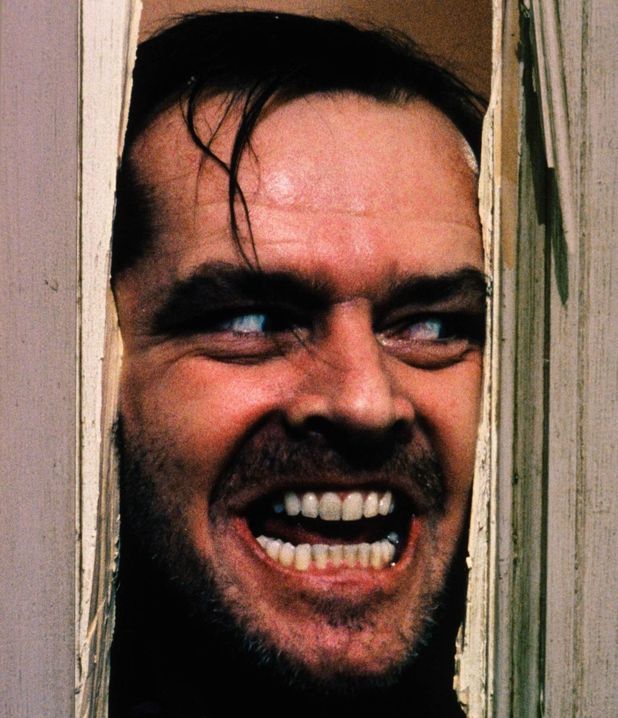 Updated mid-2015
 Update early 2019: Never a fun time reading these college-age early reviews, especially when you don’t have time to write-up a new take in full, but I’ll say after a rewatch that Carpenter’s film remains one of the quintessential films in its genre, and its decade: a portrait of geographic seclusion as abyssal isolation that doubles as a study in the breakdown of democracy, all while replacing the proverbial conservative “Other” of horror with the Other within. It’s greatest trick, then, is that it turns one’s opacity to one’s own self into a truly terrifying dispatch from the fringes of society, both a final transmission from flickering-out ’70s ennui and an inaugural howl of ’80s malaise. And it achieves this inward turn, forcing us not onto an outsider but back onto our own frightening selves, without ever resorting to any “psychological horror” tools to launder the horror by ensconcing it only within one character’s head-space. Truly disquieting stuff.
 The Long Take