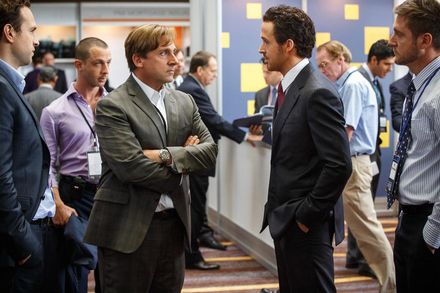
 Flippant, self-consciously ingenuous, vacantly screwball-y, the caper film credentials are plastered all over The Big Short’s snazzy, flash-in-the-pan cinematography and relatively rudimentary bag of metatextual tricks. It’s a little like Great Recession fast food, although its overweening sense of “cool” calls back to the mid-’90s glut of post-Tarantino provocateurs with a camera. For the vast majority of its run-time, Adam McKay (of the Will Ferrell, internet comedy school of modern filmmaking) and co-writer Charles Randolph are not especially vexed by their total and complete disregard for the casualties and consequences of a crisis that can never fully be contained, or explained, in a single film, so for most of the run-time, they don’t even try.
Which is probably bad morality, but it doesn’t guarantee antiseptic cinema. For better or worse, Hollywood has relied on tragedy as the girders of grandly architectural cinematic entertainment for nearly a century, and if there’s a disingenuous nature to a cotton-candy approach, then a morose, ultra-serious tone doesn’t exactly wash away the failings of cinema or any art to truly capture tragedy as a lived experience either. No film can legitimately treat the tremors of life with the gravity they deserve; even when they inform us of their seriousness, bubble-wrapped films like 12 Years a Slave or Schindler’s List can’t but construct their tales around, for instance, the African-Americans and Jews who lived through unknown tragedy, rather than those who died under its wake. Films cannot raise the dead, even if they wear a necromancer’s cloak.
Although the question will likely remain forever intangible and unsolvable, a case forms for cinema that doesn’t even bother to insist on or imply its ability to truthfully expose the complexity and contradictory complication of history or experience at all; such films instead inhabit a realm of honest dishonesty, necessarily reflecting the ways in which even the most troubled and tormented “serious” films only convince us to believe that they are truly reflecting experience, rather than actually revealing it. Rephrased in the vernacular of the high school post-modernism of The Big Short, “films aren’t reality, so why bother pretending they are?”
Call it facile or amoral, but there’s a tang of truth to a film that legitimately and filmically interrogates the limits of cinema to construct experience. The trouble with The Big Short is that, while it exhibits an ounce (but no more) of this spitfire ingenuity, it is also incessantly culpable in the crime of pedantry. In other terms, a work of pop-economics is necessarily perched at the intersection of cataclysm and carnival, and The Big Short hasn’t the slightest whisp of a clue how to remove itself from the calamity that ensues at that fork in the road. Rather than pursuing one direction, it tries to ride two horses – the glib and the earnest – inconstantly, and the ramshackle, moldy-wooded wheels of its cart fall off before it gets anywhere with its own internal contradictions. The vaguely ironic oxymoron in the title is indicative of the central incertitude of the film itself; it wishes to be both grand and intimate, anthropological and personal, momentarily enthralling and fitfully educational. In the end, it only proves elusive.
Adapted from Michael Lewis’s book of the same name, The Big Short earns a point or two for perspiration, rushing from moment to moment and breaking so much sweat trying to involve its audience in material it never truly trusts we care about. In context, the self-serving swerves into sincerity (mostly near the end) feel profoundly disingenuous in light of the film’s otherwise madcap distrust of its own audience. The drama the film implicates itself in, particularly in sub-plots surrounding a mercurial, never-better Steve Carrell and a sullen Brad Pitt, is a self-aggrandizing , diaphanous layer of stuck-up moralizing ( I won’t go into too much detail about the individual characters or stories; that would be giving the film too much credit). It’s no secret that the filmmakers desperately hope the film’s sidetreks into tragedy will wash away the taste of the screenplay’s frivolousness; instead, the speechifying only reminds how contested the film really is about how to treat its material.
Part of the problem is that the film’s tricks never veer too far from the surface; the trouble with the post-Tarantino irony is that most of the filmmakers who adhere to it are mainstream welterweights whose surface-level idiosyncrasies never settle into the core of their beings. Much like suburban youths reared on Eminem and Jay-Z, these filmmakers pine for rebellion and youthful zest, but the apple never falls too far from the tree; these people are still products of mainstream institutions, and their films never sway too far from Hollywood convention after all. The Big Short is still trite Oscarbait, irony or no, and least most Oscarbait is a little more earnest about the saccharine strings being pulled in the background
One gathers that The Big Short’s most ostentatious, signature gesture – stopping itself dead in its tracks while a celebrity husk is carted out to demonstratively reduce financial jargon to human terms – is a swipe at itself. Yet in criticizing its own investment in chic celebrity couture and its shotgun-fired amelioration of fiery fallout with cool blue, easily-digestible cinematic jazz, the film also condescends vociferously and then has the nerve to sit down for story-time and teach us a message in the process. Seldom has Hollywood felt so palpably self-satisfied in its self-imposed superiority to its audience. You cannot, as the old saying I just made up goes, be a preacher and a stand-up comic at the same time.
Score: 5.5/10

 After the laconically witty, good-natured “wait, how much money are they giving me?” spurt of Big Trouble in Little China, John Carpenter decided his steadily encroaching ascent into mainstream fluff required a course correct. His 1987 feature, Prince of Darkness, reflects a homecoming of sorts, a rejection of the more-is-more pomp and circumstance of the 1980s for the merciless fringe-dwelling independent malevolence of Carpenter’s upbringing in the 1970s and his time being reared on the works of Val Lewton, Samuel Fuller, and Nicholas Ray. Antithetical to good cheer, the fluctuating energy levels of Prince of Darkness occupy a secluded spectrum from poison-cloud malevolence to throat-grabbing holocaust of horror. If Big Trouble was escapism, Prince of Darkness feels like it cannot be escaped. Continue reading
  It would not be incorrect to treat Yasujiro Ozu’s works as a mere question of how geography intersects with modernity, but it would be incomplete. Surely, his mid-century, middle-class films about Japanese men and women both enlivened by and enveloped within the social structures around them do unearth great truths about the specific nature of life in post-war Japan and, particularly, about generational divides. His Late Spring, a story about a woman, Noriko (played by Setsuko Hara) in the late spring of her life and her father, Shukichi (played by Chisu Ryu), no doubt treats on the same issues. With the daughter aging beyond the father’s interest, he, a widower himself, feigns a fake marriage plan to convince his daughter that there will be no room for her in his house. Naturally, the hope is that she will find a marriage partner herself, and questions of gender oppression and the iron grip of social expectancy marinate throughout Late Spring, coursing through the veins of the diorama-like closed-spaces that Ozu relies on to ensnare his characters in the vise of social geometry.
  Robert Altman’s great mode as a director was the comedy of desperation, or in some cases the more elemental buddy film of loneliness, both genres served well by his democratic, crowded, fragmented spaces defining loneliness not as a form of isolation opposed to collectivism but as an isolation within community. For the Altman welterweights who think of the director’s ’70s as MASH, Nashville, and a murderer’s row of films of lesser import withering on the vine in between those two powerhouse works of communal chaos, California Split’s nominally more centered, two-character pas de deux seems more straightforward and less robust. In comparison to the wide swaths of partial Americana glimpsed in the roving camera of those, his more famous films, one might obfuscate and avoid California Split by nominating it as “lesser Altman”.
 The perennial punching bag of the French New Wave, Alain Resnais’ very willful 1961 Last Year at Marienbad, a descent into psychotropic memory and defiantly deviant notions of storytelling and fiction, hasn’t had it easy. Resnais’ most debated film has spent over a half century as alternately much-beloved expressionist think-piece, bamboozling artifact of a more radical cinema long past, and benighted object of a time when movies were nothing but arrogant, oblivious ego-stroking carnival clowns in search of an audience of zero. One of the true “love it or hate it” artifacts of cinema, let no one say Resnais’ work calls for mere shrugging off. Either delusional or concerned with, but not victim to, delusion, it remains about as unknowable and provisional a film as the species has produced, and thus as fascinating. Totally undermining classical presumptions about narrative, Resnais’ film is riddled with conditional tenses and scrambled cadences, culminating in a truly heinous detonation of foundational or categorically true knowledge. Although suffused in the pallor of death, for a certain kind of audience, it’s a modernist jolt, one of the few truly idiomatic films.
 With the release of Hail, Caesar!, a look back on some of the Coens’ previous comedies is in order.
  With the release of Hail, Caesar!, a look back on some of the Coens’ previous comedies is in order.
 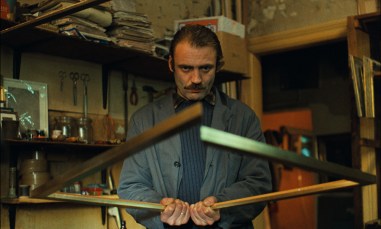 Relative to his New German Cinema compatriots – or sparring partners more appropriately – certifiable humanist Wim Wenders was a late bloomer. His ’70s is dotted with highlights, but you won’t find an Aguirre or a Petra von Kant hiding among them, even if his Road Trilogy begs to be rediscovered to this day. This is no knock on Wenders; his years-long quest to discover something at the mountaintop of (usually American) cinema necessarily required nurturing and exploration that the more primal impulses of Rainer Werner Fassbinder rejected as vestigial structures of sane society. Plus, by the end of the ’70s, Wenders still had the finest modern study of American geography-of-the-mind in his near future, while Fassbinder’s cocaine-addled filmmaking was about to overflow into personal disaster. Neither filmmaker was necessarily superior to the other (although crossing their streams would likely prove a recipe for nuclear fallout), but 1977 was still a year of personal journey for Wenders. He hadn’t yet reached his destination.
  There’s something elusive and mystical about confronting a cinematic stand-by, a work read and tweaked and revisited by directors across decades and nations. The post-They Live By Night world was ushered in almost immediately by the psychotic, sexually-charged thrust of Gun Crazy, which toyed with many of Night’s themes, but it wouldn’t be for another decade until director Nicholas Ray’s contrarian style would emerge as canonical in the minds of the French New Wave. Watching The Live By Night, you can practically imagine the entire Cahiers crowd almost asphyxiating on autoerotic fantasies of their own cinematic futures. This imaginative hyperbole is entirely fitting for a work like They Live By Night, too, since it is at once latently sexual and surrounded by violent hairline fractures that strut into the cinema and threaten its very being.
  Identities intimate and societal, opaque and translucent, course through the veins of the somewhat curatorial Phoenix, although complexities are little more than skin deep when the curtains are called at the end. Christian Petzold’s film about personal and national visage talks a mighty talk, entangling itself in historical woes and post-Holocaust turmoil in a museum-bound Austrian society. Of course, a tale about a woman Nelly (Nina Hoss), recently returned from a Nazi death camp with a surgically altered face can’t but wade in the murk of history, especially when said woman reintroduces herself to her husband (Johnny or Johannes, played by Ronald Zehrfeld) who doesn’t seem to recognize her but finds a use for the new face that she wields anyway.
