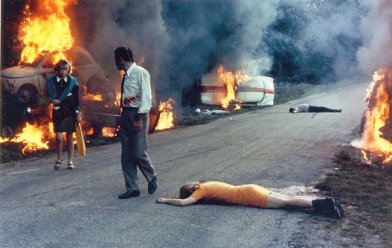
Update late 2019: After realizing just how omnipresent modernization rhetoric was in France in the ’60s, how severe the hypertrophy of automation, how extensive the rhetorical quickening of the society, and how emphatically connected the unending road and the conquering car were to those symbolic projects, Godard’s sudden, inexorable brick wall seems all the more brutal, and all the more perceptive. Weekend is a centrifuge that spins what many were calling “modernism in the streets” into a perhaps-unrecoverable tailspin, a remorseless, unbending monstrosity propagating an unshakable doubt about the future of the world and the growth projections of Western modernity,
Original Review:
Reviewing Goodbye to Language made me realize how criminal it was that I had never, in almost two years of blogging, reviewed a film from perhaps the most important director of the past sixty years. What was I doing with my life?
If Pierrot was the cataclysm, Godard’s Weekend is the fallout. An offhand joke midway through Pierrot – one of the many murders either committed or not committed by the central couple is presented as an impossible Dadaist implosion of automobile parts turned on their slantwise dimension – is curdled into a drunken stupor in Weekend. In Pierrot, the moment was baleful in its satire but flippant and recklessly fleet in its unceremonious, abstract, sudden-gust-of-wind presentation. In Weekend, an automobile pile-up rendered avant-garde art piece stops the film dead in its tracks, intentionally so, as the main characters errantly slobber between cars as subversive minimovies play out between the other passengers. It’s an elegant, wrathful expression of Weekend’s position as the comeuppance for Godard’s race-car cinema, a self-imposed crackerjack crash of non-narrative film now stopped dead in its tracks by its own ambition. Cinema breathing in its own fumes too long has turned into the cinema of the fumigated. Continue reading →

 Filmed in Atlanta and set in a New Englander’s nightmare vision of a Southern city contaminated with centuries of race and class disparity, Triple 9 at least deserves some credit for marinating its city with the grime and grotto typically reserved for world cities like New York. With images of the Big Peach still fraught by the oppressive genteel paternalism and antebellum haze of Gone with the Wind and the cringe-inducing respectability politics of Driving Miss Daisy, Triple 9 at least relies on the now cosmopolitan city to construct an identity out of more modern visions of race and class consternation. Triple 9 is not trapped in the streamlined racism of old, but fraught with the combative, confrontational contortions of a city that pummeled its way into the future while still remaining trapped in the past. Continue reading
  Now that the release of Terrence Malick’s Knight of Cups upon us, a review of his second film is in order.
  A pair of reviews from a series last year I never got around to publishing…
 A pair of reviews from a series last year I never got around to publishing…
 With Ghostbusters ubiquitous in the news over the past week, a review of the original film is in order…
 Reviewing Goodbye to Language made me realize how criminal it was that I had never, in almost two years of blogging, reviewed a film from perhaps the most important director of the past sixty years. What was I doing with my life?
 Reviewing Goodbye to Language made me realize how criminal it was that I had never, in almost two years of blogging, reviewed a film from perhaps the most important director of the past sixty years. What was I doing with my life?
 Reviewing Goodbye to Language made me realize how criminal it was that I had never, in almost two years of blogging, reviewed a film from perhaps the most important director of the past sixty years. What was I doing with my life?
 Watership Down begins with an iridescent slab of primal, irradiated cartoon psychosis, a deceptively primitive work of mythological animation as welcome in the Disney canon as it would be adorning Ancient Greek pottery. Regaling us with the oil-and-syrup concoction that is the mythological fable of rabbit-kind, we’re informed how the fecund species was blessed with fleet feet and cursed with a menagerie of predators. The simultaneously timid and trepidatious imagery of crayon-infused characters backed by an illuminated white hell evokes a cautionary tale most bold. Animation in 1978 was at something of a nadir as up-and-comers were rabidly chasing down the cadaverous corpse of Disney and looking to impose new styles all their own, and in this light the intro of Watership Down feels particularly prescient. Watching the introduction of Watership Down, it’s as if the film chose to begin with a despairing version of the classical American cartoon style – all curvaceous, simple lines and expressively elegant crayon-scrawl – to pay homage to the old before casting about with the new.
