A year later, I couldn’t resist. Much as I adore sacrificing myself at the alter of good cinema, the call of incompetence beckons me like a wolf. It’s time for another month-long exploration of some of the most criminal cinematic offenses in history. For those playing along, each film will be given two scores, one for its actual formalist quality and one for how divinely entertaining it is as an inebriated exercise in cinema at its most dumbfounding. We’re starting the month with two releases from the modern godfathers of bad cinema, Golan and Globus.
 Even by the standards of mush-mouthed ‘80s mega-producers Golan and Globus, 1989’s Cyborg is inexplicably, improbably bad, descending in a feverish plunge of toxic awfulness and incomprehensibility that comes within spitting distance of the disfigured joie de vivre of earlier schlock progenitors like Jean Rollin. From the scorchingly constipated opening narration to the on-screen text informing us that our newest hellscape is “ in the future” (presumably a time-span discovered after much research on the filmmakers’ part), we’re in the realm of classified bad-movie company here. It should be protected as a national treasure, or at least investigated by the FBI to make sure no one is planning on stealing it today.
The opening sequence, a fetishistically slow-motioned action sequence comprised primarily of people walking horizontally across the screen, as if to prove they can do it, doubles as an exploration of Bush Sr. era strife (in my mind at least) and triples as a surefire claim that, in the great “Conan the Barbarian rip-off vs. Mad Max rip-off” debate of the 1980s, we are distinctly in the later camp. Or at least, the film seems to think it is. Based on Heidi Kaczenski’s costuming, it might as likely be a new music video for RATT. It clarifies something, although not much given the ramshackle, obviously dust-bowl nature of the film’s look, that the costumes and sets were originally intended to buttress a version of either Masters of the Universe directed by Albert Pyun or some godforsaken adaptation of the Spider-Man comic that I for the life of me can’t see in anything this film slathers on screen. Not even if I squint.
But Pyun, knowing his corporate masters Golan and Globus wouldn’t back down from finding some use for their investment (they were, after all, dynamite capitalists in the William Castle mold to say the least), ended up commandeering these costumes for a quickie film called Cyborg. This nearly accidental, DIY quality to the film’s production perhaps explains why the resulting film’s mise-en-scene is both non-specific (creating no cohesive world) and oddly effortful (the costumes look like someone, or some acid flashback, was putting in their version of overtime to imagine them, as cheap as the finished products actually are).
If the film actually boasts a commercial coup, it’s Jean-Claude Van Damme in one of his earliest American roles, the tentative nature of physical space in this film’s version of America allowing him carte blanche to retain his Belgian accent thankfully. He plays a … ahem … Gibson Rickenbacker, a hired fighter protecting a cyborg named Pearl Prophet (Dayle Haddon, sacrificing herself to lines like “I am a cyborg”) from a group of bloodthirsty pirates headed by Fender Tremolo (and suddenly, Gibson Rickenbacker seems like John Smith). Tremolo, for his part, is played by Vincent Klyn with the most pained bass moan of a voice I have ever heard. For the sake of argument, let’s take the film at its word when it says Prophet needs to get from New York to Atlanta so that she can provide much-needed information to a group of CDC doctors working on a cure for the plague that ravaged America.
Pyun’s most famous film, by far, is his next-year adaptation of Captain America (the holy text for bad pre-2000 superhero adaptations), but on the back of Cyborg, he should win a peace prize for distracting people from their real problems. Or at least his editor should. This is a fluorescently edited motion picture, abetted by a bewildering pastiche of montage that feels like Nicolas Roeg wandering the streets on a drunken bender, particularly during flashbacks to Gibson’s earlier life when the editing arhythmically seizures about in a gross parody of both Soviet montage and the post-traumatic mind’s inability to reason with crisis head-on. When you add in the fact that the film’s conception of the Eastern Seaboard is both irreconcilably antebellum and disarmingly retro-futurist, you have a film that is bewilderingly exasperated in trying to achieve something and dumbfoundingly incapable of completing its stated goals. Plus, and maybe it’s just the native Atlantan in me, this film’s hot-headed vision of Georgia could sure use a Mint Julep or two to cool itself down.
But, as any scholar of cinema knows, the best bad movies are united with the best good movies in that they are museum exhibits to a flaring passion for being themselves. It’s why William Castle’s work has lasted so long in the bad cinema consciousness – Castle clearly enjoyed the films he was making. Incompetent though they may have been, “hackwork” doesn’t cut it, and it doesn’t cut it for Cyborg either. Much like how the bowel-trembling inertia of Klyn’s performance threatens to give him hemorrhoids for his effort, Cyborg is clearly a film that someone put effort into, and twenty seven years later, that’s why its incompetence is not only notable but commendable.
How good is it?: 0.5/5 (we’re in rarefied company here)
Sure, but how “good” is it?: 4/5 (it has one of the most uniquely indecipherable visions of the post-apocalypse I’ve ever seen, and Klyn just pushes the whole affair over the edge)

 Roger Corman’s films and their narratives were typically barely masqueraded Cinema of Attractions spectacles, experiential flights of fancy rooted in an insatiable thirst to expand the human eye itself. What Corman understood, something many a better filmmaker has conveniently sidestepped, is that cinema lives first and foremost on the surface and with the eyes. The brain, the mind, the heart; they all draw oxygen from the senses, not the other way around. So many filmmakers ladle their cinema in a bath of surreptitious symbolism or overly-curated suggestion that they exist only, exclusively, in the abstract nebula of the intellect; the beauty of the art itself is often the aesthetics of appearance that prefigure and often elude the capacities of our mind define them. In attempting to explain everything, to append meaning and content to the deliciously provocative uncontainbility of nature and the senses, these filmmakers fail to grasp what is right in front of them for the taking. As Susan Sontag so eloquently wrote, in searching for the truth beneath the surface, they fail to see the thing at all. Continue reading
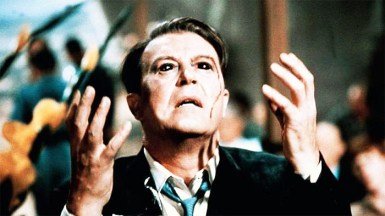
  Aesthetically-minded avant-garde director Nicolas Roeg, daringly immature puppetcraft impresario Jim Henson, and nasty-whimsy peace-negotiator Roald Dahl is one of those divine, demonic accidents of circumstance you didn’t really know you needed. Easily Roeg’s most commercial film, but not a cash-grab judging from his delectably devious direction and satisfyingly cryptic editing, The Witches was still a commercial misfire. Which isn’t a surprise; even by the standards of the late-‘80s run of vaguely dark and dreary children’s horror pictures either adapted directly from Dahl or owing kinship to his spirit, The Witches is an insidious little devil of a picture, vastly more warped and spidery than even the Grand Guignol likes of Return to Oz earlier in the decade. It settles more for naughty than nasty, but the effects are heinously satisfying nonetheless.
  Superstar ‘80s film producers and delirium-slingers Yoram Globus and Menahem Golan took as their mission statement to make a buck at any all costs, assembling casts and crews that, incompetence or not, were uniquely qualified and gamely willing to pretend that their bare-bones make-money cash-ins were, in fact, real movies. Products they were, not only first and foremost but nearly exclusively, and 1987’s Masters of the Universe is also uniquely special for how unmitigated by common sense it is in its desire to synergistically appeal to every single facet of its audience’s cultural iconography in order to draw them to theaters and steal their money. More than anything, this is cinema-as-pop-culture-platonic-ideal, perhaps more than any single cinematic product I have ever laid eyes on. They don’t deserve credit for anything else, but Golan and Globus were intimately, almost defiantly, aware of the world that bred their films.
  The ‘Burbs
 Much like his later A Separation, Asghar Farhadi’s About Elly is a bitter respite from the filmic hierarchy in that it refuses to afford us what might be called an omniscient, privileged position. Instead of knowing everything beforehand, it adopts a perspective that slides between characters and perspectives to construct a multiplicity of experiences or opinions that elide the notion of an essential truth. The most obvious characteristic of this lack of omniscience is the film’s disinterest in imparting a cohesive depiction of the world of the characters, instead choosing to construct a minefield of contradictory, contested opinions. This is, first and foremost, a proclamation against the tendentious norms of cinema where a film’s moral mapping is supposed to conspire to slam that film’s presumptive argument home in the final stretches; in comparison, About Elly always, fascinatingly and rebelliously, feels like it is slipping away from us. If most films are lit toward a primary beam of crystal-clear truth, About Elly refracts the light through the crystal and constructs a variegated, prismatic rainbow of varied perspectives and possibilities.
  Edited for Clarity
 Compared to “Kiss Kiss Bang Bang for The Nice Guys”, “Ocean’s Eleven for Money Monster” isn’t as clean a comparison. But I really like Soderbergh’s collaboration with George Clooney, Julia Roberts, and mindless excess, and clearly Clooney and Roberts enjoyed themselves too; Money Monster reteams them and brings a different kind of capital along for the ride.
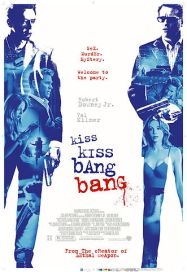 This one just writes itself. Writer-director Shane Black is back with another buddy comedy, so let us look at his last one, a return to form after nearly two decades of wallowing in nihilism, misogyny, and eventually, oblivion.
