 Edited
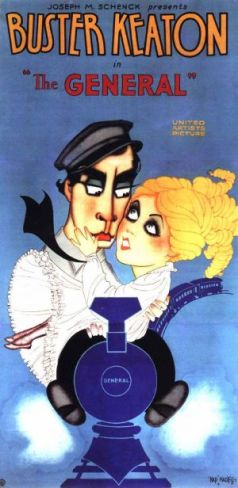
Above all, Buster Keaton’s The General is a caricaturist cartoon scrawl of history, a historical epic tethered to, and upended by, the hair-raising hare Bugs Bunny. Unmolested by the burdening weight of its importance, The General is Keaton’s excuse to raise a ruckus with the past, to twist the partitions of memory, and to alloy historical event to a study in stasis and kinesis with the primordial essence of pure cinema. The presumption of operatic diction and molasses-thick sobriety assumed in most waxworks-show historical cinema – often obelisks to history rather than living and breathing exercises in movement with history – is but a distant rumor in Keaton’s phenomenally unpretentious explosion of screen momentum.
In a film beset with, or at least erupting from, the Lost Cause ideology that the South’s loss was a tragic failure of valiant rebels standing up for their beliefs, the two primary causes for Johnnie Gray (Buster Keaton) are his two lifehood loves, his train that he repairs by day and his female companion Annabelle Lee (Marion Mack) he woos by night. His life is tarnished when she rescinds his offers once the Confederates refuse to enlist him due to his importance as an engineer. When his beloved train is stolen by Yankee spies, Gray is whooped and hollered into action to retrieve it almost in spite of himself, acting almost without visible emotional comment in his face. Early on, the world, even his own actions, coast by him with a certain predetermined status, like he is part of an unthinking tapestry rather than an active participant in the world. Until, of course, Johnnie becomes a human mid-way through, a transition with vastly more complicated and foundational reflections on American politics, cinema, and social assumptions than even the film’s revealing connection the the Confederacy. But we’ll get there before the review’s end. Continue reading →

 So Rod Serling, Charles Dickens, and Alfred Hitchcock walked into a bar…
 Trespass
 The Man From UNCLE
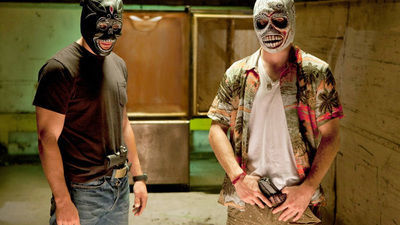 Oliver Stone’s twenty-years-late return to his barn-burning, muck-racking, mutinous youth as a hit-the-fan molester of respectable cinema, Savages is both undeniably admirable and definitely worn and torn by the years of middlebrow cinema Stone exerted onto himself over the years. After expending the ‘00s on pointless, anemically respectable productions like W and World Trade Center, two of-the-moment “take me seriously” political films with none of the director’ momentous, ribald energy, Savages is a return to form of sorts. But the lethargy of lost time has set in a little bit, and the film’s ricocheting-but-not-undulating formal hassle sometimes feels like Stone overcorrecting for the staid, empty crucibles of his turgid ‘00s work by inducing their polar opposite: an undomesticated, totally neurotic rollercoaster. Less Stone at his best than a phoenix raised from the ashes of Stone’s aimless 21st century films, Savages is an intermittently great filmmaking blast of alacrity and elan, but it feels more like Stone-knew-a-guy than Stone himself.
  In Frank Borzage’s 7th Heaven, much like F.W. Murnau’s Sunrise from the same year, and same production company, the mettle of duality and human romance is energized with cinematic luminescence, ultimately transforming togetherness into a prism for enlivening the world and lighting the way to an otherworld that, not heaven or hell, is more akin to the resplendence of worldly beauty itself. Producer William Fox was a sky-high romanticist with peaceful, radiant aspirations for humankind both exhibited within his films and enshrined in their making-of stories. Unlike many Hollywood producers quite this early on, he chose to jump the Hollywood ship of home-grown talent by acquiring some of the most rapturously received European auteurs for his productions with the quixotic belief that his production company’s cinema should be unrestrained and untrammeled on by national borders.
  Agitprop as festivity more than hoosegow, Sergei Eisenstein’s first film is also his most disarmingly pure and innocent in its desire to agitate not only society but cinema, a film thoroughly unmitigated by its own weight and purpose. The perpetual penitentiary many modern viewers discover when viewing Eisenstein’s unmistakably political films is replaced with a kindled carousel of motion and action, reaction and consequence, that feels not only undated but more progressive and alive with possibility than any film released in the 2010s. A freedom-fighting film that, in a fit of art imitating the dreams of a life that never came to exist, feels palpably liberated from the cinematic status quo. Rather than merely political critique, Strike is a filmmaking polemic, a hustle-and-bustle strike of inventive cinematic mechanisms enlivening the passé “historical cinema” genre that was often as inept and anonymous then as it is now.
 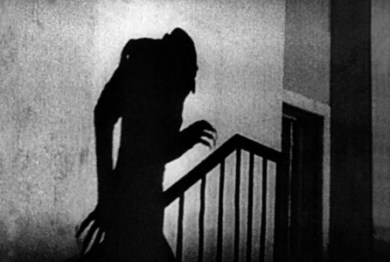 As the ur-horror film and the first masterpiece from the second visual master of the cinema (tied with Eisenstein; Griffith was the first) Nosferatu could crumble under the surfeit of weight on its back. And, like a steadfast Atlas, it holds up the earth with the gravid, implacable charisma of an obelisk absorbing a totem pole. F.W. Murnau’s incandescent grasp of cinema as a mythical creation capable of inscribing dreams and nightmares in the sky had not yet been matched by anyone in the medium (rather than achingly poetic dreams on alternate planes of reality, Griffith’s and Eisenstein’s films were more monumental architecture, or theater and dance respectively to crib from Godard). And, without much squinting, it’s almost as easy to claim that no one has actually dreamt Murnau’s dreams as well as Murnau in the 85 years since his untimely death.
 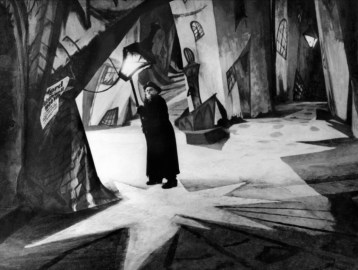 The, ahem, “mindfuck” movie is more or less a reputable genre these days, having twenty years ago adopted a throne in the highest echelon of the cinematic kingdom, at least in the minds of adolescents and high-school film-major-wannabes all across the land. You know, the kind who just can’t wait to tell you about how Fight Club is a metaphysical tract raging against the dying of the individualist, anti-social light or how The Matrix excavated a new world of possibility and mental-architecture and Laurence Fishburne’s voice is so gravelly and sonorous and important so we need to pay attention to it because Morgan Freeman in The Shawshank Redemption. And Stuff.
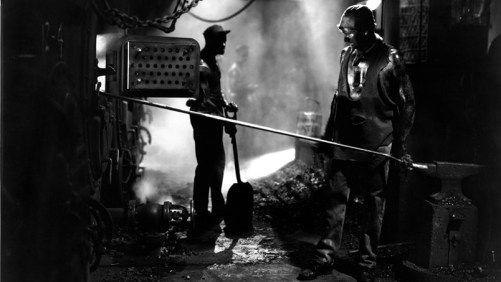 A tempest of Murnau, Borzage, and Griffith with its own achingly sensual, mist-shrouded, potently translucent vision of city life and the mystique of human desire, Josef von Sternberg’s The Docks of New York is one of the pinnacles of American silent drama in the year of its acme. Which was, coincidentally, the year of its sputtering death throes, almost as if the pre-sound era was firing on all cylinders to stave off the phantom of sound, to preserve the crystalline purity of the visual medium and acclimatize viewers to the potency of the screen itself, and, above all, to throw itself the most divine combination going-away party and sarcophagus it could muster from its own hands. If so, Victor Sjöström’s The Wind might be the mortal specter of tenuous life, the skeleton in the casket, and Murnau’s Sunrise could be the grand, angelic denouement, the swooping saving grace to send the silents off to Asgard or some other heavenly resting place after being tempted by fate. I think it fitting that The Docks of New York would only ever take pride of place at silent cinema’s funeral as the drunken after-party, with the blissful ignorance of acceptance slurring around a fear of the future that is still waiting in the wings.
  The Long Take