 After a decade or so building up his reputation as the heir to the throne of Kubrick, Scorsese, or Altman (depending on one’s critical proclivities, or the specific scene one is viewing), writer-director Paul Thomas Anderson’s edifice has since lightly toppled, or at least begun teetering. He has thus far spent the 2010s in a mild critical comedown. But, perhaps having attained the mount, he’s also fallen a dizzying, wholly edifying route, pirouetting with grace and exploratory abandon by virtue of his will to test his own mettle rather than rest on recapitulating past glories, often one’s borrowed rather than conjured on his own. Only in the 2010s has Anderson finally cultivated his own genuinely contradictory style, and folded in the parallel and perpendicular tendencies of his forebears, say jittery Scorseseian nerviness, soft and humanistic Altmanesque woundedness, and calculating Kubrickian brutality, in intoxicatingly heterodox ways.
With his two films of the decade preceding The Phantom Thread, he both deliberately plays up his inscrutably high-brow and his incredulously low-brow tendencies, often thinning the membrane between the two until the safety of assured boundary is nonexistent. First up was The Master, his highly elliptical, self-consciously masterful analysis of mid-century loss galvanized in two human figures whose relationship is liminally slotted between father-son, not-quite-lovers, master-servant, and allegorical two-sided-Janus-head. After Anderson spent five years on this follow-up to his rapturously adored There Will Be Blood, audiences were certainly expecting (hoping for?) something less willfully alienating. But what they got was an atomic-age potboiler and a grandiloquent melodrama walking into a bar, both flattened under the all-seeing eye of searing 70mm art-house muscle.
The Master may seem a little too capital-A artistic for its own good, but beneath the film’s beauty lies a subterranean labyrinth of lost American dreams, haunted ambition, and aimless humanity just searching for an exit. It’s the first of Anderson’s films to truly wander with errancy, to move with the fascinatingly irregular, haphazard sense of its characters hesitant, staggered attempts at human connection and belonging. The first of his films to speak with his characters rather than for them. The first not to calculate its self-consciously limber camera glides with a stuffy, overly-manicured perfectionism and over-determined striving for greatness. It’s the first of his films to harbor a subcutaneous element, to expose the push-pull between explicit social revelation and private intimation, the first of his films aware of the opacity its characters carry and cultivate in their attempts to preserve their individuality apart from society even as they search for a facsimile of family amidst mid-century American disenchantment. Continue reading →

 With two images of social collapse under his belt, writer-director Paul Thomas Anderson wisely made the decision not to repeat himself with his first 21st century film. Magnolia was akin to dropping a bunch of loose human animals in a preserve just to experiment, even if Anderson never lost his personal compassion, never diminished his characters to mere subjects of analysis. Magnolia was also a monolith, a messianic and almost apocalyptic vision of life at the end of the 20th century that (fairly successfully) interpreted depth as only a question of breadth. Understanding its subject was equated with conquering any and all subjects, consuming monoliths with a hubristic and unerring pull to complicate through augmentation, amplification, and magnification. Which, glorious though that film was, also sacrificed a certain intimacy, out-sizing the boldness of its landscape and its “visionary” status at the expense of its ability to register untold personal truths, to intimate the unvoiced longings and desires at the core of its tale but sometimes drowned out by the grandness of the camera, the monumentality of the sound, the exorbitance of the design. Continue reading
 Befitting a film so infatuated with the experiential possibilities of considering textures and aesthetics anew with every shot, Luca Guadagnino’s surprise Oscar contender Call Me By Your Name resonates deeply with another classic about Westerners aimlessly adrift in Italy: Roberto Rossellini’s Voyage to Italy. In that film, the two principals, Ingrid Bergman and George Sanders, cast themselves errantly through the emotional and moral quagmire of personal disconnection as they wander through a mid-century Italy they feel totally dispossessed of.
 First things first. As with a coalition of other 2017 awards contenders (Lady Bird, Call Me By Your Name, etc) I’m slightly bamboozled as to why The Florida Project specifically – as opposed to other equally great films that are, to my mind, similar in level of difficulty and comparable likeliness to receive Oscar attention – is being attended to by Oscar. In this case, the appreciation for writer-director Sean Baker’s The Florida Project is hard to square not only with the relative sidelining of Baker’s previous films – appreciated on the festival circuit, among critics, but never able to peak into the mainstream – but with David Gordon Green’s equally shambolic, equally hushed, and no less Southern films from the early ‘00s. Great films in The Florida Project’s milieu exist. It’s just that The Florida Project happens to be an especially stellar version of this milieu, mobilized to particularly evocative and fascinatingly self-contradictory conclusions or lack-therof. So, yeah, it goes without saying that it shouldn’t have to singularly bear the burden of Oscar glory and the attendant backlash it has received. But with a film this empathetic to all of its characters, what good is a review that doesn’t grant the film the courage of its empathy simply because people have finally decided to notice that the film is truly rapturous in its own majestic anti-majesty?
  Neither the safety of the hearth nor the anxiety-ridden but possibility-laden frontier of the homestead, The Lost City of Z is an encounter between firm Old Hollywood cinema classicism and the porous potentiality of forward-thinking modernism. Basically, it’s the best kind of semi-mainstream 2010’s cinema, loosened enough from stultifying Oscarbait propriety by its independence from mainstream “prestige” cinema but never fully disarticulated from convention to the point where it barely reads as a narrative drama. Director James Gray’s film is irreparably sturdy but not chaste and never stodgy or conservative in aims, style, or ambition, creating a film that goes down smooth but burns in the throat and can be felt in the stomach. It’s not out of Gray’s wheelhouse; he’s been stripping various epochs of classic Hollywood cinema for parts for almost twenty years now. But he’s among the only directors to nail the ever-elusive sweet spot between, say, the aesthetically and socially empty, non-directed husks of Edward Zwick – indebted to the worst of classical Hollywood Oscarbait – and the too-pristine, over-directed formalism of David Fincher where mechanical rigor trumps everything and anything, including meaningful interaction with theme. Lost City of Z is a conventional film, but it breathes new life into playing the classics.
 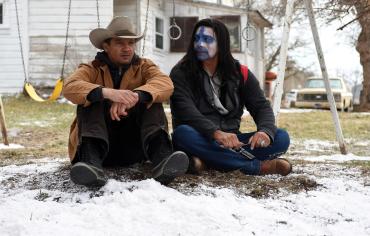 The anticipated directorial debut of writer Taylor Sheridan – fresh off of the ice-cold hot-iron Sicario and the wonderfully arid, sand-blasted Hell or High Water – is simultaneously inspired and perfunctory, trenchant and essentially irrelevant. I would never call its engagement with issues of misogyny and Native American issues fraudulent or unearned – the film’s heart and mind are headed in the right direction – but for a film about race, its treatment is disappointingly cosmetic. The surfaces shimmer with sturdy, appreciably classical filmmaking smarts, but they never disturb or inspire. Much as I appreciate the film’s commitment to navigating the tangled web of US governmental jurisdiction – and concocting a thriller out of no less a subject than jurisdictional boundary disputes – Wind River settles for even-keeled watchability rather than truly chilling to the bone, or stoking a self-propagating frenzy like Sheridan’s other films.
  For most of its run-time, Stronger is admirably the inspiration of director David Gordon Green, rather than merely the corporate product of a Jake Gyllenhaal-fronted Oscar hopeful. Which means it’s a necessarily and admirably stunted venture, one which doesn’t simply spell out or depict a narrative but one which scrapes through one, knocking into the walls of the various paths it explores, and knicking into on loose nails and shards of glass strewn through human life but generally scrubbed-clean in Hollywood narratives. Because this is Green, it also means Stronger is a story about arbitrary hang-ups, human ambivalences, wasting away in space, and foiled and failed plans rather than, say, bettering the self, achieving goals, or any kind of aspirational narratives. It’s not about getting stronger through surpassing limits, but about living with them.
  Crookedly satisfying and more homegrown than director Steven Soderbergh’s Ocean’s trilogy, Logan Lucky is much more than the much-vaunted director’s return to cinema from a thankfully-brief self-imposed exile. It’s also a return to the subject matter of his greatest popular successes – the ‘00s-defining trilogy of glitzy star-studded celebrity-commentaries mentioned above – but, crucially, not entirely a return to the idiom, mood, or tempo of those films. Logan Lucky, a scratchy and Southern version of those self-conscious tall tales with moonshine and whiskey replacing scotch and Vespers, is admittedly adjacent to those films, and its populist goals are harmonious to them. But Logan Lucky is also a film for our times: a post-recession hoe-down that is sun-baked, scrubbed-out, and let-down by the world in equal measure, a work of high spirits but weary eyes with glances both toward day-dreaming in the clouds and staring at the pavement. Either way, it’s hard for it to look straight ahead.
  There’s a long-running parallel that suggests that the perennial questions of family legacy and destiny which populate the Star Wars films also animate the attitudes the various Star Wars filmmakers have toward their own fandom, not to mention their corporate masters, their own franchise-family legacy. On one hand, the films themselves rely on decrees about fulfilling parental lineage and, alternately, self-sovereignty, the possibility of personal choice, each film balanced precipitously in between a morality of fulfilling known destiny and the personal free-will necessary for agency. They suggest both a galaxy of possibility and free movement and a limited channel of feasible options that perennially return to light sabers, space battles, and children granted binary oppositions between becoming and not becoming their parents, as though no other options actually existed for them.
