
 Colin Trevorrow and Derek Connolly’s screenplay for Jurassic Park: Fallen Kingdom veers between idiotic and knowingly idiotic. On balance, it doesn’t salvage the film, but they sure do give it a game try. Whereas The Lost World all the way back in 1997 was essentially unruffled by the astonishing mismanagement of its protagonists and their dubious morality, Fallen Kingdom is certainly at least literate in the criticisms which have been labelled upon that earlier film. Although not as subversively or as stridently as, say, Gareth Evans’ Godzilla, and with a much cheerier, more flippant attitude toward human incompetence, Fallen Kingdom is essentially content to mock its protagonists rather than celebrate them. As with Raiders of the Lost Ark, they accomplish very, very little by film’s end, just barely managing to survive their mistakes time and time again. While the film isn’t as willing to actually question the hero’s own complicity in the villain’s schemes, it is at least aware that, come film’s end, it cannot keep on defending its protagonists as ecological warriors.
Rather, in an increasingly technological world, where biological life is no longer singularly sacrosanct (as though it ever was), the only serious way to think about the debate over the dinosaurs in Jurassic World is to consider whether an expansive and more ephemeral, more dangerous, notion of life (that is, life created through human manipulation) is worth defending. Which is to say, the dinosaurs in Jurassic World 2 are artificial, and this is the first film in the franchise to seriously weigh the contours of this artificiality rather than equate the dinosaurs with naturally-reproduced animals. One might also say that it’s the only film in the series thus far to seriously question its own blockbuster artificiality, after its immediate predecessor so self-damagingly lambasted its audience in the most half-baked pop-post-modern gesture this side of, well, ever. This is the first film in the series to admit that to generally side with its heroes is to play the villain’s game and accept that artificial life cannot be dismissed emphatically, but must be seriously weighed as part of the patchwork of modernity. That, in other words, the possibilities of artificial life must be wrestled away from the corporate monolith’s which currently determine its contours. Continue reading
 George Lucas’ Star Wars franchise was conjured out of the spirit of mid-century pulp and genre fiction, from Westerns to war films to noir, and it frankly remains as moored in these frameworks over 40 years later. There’s no shame in that. In spirit, pulp is as fine and potentially multiphonic a template for any modern filmmaker as any other, one with secrets left to uncover decades later. And Lucas has done as much as anyone over the ensuing forty years not only to expose the limits of his forebears but to invite their more self-conscious, inquisitive, and socially rambunctious textures, exploring their more contradictory valences and inviting us to consider what really makes ostensibly simplistic mythology tick. The fact that Solo: A Star Wars Story is so indebted to that swashbuckling mid-century spirit is merely a fact of nature, a canvas for good or ill.
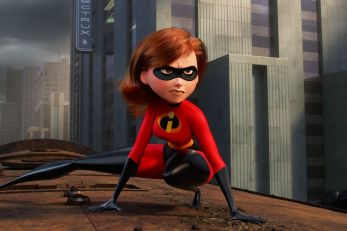 Now that we’re firmly in the decade of Pixar shoring up its status with sequels to best-in-show properties rather than adventurously casting off its lot in less-rehearsed, more invigorating directions, we can at least be pleased that this particular sequel is an excuse for Brad Bird to return to the world of Pixar. Which, apparently, is a generally commensurable company to house his relentlessly optimistic aesthetic indulgences in the widest-eyed corners of mid-century Americana and pulp sci-fi. And house it does! While Bird’s good-natured futurism felt awkward while navigating the confines and demands of live-action cinema in the sometimes-effervescent, sometimes-cloying, sometimes-unwieldy Tomorrowland, there’s a natural mutability to animation that fits Bird’s relatively (and gloriously) surface-bound style like a glove.
 I remain heartened months after its release that the internet spent a good few weeks desperately trying to shoot some adrenaline into cinema’s most deeply tiring franchise by convincing the world that Avengers: Infinity War was an experimental film of sorts, and how do I wish that little gambit provided more real food for thought than it does. It certainly does distract us from the actual film, which, as the claims of “avant-garde” suggest, only tenuously clings to that signifier “film,” or at least more tenuously than any blockbuster film is supposed to these days. But while, I don’t know, Speed Racer (all the way back from the inaugural year of the MCU) feels divinely inspired to dismiss the rules of blockbuster filmmaking as a moral and ethical statement, and an incendiary display of personal conviction, Infinity War isn’t a conventional “movie” out of some combination of laziness, failure, necessity, or simply because it can’t be bothered. That’s more or less interesting, and probably more fascinating to think through than an 18th entry into any franchise should be. But I can’t resist the sensation that I and the internet are playing head-games with ourselves to privately amuse ourselves, semi-ironically meditating on the norms of cinema with Infinity War as a catalyst just to pass the time searching for something, anything, to say about the most milquetoast cinematic franchise of the 2010s. The MCU has held modern blockbuster cinema prisoner for almost a decade, but, as if the delirium of no escape is kicking in, the voices of the internet refuse to give in. They resist.
  Granting a movie its concept is, in general, as axiomatic a principle as a respectable film critic can hold, but boy does Susanne Bier’s Bird Box test that classical truth at every turn. Adapting a story about the perils of sight to a visual medium is both a grand folly and a delicious possibility, a dare to accept the task of playing around with cinema’s very form. To forget the foundational cinematic tradition of show-not-tell. To both advance to its logical conclusion terror’s tradition of visualizing the un-visualizable and, as importantly, to acknowledge what can’t be seen. So the “concept” of Bird Box isn’t actually rotten so much as a question mark, a quandary to be used for good or ill as the creators see fit. How do you use a visual medium to thematize the inability to see?
  Noise kills, and that old trope of a horror film narrative device is given a sturdy work-out by director John Krasinski in A Quiet Place. Himself playing the male lead and casting his wife as his on-screen partner, it seems self-evident that A Quiet Place treats its horror as a distinctly personal affront, and his craft belies the care he put into this production. This, in other words, is personal for Krasinski. But, if this film relies on horror as personal threat, it is definitively not an existential threat here: the bestiary of A Quiet Place is a threat to an assumed normative domesticity rather than a question for it. Family-hood is pro forma here, a way to appeal to an audience’s basest fears rather than reconsider them. In a film like A Quiet Place, women give birth because, well, why would one ask?
  Spider-Man: Into the Spider-Verse
 The Long Take