
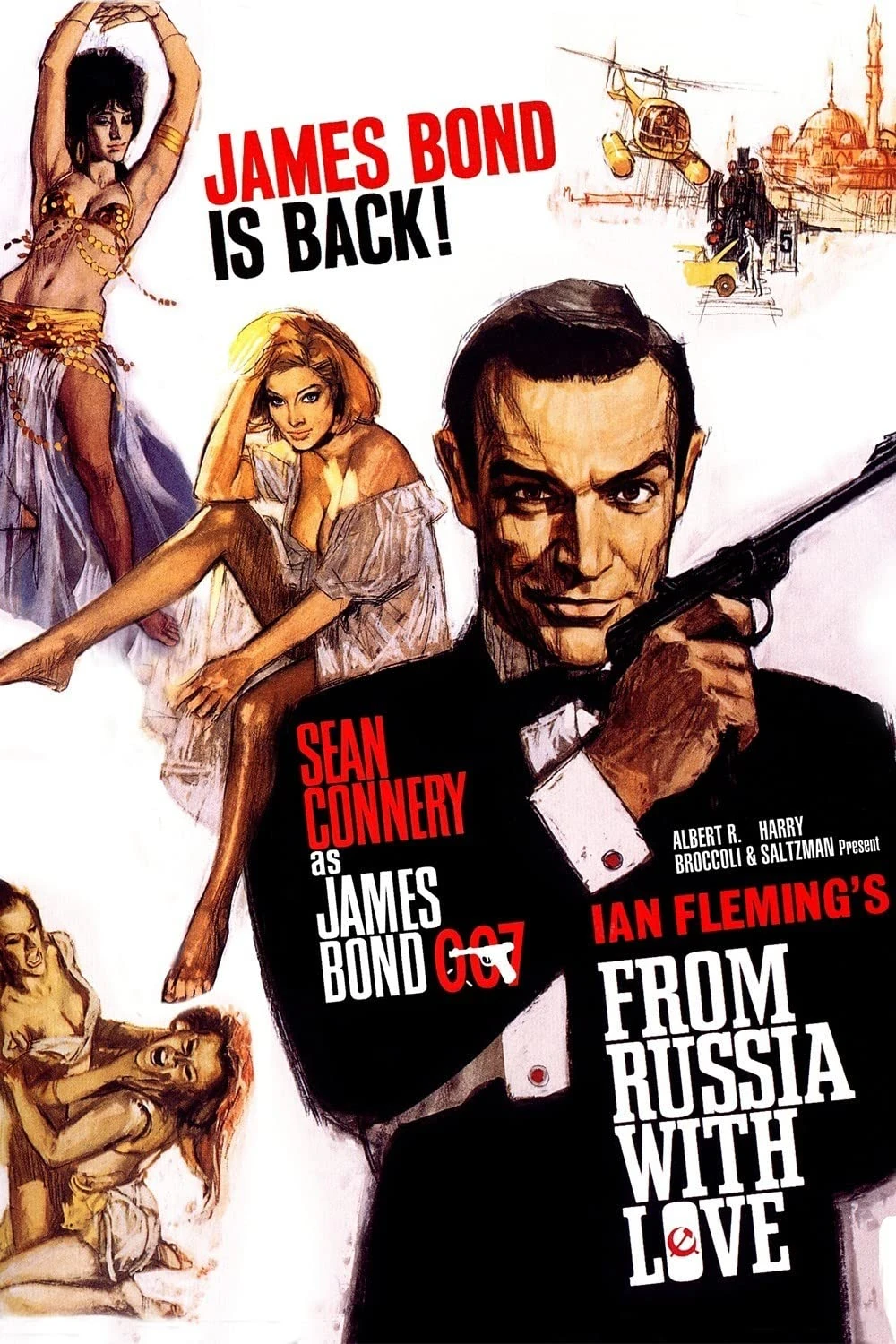
 From Russia with Love is a curious beast. It does not “work” according to the distinct rhymes and reasons of what would become the “Bond film” archetype. It does not establish its own vision of what cinema ought to be, as so many other Bond films went on to do, starting with the very next film in the series, Goldfinger. It lacks the pop art, it lacks the pizzaz, it lacks the chutzpah of those other glammy, punchy Bond films that established a certain modern cool-chic lifestyle porn take on watching movies simply because they could give you visions of things that life in its mundane reality never could. On most of the basic “rules” by which Bond films are generally judged, it doesn’t even attempt to pass muster. In fact, it is, excepting its predecessor Dr. No, a work that could charitably be described as “mundane”.
But Terrence Young’s film may very well be the best film in the entire series, and it may be the best specifically for how it does not meaningfully have anything to do with “being a Bond film”. What the lack of a formula bestows upon it is the freedom to simply focus on being itself, on being the best individual film freed from the expectations and rules of a specific form and a style. It is freed to the point where it can utilize its editing, its framing, its acting, and its writing, to simply be the best film it can be, freed from any expectations in the world of fitting a well-defined formula. Continue reading
 America did pop proud in the 1960s, but pop didn’t always imply a bulging budget or grandiose popular success. The lingering vestiges of that most ’50s of all genres, the atomic underground horror, still clung to the beginning of the decade like a wandering specter. Admittedly, the low-brow, even-lower-budget works suffered a little about how to re-invent themselves; Hammer Horror in the UK certainly hit a few home runs, but flooding the markets ran them red with bloody boredom sooner than not. In the US, where “underground fare” similarly served as a safe, parental euphemism for horror, things were likewise stuck in a liminal space between the pre-Bay of Pigs interest in fooling around with atomic supermen and nuclear fall-out monsters, and the genuine “exploitation” of exploitation cinema came to fruition in the very late 1960s. In between, in the early 1960s, what was underground horror to do?
 It is a go-to pocket complaint of modern Disney that, at some point, they lost interest in the mythic and left the magical by the wayside. From the dark days of the 1960s until darn near the embryonic stages of the 1990s, their films were marked by increasingly poor animation quality and a loss of exploration and heart to match. One Hundred and One Dalmatians holds the unfortunate distinction of being definitively the locus of this three decade dalliance with ground-level storytelling, the period where Disney turned its back on the skies. All of this circles around one point: One Hundred and One Dalmatians is a crying shame, and one of the most disappointing Disney features every released.
  Another relatively short new feature to round out the month, this one about so-called “entertainment” films for the masses in the 1960s. Even when they weren’t doing much of anything else, films from this decade, the golden-age of gee-shucks entertainment, sure knew how to pop!
 The Long Take