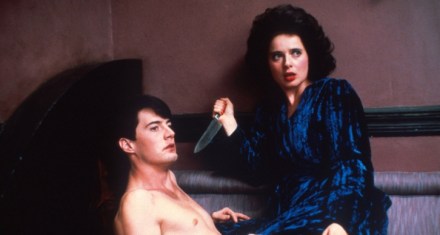
 I was planning on curbing my tendency to upload two reviews every week for Midnight Screenings, rather than one, but seeing as how I missed last week’s review, I’ll post two this week one last time. One is below, with another, linked by theme and something a bit more concrete, to come tomorrow.
Update June 2019: After another rewatch, I remain enamored of Lynch’s general aura of cinematic discontent, and even more enamored of his obvious empathy for (most of) his characters: the American dreams that Lynch devours whole-cloth are, of course, his own dreams, and Blue Velvet in particular has the unmistakable mood of possibility thoroughly deflated, of Lynch’s own innocence curdled into demonic cynicism. Lynch’s immanent critique of mid-century Hollywood cinema and the dreams it promised feels less like an outsider director dismembering a naive vision he feels foreign to (and thus one he views as deluded) than the tragically absurd sight of an animal devouring itself from behind. For that reason, the film’s mood is not of barking cynicism but elegiac collapse, a dream realizing that it cannot sustain itself after all.
Still, after having done more of a deep dive into Lynch in the ensuing five years, Blue Velvet does feel slightly … cruder this time out. It’s fantastic cinema, and in 1986 it must have felt like an apocalyptic full-frontal onslaught, but after three (on-and-off) decades of Lynch so thoroughly burrowing into and then disemboweling everyday life and the cinema that upholsters it, one can’t help but think of Blue Velvet as a test-run for Wild at Heart, or a cinematic prelude to Twin Peaks, to say nothing of the sheer depths of cinematic exploration he would achieve with Mulholland Drive. His elastic attitude toward aesthetics – many images evoke demented horror, mournful drama, and tortured comedy at the same time – is as phenomenal as ever. But Blue Velvet feels a bit more schematic in its analysis – many of the visual contrasts are explicitly schematic, for that matter – and less of a maddened dispatch from another world (that is, of course, the underbelly of our world) that exposes the soul-devouring undercurrents of a reality totally riven before our eyes. It’s the only one of Lynch’s mature (which is to say, Blue Velvet onwards) features that feels like he’s already worked everything out in his head before filming, and that robs the film of Lynch’s typical aura of having discovered modernity unraveling itself mid-process.
Original Review:
Blue Velvet is curiously, even paradoxically, both director David Lynch’s most anarchic film and one of his most straightforward. Perhaps the two are linked, for Lynch opens up the film with an image of straightforward reality he spends the film taking to task. We get clean-cut grass and well-manicured houses, spaced evenly between one another, hiding well-manicured people who probably take pains to space themselves evenly as well. Lynch is aware that these images construct our dreams of America, or at least our dreams of an American past, and even in his admitted celebration of them, he also examines them, cutting into them like a knife through pre-sliced, packaged white bread (what could be more American?) hiding maggots under its façade of comfort. Continue reading →

 Update mid-2018: A delirious and truly tragic portrait of egomaniacal scientific rationalism, David Cronenberg’s The Fly still earns any and all comparisons to Shelley and all others who have traced the contours of modernity in the Dark Romantic tradition, from the summit of intoxication all the way to the pit of self-inflicted abjection.
 Australia’s great lost film, Wake in Fright, is a movie of untold wonders that might have been better left untold. Released in 1971, the film is mesmerizing but was nearly lost to the muck from whence it came, fitting considering its bleak, cynical worldview of perpetual loss and emptiness. It’s easy to see why it failed to find DVD or VHS distribution until the 2010s, nearly forty years after its release – this is about as far from a “feel-good” mainstream film as you’ll find. It’s not an easy film to sit through, the kind that not only depicts horrors of all variety but dares us to keep watching and then scares us for our own complicity in the activities it depicts. Wake in Fright marries realism to the land of nightmares as it gives us a vision of modern maleness and male-run civilization as a bandage stretched thin over past wounds still left to fester elsewhere in the world, forgotten by others. It’s a necessary film, an important social statement, but most people would probably rather not have to hear it. Wake in Fright is the purest form of lonely oblivion, an eternally mangled wail into the darkness of blinding light. It is cinematic ungodliness.
  A question: Have you ever seen a movie that made you want so furiously to scribble down notes about its greatness while watching that you were actually annoyed that it kept you looking at the screen with its unapologetic greatness to the point of being unable to write anything down legibly? I ask in this form, of course, because naturally I’m only writing to people who would want to write down notes about movies while watching. Everyone else who could conceivably see this film will probably be turned off by how garishly oppressive and gloriously messy it is to have any interest in reading this. And they’d be completely right too, but I still like the film anyway.
 Update early 2019: Never a fun time reading these college-age early reviews, especially when you don’t have time to write-up a new take in full, but I’ll say after a rewatch that Carpenter’s film remains one of the quintessential films in its genre, and its decade: a portrait of geographic seclusion as abyssal isolation that doubles as a study in the breakdown of democracy, all while replacing the proverbial conservative “Other” of horror with the Other within. It’s greatest trick, then, is that it turns one’s opacity to one’s own self into a truly terrifying dispatch from the fringes of society, both a final transmission from flickering-out ’70s ennui and an inaugural howl of ’80s malaise. And it achieves this inward turn, forcing us not onto an outsider but back onto our own frightening selves, without ever resorting to any “psychological horror” tools to launder the horror by ensconcing it only within one character’s head-space. Truly disquieting stuff.
 Halloween was writer-director-composer-producer-fanboy John Carpenter’s introduction to the world of the cinematic masters (befitting his name, he probably is a carpenter too for god’s sake). It is, above all else, a master-class in pure style as well as a reminder that in horror, filmmaking skill and raw dread drive the narrative rather than the other way around. It’s economical, ruthlessly efficient, and spare. There’s a sense that every shot holds a purpose, and that Carpenter knows how to stage his camera for maximum impact. The film feels planned, rigorously so, and ruthlessly composed to a point bordering on obsession. It’s a masterpiece of slowly unnerving tension that builds at just the right amount throughout – every image adds to the film, and edits don’t so much transition as ransack the previous shot and take control. It’s fitting that its creator bears the last name of a craftsman – this film is all ruthless, clinically potent, monstrously well-constructed craft. If, in fact, he did hold the profession of his surname, this would be an oak chair assembled guerilla style and with little funding or time (the film was shot on an extremely meager budget), but which would bear the love and care of someone who truly loved woodwork and put every ounce of his skill and passion into making that one chair. That it would be the devil’s throne is just the other half of the fun.
 Edited May 2016
 Preface: Now that I’ve finally decided to go “old” with the blog, I’m doing it in style with not just a regular “old” film, but two, and two that have ripened with age. For this week’s Midnight Screenings, the ’90s, ’80s, ’70s, ’60s, ’50s, and ’40s wouldn’t do. I’m taking it back to two of the granddaddy’s of filmmaking from the early ’30s, two of the earliest “talkies” and two supreme influences on Midnight Cinema from a time where films could be more openly playful and subversive as filmmakers were still trying to prod and poke at the medium to expose its limits and possibilities.
 filmEdited
 Maniac is a difficult film to review. As a remake of a notorious Video Nasty from 1980 of the same name, this film sets out to drag us through the mud and generally make its audience feel not just uncomfortable but nasty. It is a relentlessly, oppressively difficult film to watch, but it also extremely, even uncomfortably, well made. Maniac sets out to do something that favors a pure lurid affect over anything else, and it succeeds entirely at meeting and even possibly exceeding those goals. Many viewers, however, will be so fundamentally turned off by the goal they won’t care.
 The Long Take